
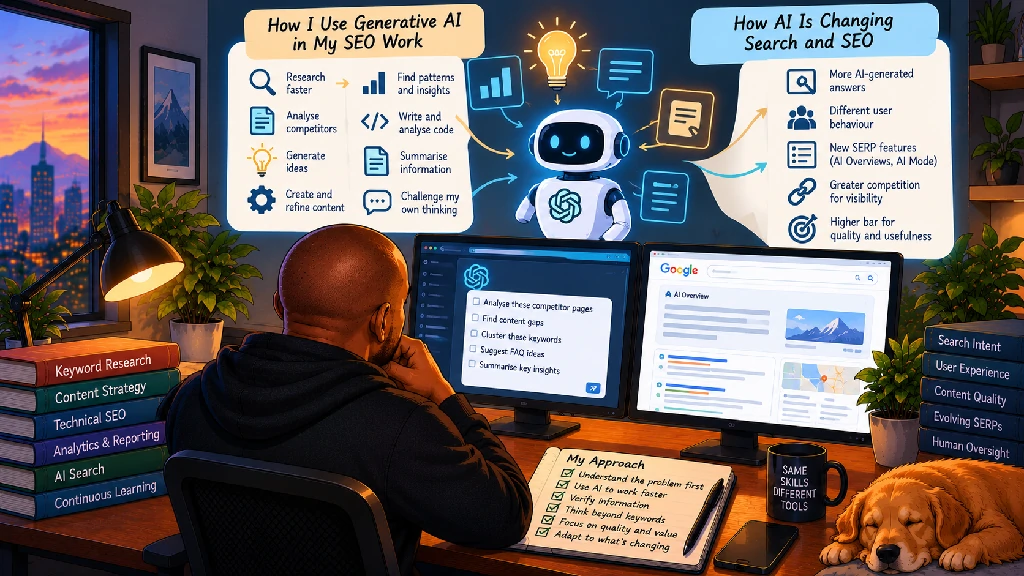
I use generative AI almost every day now.
Not because I think it can do my job for me.
And definitely not because I want it to make every SEO decision.
I use it because, when used properly, it makes me faster at certain things and forces me to think differently about others.
That’s probably been the biggest change for me.
When generative AI first exploded into everyday use, much of the SEO conversation was about content.
Can ChatGPT write blog posts?
Will Google rank AI-generated content?
Can we create 1,000 pages with AI?
Will AI replace copywriters?
Will AI replace SEO?
Those are still valid questions, but they now feel like a very small part of what generative AI means for search.
The bigger change, at least from where I’m sitting, is that AI is affecting both sides of SEO.
It’s changing how I do the work.
And it’s changing the search environment I’m doing the work for.
Those are two very different things.
I’ve already written about whether AI will replace SEO and what I think is actually changing.
My conclusion there was basically this:
AI will automate parts of SEO.
I’m okay with that.
What I’m more interested in now is how it changes the way I actually approach the job.
I Don’t Start With “How Can AI Do This for Me?”
This is probably an important distinction.
When I have an SEO problem, I don’t want my first thought to become:
Can ChatGPT do this?
I still want to understand the problem first.
Why has traffic declined?
Why isn’t this location ranking?
Why are these pages not being indexed?
Why is Google choosing the wrong page for this query?
Why isn’t this content performing?
Why are leads declining even though rankings look relatively stable?
Once I understand what I’m trying to investigate, AI can help me get there faster.
That’s different from handing the entire problem over and saying:
“Do SEO.”
I don’t think that’s particularly useful.
AI Has Made Research Much Faster
Research is probably one of the most obvious changes to my workflow.
SEO involves a lot of gathering information.
Understanding an industry.
Understanding a client.
Looking at competitors.
Analysing search intent.
Reviewing content.
Identifying recurring questions.
Comparing pages.
Understanding unfamiliar terminology.
Before generative AI, I’d often have 15 tabs open while trying to piece something together.
To be fair, I still have 15 tabs open.
Some habits are stronger than technology.
But AI can help me make sense of the information much faster.
I can provide context and ask:
What patterns do you see?
Which themes keep appearing?
How are these competitors positioning the service differently?
What questions haven’t we answered?
Where are these pages overlapping?
What assumptions am I making?
That last question has become particularly useful.
AI doesn’t only have to generate answers.
It can help me challenge my own.
But I’m More Careful About Verification Now
There’s a strange contradiction with AI.
It makes accessing information easier.
It also makes verifying information more important.
An answer can look excellent.
Well structured.
Confident.
Detailed.
Completely believable.
And wrong.
That’s dangerous in SEO because small factual errors can become big content problems.
I’ve seen enough AI output to know that confidence isn’t evidence.
So my workflow increasingly looks like:
AI helps me investigate. The source helps me verify.
If something matters, I want to know where it came from.
Official documentation.
The client’s website.
Search Console.
Analytics.
A crawl.
The actual SERP.
First-party data.
A credible source.
The AI answer can point me somewhere.
I don’t want it to be the end of the investigation.
Keyword Research Feels Different Now
I still do keyword research.
I don’t think AI has made keywords irrelevant.
People still use words to express what they want.
But I’m less interested in treating every keyword as an isolated target.
Let’s say I have:
“franchise training”
“training for franchise owners”
“new franchisee training”
“franchise training programme”
“franchise owner support and training”
Old-school keyword thinking can easily turn those into five content opportunities.
But do we actually need five pages?
Maybe.
Maybe not.
AI is useful for helping me explore the relationships between queries.
Which ones represent the same underlying need?
Which have genuinely different intent?
What questions sit underneath them?
Where should they live on the website?
That’s moving me further from:
Keyword → Page
towards:
Topic → Intent → Question → Entity → Page
The keyword still matters.
It’s just one piece of the decision.
I’m Thinking More About Questions Than Exact Phrases
This has become especially important because people don’t interact with AI systems exactly like they interact with traditional Google Search.
A Google query might be:
best restaurant franchise
An AI prompt could be:
I’m considering buying a restaurant franchise in Pretoria. What should I compare before choosing one, and which brands should I research?
That’s a much richer information need.
There are entities.
Criteria.
Context.
Location.
Intent.
Potential follow-up questions.
That changes how I think about content.
Instead of only asking:
“What keyword are we targeting?”
I increasingly ask:
“What does somebody actually need to understand before they can make this decision?”
That’s a much better content question anyway.
AI search is just making it harder to ignore.
I’m Thinking More About the Whole Topic
For years, SEO could become very page-focused.
Optimise this URL.
Target this keyword.
Improve this title.
Build links to this page.
Those things still matter.
But generative AI is pushing me to think more about whether a website demonstrates a coherent understanding of a subject.
If you’re a franchise brand, for example, do you clearly explain:
Investment.
Training.
Support.
Ownership.
Territories.
Business model.
Ideal franchisee.
Frequently asked questions.
Available markets.
The opportunity itself.
Or do you have one enormous page trying to rank for everything?
Likewise, if you’re a multi-location business, does the website clearly communicate the relationship between:
The brand.
Its services.
Its locations.
The areas those locations serve.
The people behind them.
The reviews associated with them.
The services available at individual locations.
This is where AI search and traditional SEO start feeling much less separate to me.
Both benefit when information is organised clearly.
Entities Matter More in the Way I Think About Search
This has probably been one of the biggest mental shifts.
SEO has traditionally been very keyword-heavy.
Generative AI makes me think more about entities and relationships.
Who is this company?
What does it do?
Where does it operate?
Which services does it provide?
Who does it serve?
What is it known for?
Which people are connected to it?
Which locations belong to the brand?
What other credible sources mention it?
Is the information consistent?
Can a machine understand these relationships confidently?
This is one reason I’ve become less interested in arguing endlessly about labels.
I’ve already written about SEO vs GEO vs AEO and what I think actually matters.
Call it SEO.
Call it GEO.
Call it AEO.
Call it AI SEO.
Whatever.
I’m more interested in the underlying work.
Can search systems understand who you are, what you know, what you offer and why they should trust the information?
That’s the useful question.
Content Needs More of a Reason to Exist
Generative AI has made content ridiculously easy to produce.
I can ask an AI tool:
“Write a 1,500-word article about local SEO.”
And I’ll have one almost immediately.
It will probably have:
An introduction.
Eight headings.
Some bullet points.
A conclusion.
Maybe an FAQ.
Perfect.
Now what?
Why does that article deserve to exist?
What does it add?
That’s the problem.
AI has lowered the cost of producing average content.
It hasn’t automatically increased the value of average content.
That’s why I’m becoming much more interested in experience.
Original examples.
Internal data.
Customer questions.
Expert input.
Case studies.
Actual opinions.
First-hand observations.
Things the organisation genuinely knows.
I’ve even changed how I approach my own blog because of this.
When I wrote about how I find SEO blog ideas without writing the same posts as everyone else, I kept coming back to one idea:
The keyword doesn’t have to provide the perspective.
Your experience can.
Generative AI makes that distinction even more important.
I’m Less Interested in Publishing for the Sake of Publishing
This is something I’ve changed my mind about over the years.
There was a time when content calendars could become almost mechanical.
We need four blogs this month.
Find four keywords.
Write four blogs.
Publish four blogs.
See you next month.
I’m increasingly uncomfortable with that approach.
Why four?
Why not two excellent resources?
Why not improve an existing page?
Why not create a service page the website is missing?
Why not consolidate three weak articles?
Why not create something based on questions customers actually ask?
Why not update an article that’s already receiving impressions?
AI makes it possible to produce more content than ever.
I don’t think the answer is automatically to publish more.
Sometimes the best AI-era content strategy might be:
Publish less. Make each thing more useful.
AI Has Made Me More Interested in Original Information
If AI systems can summarise information that already exists, then giving them another version of the same information doesn’t feel particularly exciting.
I’d rather find something new to contribute.
That doesn’t always mean conducting a massive research study.
Original information can be small.
A company has worked with customers for 20 years.
What questions keep coming up?
A franchise brand has hundreds of franchisees.
What do successful owners tend to have in common?
A multi-location company has 300 Google Business Profiles.
What patterns do we see in reviews?
A business has internal experts.
What do they know that isn’t currently on the website?
A company has customer service teams answering the same questions every week.
Those conversations are content research.
AI can’t independently know those things.
The business does.
Our job is increasingly to extract that knowledge and make it useful.
I’m Using AI to Challenge Content Before Publishing It
This is one of my favourite uses.
Instead of only asking AI to write something, I can give it a draft and ask it to attack it.
What’s repetitive?
Which sections are vague?
Where am I making unsupported claims?
Which questions haven’t I answered?
Where does this sound generic?
What would a sceptical reader challenge?
Which paragraph says a lot without actually saying anything?
What would someone with more expertise expect to see here?
That can be much more valuable than:
“Rewrite this article.”
I don’t necessarily accept every suggestion.
That’s important.
Sometimes AI wants to make writing technically “better” while removing everything that makes it sound human.
You start with:
“I spent three hours trying to figure this out and eventually realised I’d made a ridiculously simple mistake.”
AI returns:
“This experience highlighted the importance of careful troubleshooting and systematic problem-solving.”
No.
Give me my mistake back.
AI Is Making Me More Protective of Voice
This has surprised me.
The more AI-generated content I read, the more I notice certain patterns.
Perfectly balanced sections.
Predictable transitions.
Everything neatly explained.
Very safe conclusions.
Nothing particularly wrong.
Nothing particularly memorable either.
That’s partly why I’m trying to make my own writing more personal.
I want examples.
Mistakes.
Opinions.
Uncertainty.
Things I’ve actually experienced.
If I’m learning Python and getting stuck, I can say that.
If I’m exploring cybersecurity and don’t know where it leads, I can say that.
If I disagree with a common SEO practice, I can explain why.
AI can help me organise the thinking.
I don’t want it sanding off everything that sounds like me.
AI Is Also Changing How I Think About Technical SEO
Technical SEO isn’t disappearing because ChatGPT exists.
If anything, machine-readable information becomes more interesting when more machines are trying to understand the web.
Websites still need to be accessible.
Pages still need to be crawlable.
Important information still needs to be discoverable.
Internal linking still matters.
Canonicalisation still matters.
Redirects still matter.
Structured data still has a role.
Site architecture still matters.
Page performance still matters.
JavaScript can still create problems.
AI hasn’t magically fixed poorly built websites.
That’s one reason my process for reviewing a homepage for SEO still begins with clarity, structure, services, internal links, technical accessibility and understanding what the business actually does.
AI adds another consumer of information.
It doesn’t remove the foundations.
Local SEO Is Making the AI Conversation Particularly Interesting for Me
This is where my experience with multi-location brands influences how I think about generative AI.
Imagine somebody asks:
“What’s the best home care provider near my mother?”
Or:
“Find me a family-friendly restaurant near Centurion with a play area.”
Or:
“Which orthodontists near me offer Invisalign?”
Those questions combine informational and local intent.
The AI system needs information.
But eventually the user needs a real business in a real place.
That business needs accurate hours.
An address.
Services.
Reviews.
Photos.
Location information.
A website.
A Google Business Profile.
Consistent information across the web.
That’s why my experience managing SEO for multi-location brands has changed how I think about local search.
AI doesn’t make local information less important.
It gives that information another environment where it may need to be understood.
Google Business Profiles Feel Even More Important to Me
I already cared about GBP before generative AI.
Working with local and multi-location SEO makes that unavoidable.
But I’m increasingly thinking of Business Profiles as part of a much broader information ecosystem.
Business name.
Category.
Address.
Hours.
Services.
Reviews.
Photos.
Questions.
Website.
Location.
All of that helps describe a real-world entity.
And when AI systems are trying to answer local questions, entity understanding matters.
I’ve written specifically about how Google’s AI Overviews are changing local SEO and how we measure it.
For me, this phase is where AI SEO becomes much more practical than debates about terminology.
A customer wants something.
Google or an AI system needs to understand which businesses might meet that need.
Is your business providing enough accurate information to help make that connection?
I’m Thinking Beyond the Website More Than Before
SEO has never really existed just on the website.
Links alone prove that.
Local SEO makes it even more obvious.
Google Business Profiles.
Reviews.
Directories.
Social profiles.
News coverage.
Industry publications.
Reddit.
YouTube.
Third-party mentions.
All of these contribute to how people encounter and understand a brand.
Generative AI makes that broader footprint harder for me to ignore.
If information about a company exists across the web, AI systems may encounter those sources too.
That makes consistency important.
It also makes genuine brand authority more interesting than simply inserting another keyword into a page.
Reporting Has Become More Complicated
This might be the least glamorous part of AI search.
How do we measure all this?
Traditional SEO reporting already wasn’t perfect.
Rankings.
Clicks.
Impressions.
Organic sessions.
Conversions.
Revenue.
Now we also have AI-generated answers influencing discovery.
Someone may encounter your brand without clicking.
An AI answer may cite you.
It may mention you without citing you.
Someone might discover you through ChatGPT and Google your brand later.
An AI Overview may answer the question while reducing clicks to informational content.
That’s why I’ve been thinking a lot about how to report SEO success when AI is changing the SERP.
I don’t think the old metrics become useless.
I think they become incomplete.
I’m Looking at Brand Searches Differently
This is another area I’m paying more attention to.
If people discover a brand somewhere else and later search for it directly, the final Google query might be branded.
Traditional attribution might make that look simple.
But what created the demand?
An AI recommendation?
A Reddit thread?
A YouTube video?
A social post?
A review?
A previous non-branded search?
Word of mouth?
Search journeys have always been messy.
Generative AI adds another layer.
That means I want to understand branded demand alongside non-branded visibility rather than dismissing branded searches as somehow less important.
Sometimes the brand search is the result of successful discovery somewhere else.
I’m Using AI More for Data Work
This is where generative AI connects nicely with another thing I’m learning:
Python.
SEO produces ridiculous amounts of data.
Search Console exports.
Crawl data.
Analytics.
Rankings.
Keyword research.
Backlinks.
Local rankings.
GBP data.
AI makes it much easier for me to explore that information.
It can help write formulas.
Explain Python errors.
Suggest ways to structure an analysis.
Help me understand why a merge isn’t working.
Explain unfamiliar code.
I’ve been documenting why I’m learning Python as an SEO because I think this combination could become particularly useful.
Python can handle the data.
AI can help me learn and work faster.
I provide the SEO context.
That’s much more interesting to me than simply asking AI to write another meta description.
AI Is Making Automation More Accessible
Before generative AI, someone like me could learn Python.
Obviously.
But there was more friction.
Now I can have an AI tutor sitting beside me while I build something.
I can ask why my code failed.
Ask for an explanation.
Ask it not to solve the entire problem.
Ask what a particular function does.
Ask whether there’s a simpler approach.
That lowers the barrier.
I’ve already started experimenting with basic Python projects that are helping me learn by doing.
That’s another way generative AI is changing my approach to SEO.
It’s not only automating SEO tasks directly.
It’s helping me develop skills that allow me to automate more of them.
That’s an important difference.
I’m Trying to Automate the Boring Parts, Not the Thinking
This is becoming one of my rules.
If I have to check 5,000 URLs, I don’t want to do that manually.
If I need to categorise thousands of queries, automation can help.
If I need to combine several datasets, Python can help.
If I need to summarise patterns across a large amount of information, AI can help.
But:
Which problem should we solve?
Why does it matter?
Which recommendation should we prioritise?
What does the customer actually need?
Is this content useful?
Is this business claim accurate?
What are we comfortable publishing?
How does this information connect to the company’s goals?
Those are decisions I don’t want to blindly outsource.
Automate the repetitive work so there’s more time for the thinking.
That’s where I see the biggest opportunity.
Generative AI Is Making SEO Broader, Not Smaller
This is probably where my thinking has changed the most.
At first, AI looked like another tool entering SEO.
Now it feels bigger than that.
It’s changing how people search.
How content is created.
How research happens.
How data is analysed.
How coding is learned.
How brands are discovered.
How answers are presented.
How traffic is attributed.
How visibility might need to be measured.
And probably several things we haven’t figured out yet.
That’s why I’ve already changed my SEO strategy in response to AI search.
I’m not abandoning traditional SEO.
I’m expanding what I pay attention to.
Some Things Haven’t Changed at All
This is important too.
Generative AI hasn’t made everything new.
People still have problems.
They still search for solutions.
Businesses still need customers.
Websites still need to work.
Information still needs to be accurate.
Good content still needs to be useful.
Technical problems still hurt websites.
Reputation still matters.
Authority still matters.
Understanding the audience still matters.
Measurement still matters.
Strategy still matters.
The interfaces are changing.
The fundamental business problem isn’t:
How do we rank number one for this keyword?
It never really was.
The bigger problem is:
How do we become visible when the right person is looking for something we can genuinely help them with?
SEO has always been one way to solve that.
Generative AI changes the environment around it.
I Don’t Want AI to Make Me a Lazy SEO
This is probably the risk I’m most conscious of personally.
AI makes it very easy to feel productive.
Generate an audit.
Generate recommendations.
Generate content.
Generate titles.
Generate schema.
Generate reports.
Generate strategy.
Look at all the things we generated.
But did we think?
Did we investigate?
Did we verify?
Did we understand the business?
Did we talk to the customer?
Did we look at the data?
Did we question the answer?
Did anything actually improve?
That’s the standard I want to keep.
AI should help me do better SEO.
It shouldn’t just help me produce more SEO-looking things.
So, How Is Generative AI Changing the Way I Approach SEO?
I’m using it more.
But I’m also questioning more.
I’m thinking beyond individual keywords.
I’m paying more attention to questions, topics, entities and relationships.
I’m thinking about brand visibility beyond the website.
I’m putting more value on original information and real experience.
I’m becoming more selective about what deserves to be published.
I’m thinking differently about local search.
I’m expanding how I think about measurement.
I’m using AI to analyse, challenge and accelerate my work.
I’m learning Python partly because AI has made that learning process more accessible.
And I’m trying to automate repetitive execution without automating judgement.
That’s where I am today.
It will probably change again.
In fact, I’d be surprised if I read this article three years from now and agreed with every part of it.
That’s the nature of working in search.
I’ve written before about whether SEO still matters in the age of AI search.
I think it does.
But I don’t think that means doing SEO exactly the way we did before generative AI arrived.
That would miss the point.
The technology is changing.
Search behaviour is changing.
The tools are changing.
The SERPs are changing.
So I’m changing too.
Not because I think everything we knew about SEO is suddenly useless.
But because one of the most important skills I’ve learned from working in SEO is this:
You don’t get to choose whether the search changes.
You only get to choose whether you learn with it.
