
For most of my career, SEO has revolved around a fairly simple goal: get the right page in front of someone when they search.
I still care about that.
But AI search is forcing me to think beyond rankings. The question I’m asking more often now isn’t just, “Can this page rank?”
It’s, “Will the brand be understood, trusted and mentioned when someone goes looking for an answer?”
That shift is changing how I approach SEO.
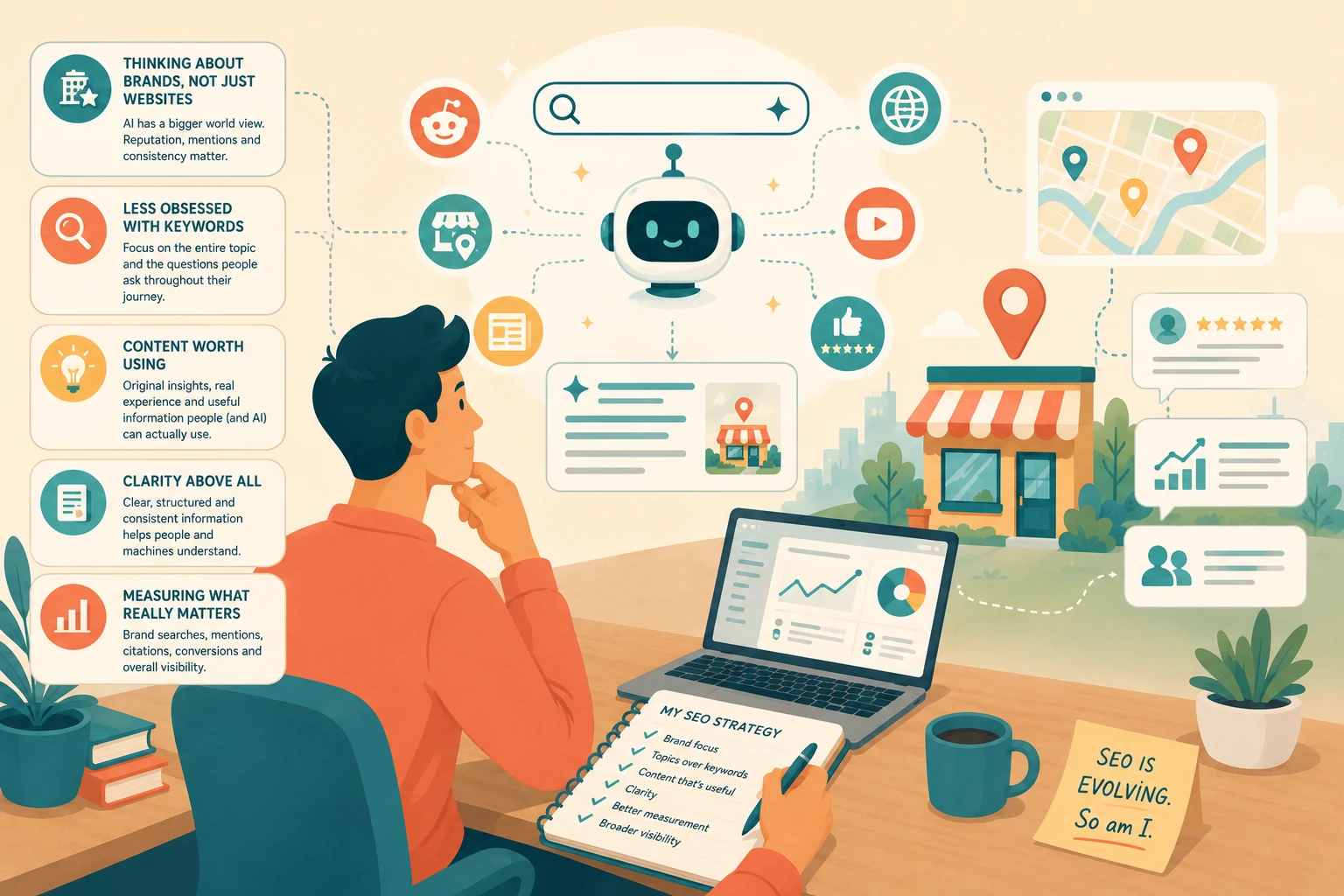
I’m thinking about brands, not just websites
A website used to feel like the centre of everything.
Build good pages. Optimise them. Earn links. Improve rankings.
Now I’m paying much more attention to what exists around the website.
What does Reddit say about the brand? What information appears on business profiles? Are reputable publications mentioning it? Do different sources describe the company consistently?
AI systems have access to a much bigger world than the pages we control.
That makes SEO feel increasingly connected to reputation, PR, reviews, social platforms and the wider digital footprint of a business.
I’m becoming less obsessed with individual keywords
I still do keyword research. I don’t see that disappearing anytime soon.
What is changing is how much importance I place on one keyword having one perfectly optimised page.
People don’t always search in neat two- or three-word phrases anymore.
They ask questions.
They add context.
They have conversations with AI tools and refine what they want as they go.
So I’m spending more time thinking about the entire subject someone is trying to understand.
What questions come before the search?
What questions come afterwards?
What would someone need to know before they were comfortable making a decision?
That usually leads to better content anyway.
I want content to contain something worth using
This is probably the biggest one.
The internet doesn’t need another article that simply rearranges information already available on ten other websites.
AI makes producing that kind of content incredibly easy.
So why create more of it?
I’m becoming much more interested in content built around actual experience: original examples, expert opinions, data, customer questions, observations and lessons from doing the work.
If we have something useful that nobody else has, I want it on the page.
Not because an AI system might cite it.
Because a person might actually find it useful.
If both happen, even better.
I’m paying more attention to clarity
There was a time when SEO copy could become unnecessarily complicated because we were trying to include every variation of a keyword.
I think AI search gives us another reason to move away from that.
Pages should make things obvious.
Who are you?
What do you do?
Who do you help?
Where do you operate?
Why should anyone trust you?
What makes you different?
Clear headings, straightforward answers, structured information and consistent facts help search engines understand a business, but they also make websites better for humans.
That’s a trade I’ll happily make.
I’m questioning how we measure success
This is the part I think SEO will wrestle with for a while.
If someone discovers your brand through an AI answer and visits three days later through a branded search, what gets the credit?
If your company is repeatedly recommended without receiving a click, did SEO succeed?
I don’t have perfect answers yet.
But I’m becoming less comfortable using traffic and rankings as the complete story.
Brand searches, mentions, citations, conversions and overall search visibility are becoming much more interesting to me.
Some things aren’t changing
This is important.
I’m not throwing away technical SEO. I’m not abandoning keyword research. I’m certainly not telling clients that Google rankings suddenly don’t matter.
Good websites still need to be crawlable, fast, useful and easy to understand.
People still search.
Links still matter.
Content still matters.
What’s changing is the environment around all of those things.
My SEO strategy isn’t becoming an “AI strategy”.
It’s becoming a broader search strategy.
And right now, I think that distinction matters.
