
SEO has always had a talent for creating new acronyms.
Now we have GEO, AEO, AIO and probably a few others being invented while I’m writing this.
With AI changing how people find information, there’s a temptation to treat every new term as a completely new discipline. I’m not convinced that’s helpful.
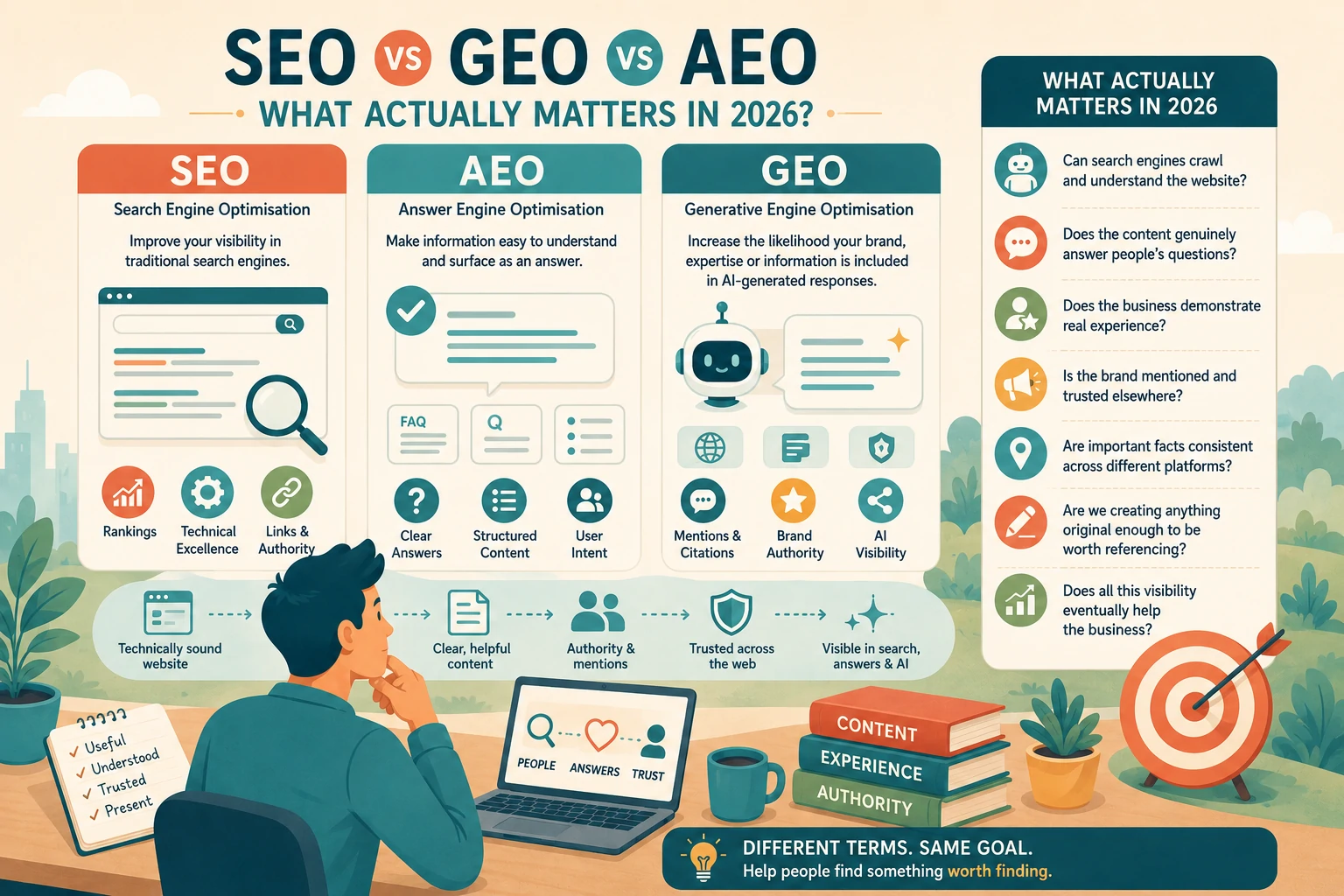
SEO, GEO and AEO describe different parts of the search landscape, but for most businesses, the goal underneath them is surprisingly similar:
Be useful, be understood, be trusted, and be present when someone needs what you offer.
First, what are we actually talking about?
SEO — Search Engine Optimisation — is the familiar one. It’s about improving your visibility in traditional search engines.
AEO — Answer Engine Optimisation — focuses more specifically on making information easy to understand and surface as an answer.
GEO — Generative Engine Optimisation — takes that idea into AI-powered experiences. The aim is to increase the likelihood that your brand, expertise or information becomes part of an AI-generated response.
The definitions matter.
But I think we can spend too much time debating where one ends and another begins.
I’m not building three separate strategies
If I’m working on a website, I’m not creating an SEO strategy on Monday, switching to AEO on Tuesday and doing GEO on Wednesday.
The work overlaps too much.
A technically sound website helps search engines access information.
Clear content helps people understand it.
Good structure helps machines interpret it.
Original research and expert contributions give other websites reasons to reference it.
Strong PR and brand mentions build authority beyond your own domain.
Consistent information across the web makes it easier to understand who you are.
Those things can potentially help traditional search, answer engines and generative systems.
That sounds less exciting than announcing that SEO has been replaced.
But it makes more sense to me.
GEO does introduce a different question
Traditional SEO trained us to ask:
“How do we rank for this?”
AI search introduces another question:
“How do we become part of the answer?”
That distinction is important.
Imagine someone asks an AI assistant to recommend companies for a particular service.
Your website could rank reasonably well on Google, and your company could still be absent from that conversation.
Why?
Perhaps nobody talks about the brand outside its own website.
Maybe competitors have stronger reviews, discussions, press coverage and third-party mentions.
Perhaps the company’s expertise isn’t clearly demonstrated anywhere.
That means visibility increasingly extends beyond the website.
For me, that’s one of the most interesting parts of GEO.
AEO reminds us to actually answer people
There’s something almost amusing about needing a new acronym to remind us of this.
People search because they want answers.
Yet SEO content has sometimes made those answers unnecessarily difficult to find.
You search for a simple question and encounter 600 words of introduction before anyone gets to the point.
AEO pushes us towards clearer questions, direct explanations, useful headings and content structured around what someone actually wants to know.
AI didn’t make that good practice.
It was always good practice.
So what actually matters?
In 2026, I care less about choosing between SEO, GEO and AEO than I do about building visibility across all the places where discovery happens.
Can search engines crawl and understand the website?
Does the content genuinely answer people’s questions?
Does the business demonstrate real experience?
Is the brand mentioned and trusted elsewhere?
Are important facts consistent across different platforms?
Are we creating anything original enough to be worth referencing?
And, most importantly, does all this visibility eventually help the business?
Those are the questions I want to spend my time answering.
Call it SEO.
Call it GEO.
Call it AEO.
The labels will probably keep changing.
The job is still to help people find something worth finding.
