
Every few months, I see another version of the same prediction:
AI is going to replace SEO.
Sometimes it’s ChatGPT.
Sometimes it’s Google AI Overviews.
Sometimes it’s AI Mode.
Sometimes it’s a new agent that can research, write, analyse competitors, generate content, audit websites and apparently finish everything before I’ve had my first coffee.
And I understand why people ask the question.
I’ve worked in SEO long enough to remember when many of the things I do today required considerably more manual work. Now I can give an AI tool a spreadsheet, ask questions about thousands of rows, generate code, analyse patterns, brainstorm content angles or summarise information in seconds.
That’s a real change.
Pretending otherwise would be ridiculous.
But I think “Will AI replace SEO?” is slightly the wrong question.
The more useful question is:
Which parts of SEO will AI replace, which parts will it change, and what will SEOs be responsible for afterwards?
Because I absolutely think AI will replace some SEO work.
I’m just not convinced that means it replaces SEO.
I’ve Heard That SEO Is Dying Before
SEO has had a surprisingly long funeral.
Google Ads was going to kill it.
Social media was going to kill it.
Zero-click searches were going to kill it.
Featured snippets were going to kill it.
TikTok was going to kill it.
ChatGPT was going to kill it.
AI Overviews were going to kill it.
And yet here we are.
That doesn’t mean nothing is changing.
Quite the opposite.
I’ve already written about why I think SEO isn’t dead, but the job of an SEO is changing.
That’s an important distinction.
Sometimes when people say an industry is “dying,” what they’re actually seeing is the old version of the job becoming less valuable.
I think that’s happening in SEO right now.
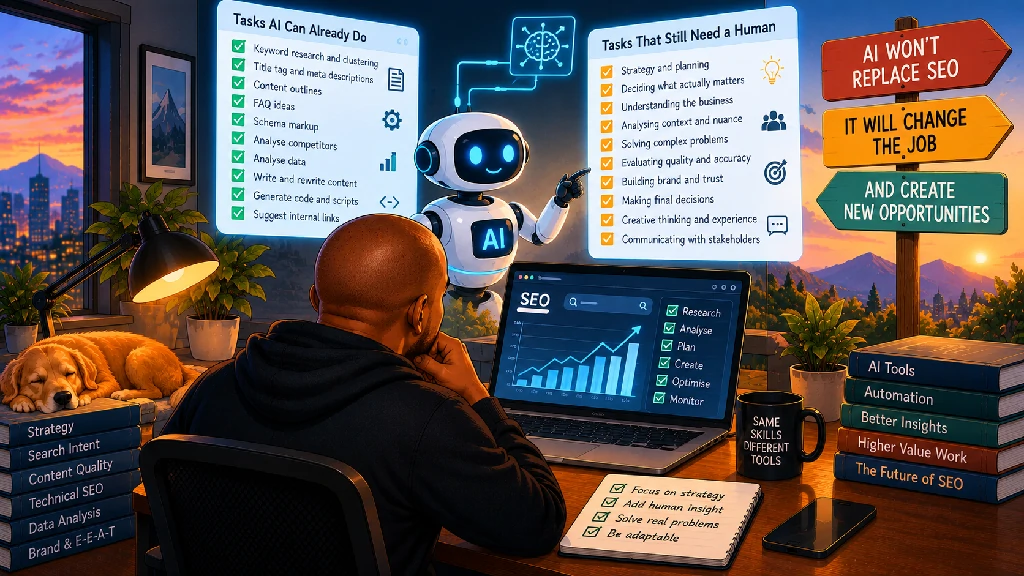
AI Can Already Do a Lot of SEO Work
Let’s start with the uncomfortable part.
There are SEO tasks that AI can already do surprisingly well.
Give it a set of keywords and it can cluster them.
Give it a page and it can suggest title tags.
Ask it for FAQ ideas and you’ll have 20 before you’ve finished typing the prompt.
It can help create content briefs.
It can summarise competitor pages.
It can classify search intent.
It can generate schema markup.
It can write regex.
It can analyse exports.
It can generate Python scripts.
It can help troubleshoot technical problems.
It can suggest internal links.
It can rewrite copy.
It can help you analyse Search Console data.
And yes, it can write entire blog posts.
Some of those tasks used to take considerably longer.
So if someone’s entire SEO value is:
“Give me a keyword and I’ll write a generic 1,500-word article about it.”
AI is a serious problem.
If your value is copying keywords between spreadsheets, generating basic metadata at scale, manually categorising thousands of queries or producing repetitive reports, AI and automation are coming for more of that work too.
I don’t think we should pretend otherwise.
But Tasks and Jobs Aren’t the Same Thing
This is where I think the conversation gets confused.
AI replacing a task isn’t necessarily AI replacing a profession.
I’ve been exploring the same thing while learning Python.
There are plenty of SEO tasks I want to automate with Python.
Why would I want to spend hours doing repetitive work if a script can do it reliably in minutes?
That’s not protecting my career.
That’s protecting inefficiency.
If I can automate checking thousands of URLs, cleaning keyword data, identifying missing metadata or combining datasets, great.
I don’t want my professional value to be:
Chris is really good at manually checking 4,000 rows in Excel.
I’d rather the computer check the 4,000 rows and I spend my time figuring out what the results mean.
That’s where I think SEO is heading.
AI Is Making Execution Cheaper
This might be one of the most significant changes.
A lot of execution is becoming easier.
Need 100 title tag suggestions?
Easy.
Need schema markup?
Easy.
Need an outline?
Easy.
Need five alternative H1 tags?
Easy.
Need to categorise 10,000 keywords?
Increasingly easy.
Need some code?
Also increasingly straightforward.
The value of simply producing something is falling.
The value of knowing what should be produced, why, whether it’s correct and what to do next becomes more important.
That’s a different skill set.
AI Can Give Me 100 SEO Recommendations. I Still Need to Decide Which Matter.
This is something that gets overlooked.
Imagine I give an AI system access to a website crawl.
It identifies:
- missing meta descriptions;
- titles over 60 characters;
- redirect chains;
- orphan pages;
- missing alt text;
- duplicate H1s;
- pages with low word counts;
- broken links;
- canonical inconsistencies;
- slow pages.
Fantastic.
Now what?
Which issue is actually hurting performance?
Which should developers work on first?
Which is barely worth touching?
Which is technically an issue but irrelevant to the business?
Which fix could accidentally cause another problem?
Which pages make the company money?
What resources does the client have?
What’s already in the development queue?
What can we realistically implement this month?
The list isn’t the strategy.
Prioritisation is the strategy.
That’s why I don’t think SEO tools have ever replaced SEOs either.
Screaming Frog can show me hundreds of issues.
Semrush can give me recommendations.
Search Console gives me enormous amounts of data.
AI adds another incredibly powerful layer.
But somebody still needs to understand what matters.
I’ve Already Changed How I Work Because of AI
I’m not sitting around waiting to see whether AI affects SEO.
It already has.
I’ve written separately about what I’m changing about my SEO strategy because of AI search, because the changes go beyond using ChatGPT to work faster.
Search itself is changing.
People aren’t only discovering information through traditional Google results anymore.
They’re asking ChatGPT.
They’re using AI Overviews.
They’re using Google’s AI experiences.
They’re asking Claude.
They’re using Perplexity.
And whatever comes next will add another layer.
That means SEO can’t only be about getting ten blue links to rank.
We’re increasingly thinking about whether brands are understood, mentioned, cited and trusted across different search and answer environments.
That’s not less SEO work.
In some ways, it’s a broader problem.
AI Search Changes What We’re Optimising For
Traditional SEO gave us a relatively understandable model.
Someone searches.
Google returns results.
We rank.
Someone clicks.
They visit the website.
Hopefully they convert.
That journey still exists.
But it isn’t the only journey anymore.
Someone might ask an AI system a question and receive an answer without visiting ten websites.
They might see an AI Overview and only click one supporting source.
They might discover three brands through an AI-generated answer and search for one of them later.
They might use ChatGPT for early research and Google Maps when they’re ready to visit somewhere.
They might encounter a brand repeatedly without ever clicking the website until much later.
That complicates SEO.
It also complicates measurement.
I’ve written about how to report SEO success when AI is changing the SERP, as traffic and rankings alone increasingly fail to provide a complete picture.
The search journey is becoming messier.
Our reporting has to acknowledge that.
This Is Especially Interesting in Local SEO
Working with multi-location brands has made me particularly interested in this area.
Someone searching for a home care provider, dentist, coffee shop, tyre shop, preschool or butchery isn’t necessarily satisfied with a beautifully written AI answer.
Eventually, they need a real business.
Where is it?
Is it open?
Does it provide the service I need?
What do customers say about it?
How far away is it?
Can I call?
Can I book?
Can I get directions?
AI can change how someone discovers that business, but it doesn’t remove the local decision.
That’s one reason I still think SEO matters in the age of AI search.
In fact, AI may make accurate business information, strong local entities, reviews, location pages and Google Business Profiles even more important.
I’ve also been watching how Google’s AI Overviews are changing local SEO and how we measure it.
For me, that’s much more interesting than simply asking whether AI will “kill SEO.”
The customer still has a need.
The business still wants to be discovered.
The interface between them is what’s changing.
I Think Generic Content Is in Trouble
This is one area where I think AI genuinely changes the economics.
For years, SEO encouraged an enormous amount of content that existed mainly because a keyword had search volume.
Find the keyword.
Check my competitors.
Create an outline.
Write 1,500 words.
Add FAQs.
Publish.
Repeat.
AI can do that incredibly quickly.
This creates an obvious problem.
If everybody can generate an acceptable article about:
“10 Benefits of Local SEO”
in 30 seconds, what exactly makes article number 50,001 worth reading?
It’s probably not just another definition taken from the same sources everyone else uses.
That’s one reason I’ve changed how I think about content on my site.
When I wrote about how I find SEO blog ideas without writing the same posts as everyone else, my conclusion wasn’t that keyword research no longer matters.
It was that keywords shouldn’t have to supply the perspective.
Experience can do that.
Original research can do that.
First-hand examples can do that.
Strong opinions supported by experience can do that.
Actual expertise can do that.
AI makes average content easier to produce.
That doesn’t necessarily make average content more valuable.
Experience Becomes More Important When Everyone Has the Same Tools
This is something I’ve been thinking about a lot.
Almost everybody has access to AI now.
So access isn’t much of an advantage.
If you and I both have ChatGPT, Claude, Gemini or whichever model we’re using, what separates our output?
Context.
Experience.
Judgement.
Data.
Taste.
Knowledge.
The questions we ask.
Our ability to recognise when the answer is wrong.
That’s important.
Because AI can produce an answer that sounds incredibly confident while missing something that an experienced person notices immediately.
The better AI gets, the more tempting it becomes to trust the output simply because it sounds polished.
Knowing enough to question it becomes valuable.
That’s Why Beginners Still Need to Learn SEO
I’ve wondered whether someone starting SEO today should just learn AI instead.
I don’t think so.
They should learn both.
If you don’t understand crawling, indexing, search intent, internal linking, content, technical SEO, authority, local search, analytics and how websites work, how are you going to know whether the AI’s recommendation makes sense?
This is why my advice in SEO Tools for Beginners: What You Actually Need to Learn isn’t simply to collect software.
Tools change.
Concepts last longer.
AI should become part of the toolkit.
It shouldn’t become a substitute for understanding what you’re doing.
AI Makes Bad SEO Faster Too
This part deserves more attention.
AI doesn’t only make good SEO specialists faster.
It can make bad SEO faster.
You can generate hundreds of mediocre pages faster.
You can create thousands of questionable internal links faster.
You can produce an inaccurate schema faster.
You can make technical changes you don’t understand faster.
You can publish incorrect information faster.
You can create an enormous amount of content nobody needed faster.
Efficiency isn’t automatically quality.
Sometimes you’ve simply discovered a more efficient way to make a mess.
That’s why human review still matters.
Not because humans never make mistakes.
We obviously do.
But somebody has to be accountable for deciding whether something should actually be implemented.
I Don’t Think “Prompt Engineering” Replaces SEO Expertise
There was a period where it felt like every profession was going to be replaced by someone who knew the perfect prompt.
I’m not convinced.
Good prompting helps.
Giving AI proper context helps.
Knowing how to structure a request helps.
But the quality of the question often depends on how well you understand the subject.
An experienced SEO can give AI better context because they know what matters.
They can challenge the answer.
They can notice missing information.
They can ask better follow-up questions.
They can recognise when the recommendation doesn’t match the website.
The prompt isn’t replacing the expertise.
The expertise improves the prompt.
The SEO Role Is Moving Up the Decision Chain
This is probably the biggest professional change I see.
The lower-level repetitive tasks become easier to automate.
So the human value moves upward.
Less:
Write these 100 meta descriptions manually.
More:
Which pages actually need better metadata, and why?
Less:
Export these keywords into a spreadsheet.
More:
What does this search behaviour tell us about the customer’s journey?
Less:
Generate an article.
More:
What does our brand know that deserves to become an article?
Less:
Give me a technical audit.
More:
Which technical issues are affecting growth and what should we fix first?
Less execution for execution’s sake.
More judgement.
More prioritisation.
More strategy.
More communication.
More understanding of the business.
That transition is already familiar to me because moving from specialist work into SEO management similarly changed my responsibilities.
The more senior you become, the less valuable it is to identify everything that could be done.
Your value increasingly comes from deciding:
What should we actually do?
Will AI Replace Junior SEO Jobs?
This is the part I think deserves a more serious conversation.
Because “AI won’t replace SEO” can become comforting without being useful.
I do think some entry-level tasks will disappear or shrink.
Work that previously gave junior SEOs experience may increasingly be automated.
Basic keyword categorisation.
Simple metadata creation.
First drafts.
Basic reporting.
Routine research.
Straightforward analysis.
That’s potentially a problem.
Because people don’t become experienced SEOs by magically appearing at the senior level.
They learn through doing.
I learned SEO partly by doing tasks that I’d probably automate today.
So the industry has another question to solve:
How do beginners develop judgement if AI performs more of the work they previously learned from?
My answer isn’t to ban AI.
That would be pointless.
It’s to make sure beginners understand the work AI is doing.
Use it.
Then interrogate it.
Why did it classify this keyword that way?
Why did it recommend that title?
Why is this redirect a problem?
Why does this page need a canonical?
Why would this internal link help?
What would happen if we implemented this recommendation?
The learning has to move from doing everything manually to understanding what the automation is doing.
AI Might Actually Create More Work for Good SEOs
There’s another possibility.
The easier it becomes to create websites and content, the more stuff the internet gets.
More pages.
More competitors.
More automated content.
More tools.
More noise.
Businesses will still want visibility.
Someone still has to figure out why one website is being surfaced while another isn’t.
Someone has to understand search behaviour.
Someone has to connect technical infrastructure, content, authority, brand, local presence, user experience and AI visibility.
Someone has to measure whether any of it produces business results.
The job may become harder rather than disappear.
And Then We Have GEO and AEO
AI search has naturally created new terminology.
GEO.
AEO.
LLMO.
AI SEO.
Probably three more acronyms will exist by the time I finish this article.
I’ve already written about SEO vs GEO vs AEO and what I think actually matters.
I’m not particularly interested in fighting over which acronym wins.
The underlying question matters more.
How do we make information easy for machines to understand?
How do we establish clear relationships between brands, entities, services, people and locations?
How do we create information worth citing?
How do we make websites technically accessible?
How do we build genuine authority?
How do we answer real questions clearly?
How do we make sure information about a business is consistent across the web?
Those don’t feel completely disconnected from SEO.
They feel like SEO is expanding.
The Skills I Think Become More Valuable
If AI keeps getting better, I don’t think the answer is trying to beat it at producing words faster.
We’re going to lose that competition.
Instead, I’m increasingly interested in the skills that help me use AI while still being useful without it.
Understanding websites.
Technical SEO.
Data analysis.
Strategy.
Business understanding.
Local search.
Communication.
Critical thinking.
Prioritisation.
Experimentation.
Analytics.
Automation.
Basic coding.
Knowing how search systems work.
Understanding how brands build authority.
And being comfortable learning things that weren’t part of SEO five years ago.
That’s partly why I’m learning Python.
It’s partly why I’m exploring cybersecurity.
It’s why I’m paying attention to AI search rather than wishing it would go away.
The job is changing.
I want my skills to change with it.
So, Will AI Replace SEO?
Some SEO tasks?
Absolutely.
Some SEO jobs that are almost entirely built around repetitive execution?
Possibly.
Will it change what companies expect from an SEO?
I think it already is.
But will AI eliminate the need for businesses to understand how people discover information, products, services and brands through search systems?
I don’t see that problem disappearing.
Google may change.
Search interfaces may change.
AI assistants may take a larger role.
Clicks may change.
Reporting may change.
Content production definitely changes.
The acronyms may change.
But businesses will still ask:
How do people find us?
Why are competitors appearing instead of us?
What information do search and AI systems understand about our brand?
Are we being recommended?
Are we being cited?
Are the right people discovering us?
Is any of this generating business?
Someone has to help answer those questions.
Maybe that person won’t work exactly like the SEO Specialist of 2018.
Good.
They shouldn’t.
I’m Not Trying to Protect the Old Version of SEO
That’s probably where I land on all of this.
I’m not interested in defending every task SEOs have traditionally done.
If AI can do something faster and better, use it.
If Python can automate it, automate it.
If a tool can eliminate three hours of repetitive work, fantastic.
I don’t want SEO to remain difficult just so my existing skills stay valuable.
I’d rather learn.
Adapt.
Experiment.
Figure out what becomes important next.
I’ve spent enough time in this industry to know that change isn’t something SEO occasionally experiences.
Change is the job.
So when someone asks me:
“Will AI replace SEO?”
my answer is becoming:
AI will replace parts of how we’ve done SEO. It will automate some of the work, reduce the value of other tasks and force us to develop new skills. But the problem SEO exists to solve isn’t disappearing.
People will still search.
Businesses will still want to be found.
Algorithms will still decide what information gets surfaced.
And someone will still need to understand how all of that connects.
Maybe we’ll call that person an SEO.
Maybe we’ll invent another acronym.
I’m less worried about the title.
I’m more interested in becoming the kind of SEO who is still useful when the tools get better.
