
For years, local SEO has had a fairly familiar playbook: optimise your Google Business Profile, build local relevance, earn reviews, improve local landing pages, and track where you appear in the map pack.
Google’s increasing integration of AI Overviews into local search could make that model considerably more complicated.
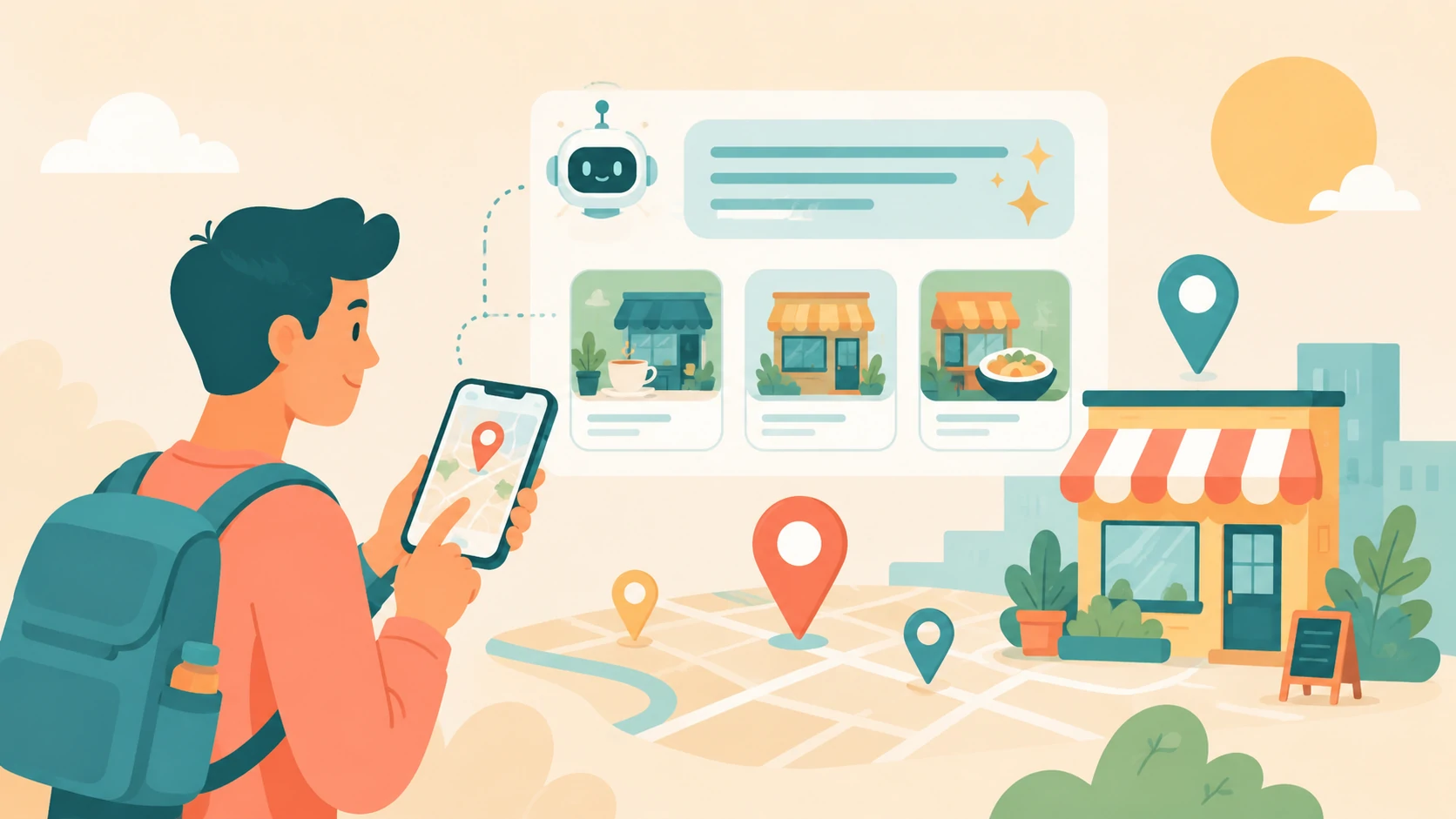
Google has been testing search experiences where AI-generated answers appear above, alongside, or potentially instead of the traditional local map pack for certain queries. These experiences can bring together information about businesses, reviews, websites and other sources into a single AI-generated response.
That matters because ranking well may no longer automatically translate into the visibility or traffic we expect.
Optimising for More Than the Map Pack
Traditional local SEO isn’t disappearing. Google Business Profile optimisation, reviews, local citations, relevant landing pages and technical SEO remain important.
But there is an additional challenge emerging: being understood as an entity that Google’s systems can confidently reference and recommend.
That potentially makes consistency across the wider web even more important.
Business information should be accurate across Google Business Profile, the website and relevant third-party sources. Pages should clearly explain services, locations, expertise and differentiators. Structured data can reinforce those relationships, while reviews and authoritative third-party mentions provide additional signals about the business.
Content strategy may need to change as well.
A search such as “plumber near me” may continue to produce a conventional local experience. But a more complex query — “best plumber near me for an emergency callout on Sunday” — gives Google considerably more context from which to construct an AI-generated answer.
SEO therefore increasingly means understanding questions and intent, not simply tracking keywords.
The Bigger Problem Is Reporting
This is where I think things become particularly interesting.
Imagine a business remains number two in the local pack. Your SEO report says rankings are stable. Yet an AI Overview now occupies much of the space above that listing and answers a significant part of the user’s question.
Technically, the ranking hasn’t changed.
Practically, the business’s visibility has.
That makes traditional ranking reports increasingly incomplete.
We need to start thinking about a broader share of search visibility: Does the brand appear in the map pack? Is its website cited in an AI Overview? Is the business mentioned or recommended in the generated answer? How prominent is it across the entire search result?
And, ultimately, what happens afterwards?
That means connecting SEO reporting more closely to Google Business Profile interactions, calls, direction requests, enquiries, leads, assisted conversions and revenue — rather than treating rankings and organic clicks as the final measures of success.
SEO Isn’t Dead. The Measurement Model Is Changing.
There is still plenty we don’t know. Google continues to test layouts, and I wouldn’t rebuild an entire local SEO strategy around screenshots of individual experiments.
But the direction is difficult to ignore.
Search is moving from a list of results towards an environment where Google increasingly interprets, summarises and recommends.
For SEO professionals, the challenge is therefore becoming twofold:
Optimise so that search engines understand and trust the entity, and report on whether that visibility actually influences business outcomes.
The businesses and SEO teams that adapt their measurement models alongside their optimisation strategies will have a much clearer picture of performance than those still relying on a monthly ranking report.
