
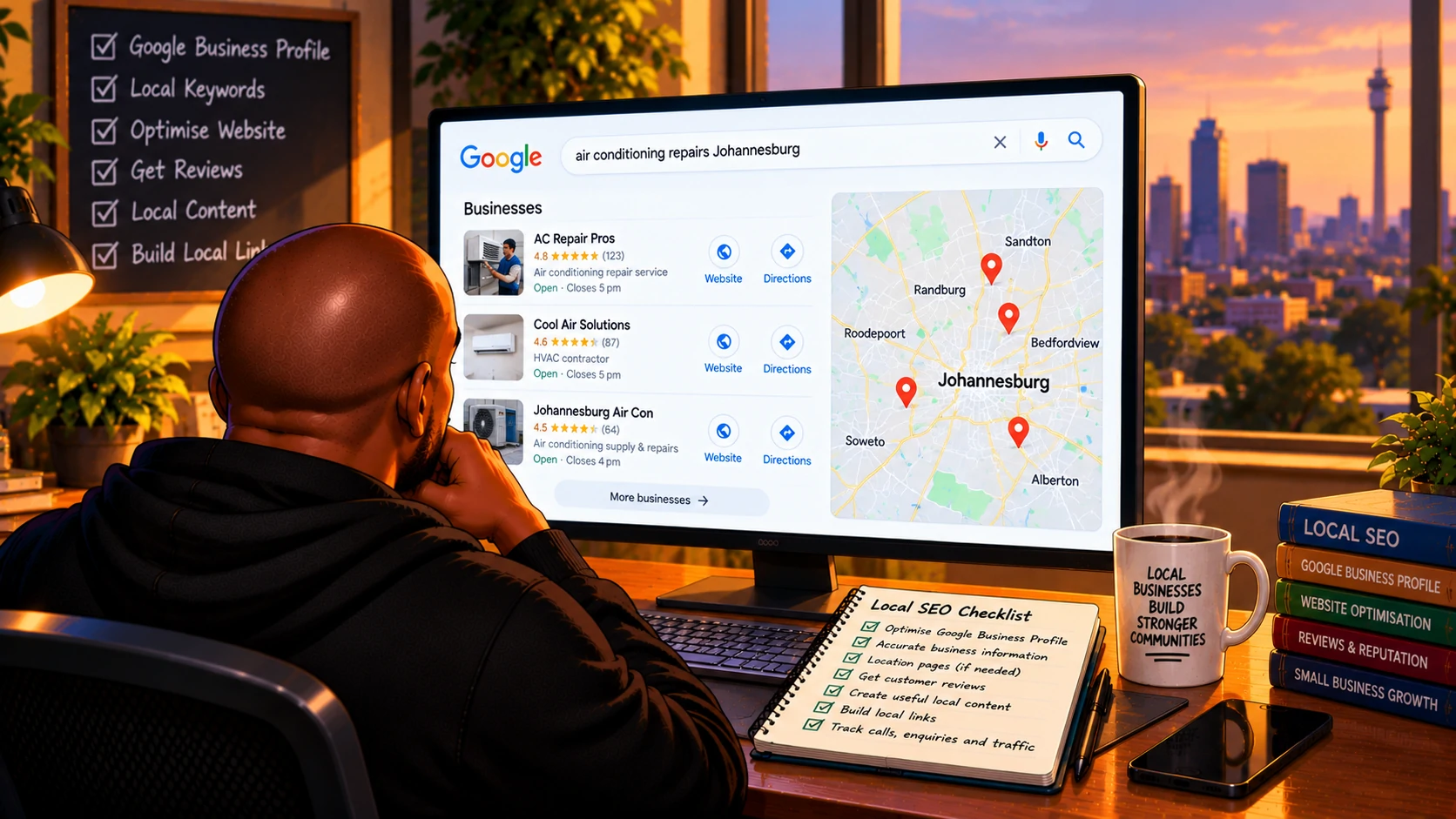
If I owned a small business today, one of the first digital marketing strategies I’d consider would be local SEO.
Not because it’s free.
Not because it’s easy.
And definitely not because creating a Google Business Profile automatically puts you at the top of Google Maps.
I’d consider it because local SEO connects businesses with people actively searching for products or services in a particular area.
Someone looking for a plumber in Johannesburg.
A parent searching for an orthodontist in Pretoria.
A driver looking for a nearby tyre shop.
These aren’t necessarily people casually browsing the internet. Many have a specific need.
And if your business can meet that need, appearing in relevant local search results can be valuable.
But here’s something I’ve learned from working with local and multi-location SEO campaigns.
Ranking in Google Maps is only part of the job.
The real objective is helping potential customers discover your business, understand what you offer and take action.
So, if you’re researching local SEO for small business, here’s what I’d prioritise, what I’d avoid and how I’d approach it without wasting money on tactics that sound impressive but deliver very little.
What Is Local SEO for Small Business?
Local SEO for small business is the process of improving a company’s visibility in location-related search results, including Google Maps, Google’s local pack and relevant organic listings.
It’s particularly important for businesses serving customers in specific geographic areas.
That includes physical locations such as restaurants, dental practices and retail stores, as well as service-area businesses like plumbers, electricians and cleaning companies.
For example, someone searching for “air conditioning repairs Pretoria” is likely looking for a company that serves Pretoria.
Local SEO helps search engines and customers understand where a business operates and what it provides.
But it involves more than inserting city names into website content.
It requires accurate business information, relevant pages, a useful website and an understanding of local search behaviour.
Why Local SEO Matters for Small Businesses
One of the biggest advantages of local SEO is that smaller businesses can compete for relevant searches without needing to reach everybody.
A business in Sandton doesn’t necessarily need visibility across South Africa.
It might benefit more from appearing when someone searches for its services in Sandton, Bryanston or nearby areas it genuinely serves.
That makes the strategy more focused.
| Benefit | Why it matters |
|---|---|
| Local discovery | Helps nearby customers find relevant businesses |
| Google Maps visibility | Makes business information accessible during local searches |
| Website traffic | Attracts visitors looking for services in specific areas |
| Calls and enquiries | Creates opportunities for customers to contact the business |
| Directions and visits | Helps customers locate physical premises |
| Brand familiarity | Repeated visibility can improve recognition |
Of course, none of these outcomes is guaranteed.
A business still needs to compete with relevant providers, and visibility doesn’t automatically translate into sales.
That’s why how SEO helps digital marketing is a useful broader conversation.
SEO should support the business, not become an isolated exercise in rankings.
1. Start With Google Business Profile
If a small business is eligible for a Google Business Profile, that’s where I’d start.
Google Business Profile allows businesses to manage information that can appear in Google Search and Maps.
Depending on the business, that may include its name, location, service area, opening hours, contact details, photographs and reviews.
I’d focus on three things.
- Choose the right category: The primary category should accurately reflect the business’s main offering. I wouldn’t choose an unrelated category simply because it appears less competitive.
- Keep business information accurate: Names, addresses where applicable, phone numbers, websites and opening hours should reflect reality.
- Add useful information: Relevant services, photographs and supported profile details help customers understand the business.
What I wouldn’t do is stuff keywords into the business name.
Google expects the name to reflect the business’s real-world name. Adding unnecessary keywords or locations can violate its guidelines.
I’ve written more about Google Business Profile ranking factors because businesses sometimes overlook these basics while searching for shortcuts.
2. Understand How Google Ranks Local Businesses
Google identifies three main factors influencing local results:
Relevance, distance and prominence.
- Relevance: How well a business matches what someone is searching for.
- Distance: How far the business is from the location associated with the search.
- Prominence: How well-known or established the business appears to be.
Google explains these factors in its guidance on improving local rankings.
Why does this matter?
Because a business can be well optimised and still struggle to rank for searches originating far outside its location.
Imagine a dentist based in Randburg.
Someone searching from Randburg may see different local results from someone searching in Centurion.
That doesn’t necessarily mean the dentist’s SEO is broken.
Local rankings change depending on where the search happens.
It’s why I don’t like reporting a single Google Maps position as though it represents visibility across an entire city.
3. Build a Website That Supports Local Search
I sometimes see local SEO advice focusing almost entirely on Google Business Profile.
But the website matters too.
It helps explain what the business offers, where it operates and why someone should consider contacting it.
For a small business, I’d focus on clarity.
Can visitors understand the main services?
Is the service area obvious?
Are contact details easy to find?
Does the website work properly on mobile?
Are important pages accessible to search engines?
I think homepage SEO best practices are particularly relevant here.
A homepage doesn’t need every service detail, but it should introduce the business and guide visitors to the information they need.
For example, a plumbing company might have a homepage explaining its services and operating area, followed by separate pages for emergency plumbing, geyser repairs and drain cleaning.
This approach gives each important service room to explain itself properly.
I’d start with the services customers actually need rather than creating dozens of pages for minor keyword variations.
Don’t Overlook Mobile Usability
Think about how people search when they need something nearby.
They might be standing outside a shopping centre, sitting in a parked car or trying to find an emergency service provider.
Often, they’re using a phone.
I’d want readable content, functional navigation, accessible contact information and straightforward forms.
I’d also review website performance.
But I wouldn’t obsess over a perfect PageSpeed Insights score.
If someone urgently needs a plumber, they shouldn’t have to navigate through several screens to find a phone number.
A usable mobile website matters more than an impressive performance score that doesn’t reflect the customer experience.
4. Use Local Keywords Naturally
Keyword research matters, but I don’t think it needs to become unnecessarily complicated.
I’d start by understanding how customers describe the business’s services.
An air conditioning company might investigate searches such as:
- Aircon repairs Johannesburg.
- Aircon installation Pretoria.
- Air conditioning maintenance near me.
- Emergency aircon repairs.
- Aircon servicing Sandton.
These are examples of possible searches, not verified search-volume recommendations.
I’d use Google Search Console and Keyword Planner to investigate demand.
But I wouldn’t assume every keyword requires a separate page.
If several phrases reflect the same intent, one useful page may be enough.
I’d also pay attention to local terminology.
In South Africa, people commonly use the term “aircon”.
In other markets, people may be more likely to use “AC” or “air conditioning.”
Keyword research should reflect how the audience searches, not simply what an SEO tool suggests.
5. Create Location Pages Only When They Serve a Purpose
This is where local SEO can become repetitive very quickly.
A business serves ten suburbs.
So somebody creates ten pages.
Each contains almost identical content.
The only thing that changes is the suburb name.
I’ve seen this approach often enough to question how much value it provides.
Location pages can be useful when a business genuinely serves multiple areas.
But they should contain meaningful information.
That might include services available in the area, local contact details where appropriate, genuine location-specific information or other details customers need.
I’d avoid pages created purely to capture keyword variations and funnel visitors to the same destination.
Google’s spam policies address doorway abuse, so mass-producing thin location pages isn’t a strategy I’d recommend.
I’d rather publish a few useful location pages than dozens that say essentially the same thing.
6. Build a Genuine Reputation Through Customer Reviews
Reviews help potential customers evaluate other people’s experiences.
Google also says that more reviews and positive ratings can help local ranking.
But review generation needs to be handled properly.
I’d encourage businesses to ask genuine customers for feedback, make the process straightforward and respond professionally where appropriate.
What I wouldn’t recommend is buying reviews, offering incentives for positive feedback or selectively soliciting reviews in ways that violate Google’s policies.
A business doesn’t need a perfect five-star rating to demonstrate credibility.
Sometimes, how a company responds to reasonable criticism tells potential customers quite a lot.
The objective should be building a genuine reputation.
Not manufacturing one.
7. Keep Business Information Accurate Across Important Platforms
You’ve probably heard about NAP consistency.
That stands for name, address and phone number.
The principle is straightforward.
Customers should find accurate business information wherever the company is listed.
If your website displays one phone number and a major directory shows another, that creates confusion.
If you’ve moved premises but old listings still show the previous address, customers might go to the wrong place.
I’d focus on correcting important business profiles and directories.
But I wouldn’t obsess over every formatting difference.
“Street” in one listing and “St” in another isn’t automatically a major SEO problem.
Accuracy matters more than mechanical uniformity.
8. Use Internal Links to Connect Services and Locations
Internal linking is one of the improvements small businesses can make without expensive software.
Imagine a website has a homepage, several service pages and a location page.
But the service pages don’t link to the location page.
And the homepage doesn’t make important services easy to find.
That’s a missed opportunity.
Internal links help visitors navigate and search engines discover related content.
An air conditioning installation page might link to a maintenance page.
A location page might link to services available in that area.
But I wouldn’t insert links simply to reach an arbitrary target.
The anchor text should describe the destination naturally, and the link should make sense in context.
9. Local SEO Should Generate Leads, Not Just Rankings
This is probably the part I care about most.
Let’s say a small business improves its Google Maps visibility.
That’s encouraging.
But what happens next?
Are more people calling?
Are they asking about relevant services?
Are website enquiries increasing?
Are customers booking appointments?
And are those enquiries becoming sales?
Those are the questions I’d want answered.
I’ve written about local SEO lead generation strategies because rankings are only half the job.
A business can rank well and still struggle with conversions.
Maybe the contact form doesn’t work.
Maybe the business responds too slowly.
Maybe its pages attract people looking for services it doesn’t offer.
Those problems won’t necessarily disappear with better rankings.
That’s why I’d evaluate the customer journey from the search result to the enquiry.
10. How I’d Measure Local SEO Performance
I wouldn’t rely on a single keyword ranking report.
I’d want to understand whether local visibility is improving and whether that visibility produces meaningful results.
| Metric | Why I’d track it |
|---|---|
| Google Search Console clicks | Understand traffic from Google Search |
| Local search impressions | Identify visibility trends |
| Google Business Profile interactions | Monitor available calls, clicks and other interactions |
| Organic landing-page performance | Identify pages attracting visitors |
| Forms and bookings | Measure potential customer enquiries |
| Qualified leads | Understand commercial relevance |
| Local rankings by area | Identify geographic differences |
I’d use Google Search Console and GA4 together, but I wouldn’t expect their numbers to match exactly.
They measure different things.
I’ve discussed this in Google Search Console vs Google Analytics.
I’d also be careful with Google Business Profile performance data.
A call-button click doesn’t guarantee someone successfully contacted the business.
And a profile interaction isn’t necessarily a sale.
For a small business, a simple monthly report showing relevant visibility, enquiries and business outcomes can be more useful than a complicated dashboard with dozens of metrics.
11. What About Businesses With Multiple Locations?
Managing one location is different from managing ten or twenty.
Each location may have different competitors, services, opening hours and customer behaviour.
I’ve written about managing SEO for multiple locations because this is something I’ve encountered professionally.
One lesson is that businesses shouldn’t assume every location will perform the same way.
A strategy that works in Johannesburg might require adjustments for Pretoria.
Even within the same city, competition and proximity can produce different results.
I’d also want clear responsibility for business information.
If a branch changes its hours, who updates the profile?
If the phone number changes, who updates the website?
If a location closes permanently, who manages its listing?
These operational details matter.
Local SEO requires ongoing maintenance, not just initial optimisation.
12. Is AI Search Changing Local SEO?
Yes, although I think we need to be careful about the conclusions we draw.
AI-powered search experiences are changing how some people discover information, including local businesses.
But traditional local packs, Google Maps and organic listings remain important.
I’ve written about how AI is changing local SEO because I think the bigger challenge is understanding how visibility and customer journeys are evolving.
A business might be discovered through Maps, an organic result, an AI-generated response or a combination.
For small businesses, I’d continue prioritising accurate information, useful content and a credible online presence.
I wouldn’t pay for a mysterious “AI local ranking optimisation” package without understanding what the provider intends to do.
The fundamentals still matter.
The Free Local SEO Tools I’d Start With
Small businesses can accomplish quite a lot without paying for expensive SEO software.
| Tool | What I’d use it for |
|---|---|
| Google Business Profile | Managing eligible listings and local interactions |
| Google Search Console | Search visibility and indexing |
| Google Analytics 4 | Website traffic and conversions |
| Google Keyword Planner | Local keyword ideas |
| Google PageSpeed Insights | Website performance |
| Google Trends | Regional and seasonal search interest |
| Screaming Frog SEO Spider | Technical website crawling |
These tools have free access or free versions, although some have limitations.
I wouldn’t immediately purchase a paid local SEO platform.
For one location with a small website, free tools may be enough to begin.
For multiple locations requiring advanced reporting, review management or geographic rank tracking, paid tools might become useful.
The important thing is buying software for a reason.
Not because somebody says local SEO requires an expensive toolkit.
My 30-Day Local SEO Plan for a Small Business
If I were starting local SEO for a small business with limited resources, here’s how I’d approach the first month.
| Week | Focus | What I’d do |
|---|---|---|
| Week 1 | Business information and tracking | Review Google Business Profile, contact details, Search Console and analytics |
| Week 2 | Website fundamentals | Check important service pages, technical issues, mobile usability and contact forms |
| Week 3 | Local keyword research | Investigate relevant services, locations, existing rankings and content opportunities |
| Week 4 | Improvements and measurement | Implement priority fixes, improve content and internal links, and establish reporting baselines |
I’d prioritise issues based on their impact.
For example, fixing a broken enquiry form would matter more to me than rewriting a perfectly acceptable meta description.
And I wouldn’t promise position one in Google Maps within thirty days.
The first month should establish a reliable foundation and identify useful next steps.
Common Local SEO Mistakes I’d Avoid
| Mistake | Why I’d avoid it |
|---|---|
| Adding keywords to the business profile name | Can violate Google’s guidelines |
| Buying reviews | Creates trust and policy risks |
| Creating near-identical location pages | Can produce doorway-style content |
| Tracking one’s map’s position | Ignores geographic differences |
| Ignoring conversions | Makes business value difficult to measure |
| Listing inaccurate service areas | Misrepresents where the business operates |
| Buying unnecessary subscriptions | Increases costs without clear benefits |
| Expecting immediate results | Creates unrealistic expectations |
Most of these mistakes come from focusing too heavily on rankings while overlooking the customer experience.
I’d rather improve the parts of local SEO that help customers find accurate information and contact a business confidently.
Frequently Asked Questions About Local SEO for Small Business
What is local SEO for small businesses?
Local SEO helps small businesses improve visibility in location-related Google Search and Maps results through business profile optimisation, relevant website content, local keyword research and reputation management.
Is local SEO worth it for a small business?
It can be, particularly when the business serves a defined geographic area. Its value depends on local demand, competition and the ability to turn enquiries into customers.
Can I do local SEO myself?
Yes. Business owners can manage many fundamentals, including Google Business Profile updates, accurate contact information, basic website improvements and performance monitoring. More complex technical work may require specialist support.
How long does local SEO take to work?
There’s no fixed timeline. Some changes may become visible relatively quickly, while competitive local rankings can take months to improve.
Do I need a website for local SEO?
An eligible business can have a Google Business Profile without a traditional website. However, I’d recommend a useful website to explain services, establish credibility and generate enquiries.
What are the most important local SEO ranking factors?
Google identifies relevance, distance and prominence as the primary factors influencing local results.
Is Google Business Profile free?
Yes. Google Business Profile is free for eligible businesses, although creating one doesn’t guarantee verification or rankings.
Should I create a page for every suburb I serve?
Not automatically. I’d create location pages when they provide genuinely useful information, rather than publishing nearly identical pages solely to target suburb keywords.
Final Thoughts: Local SEO Should Help Small Businesses Get Customers
I think local SEO is one of the most practical digital marketing opportunities available to small businesses.
It allows companies to focus on the areas where they operate and connect with customers searching for relevant products or services.
But I don’t think businesses should approach it as a collection of Google Maps tricks.
A complete Google Business Profile matters.
So does a useful website, accurate contact information, genuine reviews and an easy way for customers to get in touch.
I’ve seen enough SEO discussions focused on ranking positions to know how easily we can forget the objective.
A small business doesn’t need to rank for every keyword in its industry.
It needs visibility for searches that matter to its customers.
And when those customers find the business, they need a reason to choose it.
For me, successful local SEO isn’t about being number one on a ranking report. It’s about helping the right customers find the right business at the right time.
