
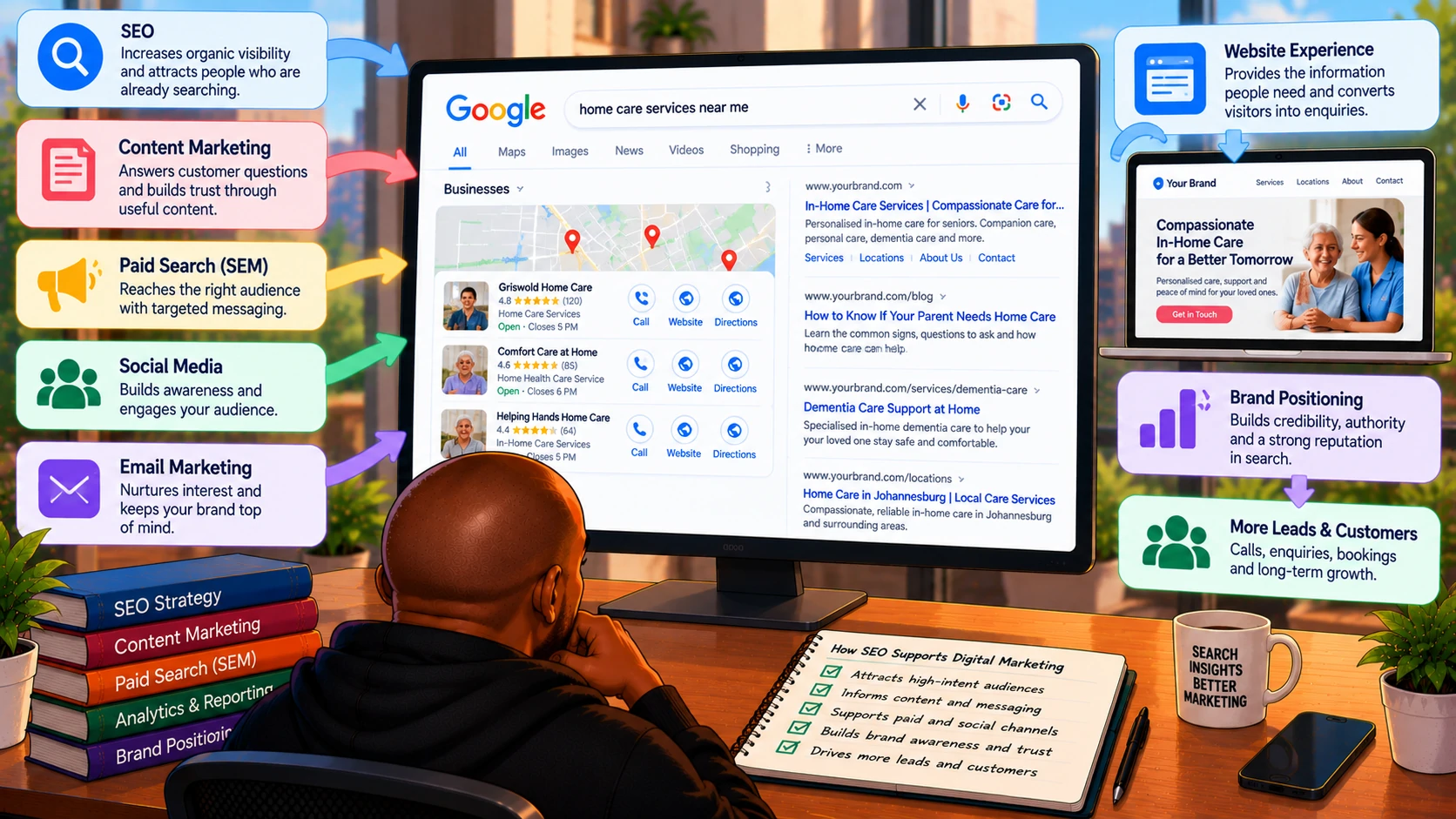
When I started working in digital marketing, I didn’t fully appreciate how much SEO would influence the way I approached everything else.
At first, SEO seemed fairly straightforward.
Find keywords.
Optimise pages.
Improve rankings.
Get more traffic.
And hopefully, that traffic turns into customers.
Of course, anyone who has worked in SEO for a while knows it isn’t quite that simple.
But the longer I’ve worked in digital marketing, the more I’ve realised that SEO does something much bigger than help websites appear on Google.
It helps businesses understand what people are looking for, how they make decisions, which questions they need answered and where opportunities exist to improve their online presence.
And those insights can influence content marketing, paid advertising, website design, conversion optimisation, brand positioning and even customer experience.
That’s why I think the question “How does SEO help in digital marketing?” deserves a better answer than just saying it increases organic traffic.
Traffic matters.
But it’s only part of the story.
What Is the Role of SEO in Digital Marketing?
SEO helps digital marketing by making a website more discoverable in organic search, attracting relevant audiences, improving content relevance, supporting website usability and providing insights that can strengthen other marketing channels.
Digital marketing includes several activities.
SEO.
Paid search.
Social media.
Email marketing.
Content marketing.
Conversion rate optimisation.
Digital PR.
Analytics.
And increasingly, AI search visibility.
Each channel has its own purpose, but they don’t operate completely independently.
Someone might discover a business through Google, read its blog, follow it on social media, receive an email and eventually return to the website to make an enquiry.
SEO may have played an important role in that journey without receiving all the credit.
That’s one reason I’ve become less interested in treating marketing channels as completely separate departments.
The customer doesn’t necessarily think:
I’m currently interacting with the organic search channel.
They’re just trying to solve a problem.
And good digital marketing should make that process easier.
1. SEO Helps Businesses Reach People Who Are Already Searching
One of SEO’s biggest advantages is search intent.
When someone searches Google, they’re expressing a need, question or interest.
They might be researching a problem.
Comparing services.
Looking for a nearby business.
Checking prices.
Or preparing to make a purchase.
That’s valuable information.
Imagine a company offering home care services.
Someone searches:
How do I know if my elderly parent needs help at home?
That person might not be ready to contact a provider.
But they’re beginning to research a real concern.
A useful article could help them understand the situation.
Later, they might search:
Home care services near me.
Now the intent is different.
They may be much closer to contacting a business.
SEO helps companies understand and serve those different stages.
But I don’t think the objective should be to target every keyword that contains a remotely relevant phrase.
It’s to understand the questions that matter to the audience and provide genuinely useful answers.
That’s where SEO becomes more than a traffic acquisition tactic.
It becomes a way of understanding customer needs.
2. SEO Makes Content Marketing More Strategic
I’ve seen businesses approach content marketing by asking:
What should we write about this month?
Sometimes the answer comes from brainstorming.
Sometimes from competitor websites.
Sometimes from whatever topic happens to be trending.
There’s nothing inherently wrong with those approaches.
But SEO adds another layer of evidence.
Keyword research can help identify recurring questions, related topics, search intent and gaps in existing content.
Google Search Console can show which queries are already generating visibility for a website.
Competitor analysis can reveal areas where audiences are searching for information that the business hasn’t addressed.
That doesn’t mean every article should be written purely for search engines.
Actually, I think that’s where content marketing often goes wrong.
Businesses find a keyword and then produce an article that says almost the same thing as every other result.
No original insight.
No experience.
No useful examples.
Just a different arrangement of familiar headings.
I’ve written about how I find SEO blog ideas without writing the same posts as everyone else.
For me, SEO should help identify the opportunity.
The content still needs to give people a reason to read it.
Search demand tells us what people are interested in. Good content gives them something worth finding.
3. SEO Can Support Brand Awareness and Positioning
Here’s something I think we underestimate.
People start forming opinions about brands before they visit their websites.
Imagine searching for two businesses offering similar services.
One consistently appears with helpful articles, relevant service pages, clear descriptions and credible information.
The other has a confusing homepage, outdated content and very little explanation of what makes it different.
Even before clicking, you may have started forming an impression.
SEO contributes to that experience.
It helps businesses become visible for topics relevant to their expertise.
It also creates opportunities to explain what makes a company different.
But there’s an important distinction.
Visibility isn’t the same as trust.
And rankings aren’t the same as brand positioning.
A website appearing frequently doesn’t automatically mean people respect or remember the brand.
The information still needs to be accurate, useful and consistent with the actual business.
I’ve explored this in my article about brand positioning through search marketing.
I think this is an increasingly important part of SEO.
We’re not only trying to make websites easier to discover.
We’re helping businesses communicate what they stand for.
4. SEO Can Improve the Website Experience
This is one of my favourite connections between SEO and digital marketing.
Sometimes an SEO audit reveals problems that affect more than search visibility.
Slow-loading pages.
Confusing navigation.
Broken internal links.
Poor mobile usability.
Unclear page structure.
Service information that’s difficult to find.
A website might have strong content, but if visitors struggle to use it, the experience suffers.
Now, I wouldn’t claim that every usability improvement automatically increases Google rankings.
That’s not how SEO works.
But many technical and on-page improvements can benefit both search engines and users.
For example, a clearer navigation structure can help visitors find services while making important pages easier for crawlers to discover.
Descriptive internal links can help people move between related topics.
A well-organised service page can make information easier to understand.
And a faster, more usable mobile experience can reduce unnecessary frustration.
That’s why I don’t like treating technical SEO as something that only matters to Googlebot.
The website still needs to work for actual people.
5. SEO Helps Paid Search Teams Understand Search Intent
SEO and paid search are different disciplines, but I think they can learn a lot from each other.
Paid search can provide visibility through advertising.
SEO focuses on earning organic visibility.
Both involve understanding what people search for and what they’re trying to accomplish.
Imagine an SEO team discovers that a particular service page receives impressions for several high-intent queries.
Those insights might help a paid search team identify relevant themes worth investigating.
Similarly, paid search conversion data may reveal which messaging or service categories attract valuable enquiries.
That information could help inform organic content priorities.
But I wouldn’t assume a keyword that performs well in paid search will automatically perform equally well organically.
The search results, landing pages, competition and user behaviour can differ.
And paid advertising doesn’t directly improve organic rankings.
The benefit is shared learning.
SEO and paid search can support the same business objectives without needing to compete for ownership of every customer journey.
6. Local SEO Connects Digital Marketing With Real-World Customers
This is particularly relevant to the work I’ve done with multi-location businesses.
A customer searches for a nearby service.
They see Google Maps results.
Compare reviews.
Check opening hours.
Look at photographs.
Maybe visit a location page.
Then call the business.
That entire journey might happen without the customer ever reading a traditional blog post.
And that’s why local SEO is such an important part of digital marketing for businesses with physical locations or defined service areas.
I’ve written about what managing SEO for multi-location brands has taught me about local search.
One of the biggest lessons is that local visibility requires more than creating a Google Business Profile and hoping for the best.
Business information needs to be accurate.
Location pages need to be useful.
Services should be represented clearly.
Reviews need genuine attention.
And customers need an easy way to contact the right location.
But rankings are only part of the equation.
A business might appear prominently in Google Maps and still lose customers because its contact information is wrong or nobody responds to enquiries.
That’s why I believe local SEO and conversion optimisation should work together.
I discuss this further in how to increase leads from local SEO.
7. SEO Helps Businesses Understand Customer Behaviour Through Search Data
I think Google Search Console is one of the most underrated tools in digital marketing.
And yes, I know that’s a strong opinion.
But consider what it provides us.
Information about the queries that trigger impressions.
The pages receiving clicks.
Changes in search visibility.
CTR patterns.
Search performance by country and device.
And potential opportunities hidden within existing content.
That’s valuable beyond SEO.
Imagine a business notices increasing impressions for searches about the cost of a particular service.
That might suggest pricing information deserves more attention.
Or perhaps a service page begins appearing for questions about a problem the business hasn’t explained clearly.
That could inform content planning.
Customer support resources.
Sales conversations.
Even how the business describes its services.
Of course, Search Console has limitations.
It doesn’t reveal every query, and search trends don’t necessarily represent every customer’s needs.
But I still think the data is incredibly useful.
I’ve written about Google Search Console vs Google Analytics.
My view is that Search Console helps us understand how people discover a website through Google Search, while Analytics helps us understand what happens after they arrive.
Used together, they can tell a much more useful story.
8. SEO Supports Conversion Rate Optimisation
This is where I think SEO becomes more valuable as you gain experience.
Early in my career, I paid a lot of attention to rankings and traffic.
I still care about those metrics.
But now I ask more questions about what happens after someone lands on a page.
Does the content match the search intent?
Can visitors find the information they need?
Is there a clear next step?
Does the page explain the service properly?
Are important objections addressed?
Is the contact form unnecessarily complicated?
SEO can help attract relevant visitors.
Conversion rate optimisation makes the website more effective at turning appropriate visits into actions.
For example, suppose a service page receives 1,000 organic visits per month and generates 20 enquiries.
That’s a 2% enquiry conversion rate.
If the same traffic generates 35 enquiries after useful improvements, the conversion rate rises to 3.5%.
That’s a 75% increase in enquiries without needing additional traffic.
Those are illustrative numbers, not results from one of my clients.
But they demonstrate why conversion improvements can be so valuable.
Sometimes the biggest opportunity isn’t attracting more visitors.
It’s making better use of the visitors you already have.
9. SEO Can Deliver Value Beyond the Life of a Campaign
One of the advantages of SEO is that useful content can continue attracting relevant visitors after the initial work has been completed.
A well-maintained service page might generate search visibility for years.
A helpful article might continue answering questions long after publication.
An improved website structure can support many pages rather than one campaign.
That’s different from paid advertising, where visibility from an individual advertisement generally depends on the campaign continuing to run.
But I think we need to be careful with the idea that SEO traffic is free.
It isn’t.
Content creation costs money.
Technical improvements require resources.
Research takes time.
Monitoring takes time.
And competitors don’t stop improving their websites simply because yours is performing well.
SEO also doesn’t guarantee that rankings or traffic will continue indefinitely.
Search behaviour changes.
Algorithms change.
Competitors improve.
AI search experiences evolve.
I’ve discussed both sides of the advantages and disadvantages of SEO.
For me, SEO’s long-term value comes from building useful digital assets that can continue supporting the business.
It does not come from assuming that organic traffic will grow forever without further work.
10. SEO Helps Other Marketing Channels Work Better Together
This is something I’ve come to appreciate more as I’ve moved further into SEO strategy.
A business might have a great social media team.
An effective email marketing programme.
A paid advertising budget.
A strong content team.
But if those activities operate independently, you might miss opportunities.
SEO insights can help connect them.
For example, a blog article that performs well in organic search might contain information worth sharing through email.
A frequently searched customer question might inspire a social media video.
A paid campaign might reveal a particular customer concern that deserves a dedicated website page.
An SEO audit might identify confusing messaging that also affects paid landing pages.
And customer feedback from social media could reveal questions that organic content doesn’t answer.
I don’t think SEO needs to control all those channels.
It shouldn’t.
But it can provide useful information that helps the broader marketing team make better decisions.
The challenge is to share the insights and act on them.
Otherwise, we’re just collecting data in separate dashboards.
11. SEO Is Becoming More Important as AI Changes Search
This might sound contradictory.
If AI can answer questions directly, why would SEO become more important?
Wouldn’t fewer people need to visit websites?
That’s a fair concern.
AI Overviews, AI Mode and other AI-powered search experiences are changing how people discover and consume information.
Some questions can be answered without a traditional website visit.
Other searches may become more conversational.
People can ask detailed follow-up questions rather than starting an entirely new search.
And businesses may need to think about how their information is represented across different search and AI platforms.
But I don’t think this makes SEO irrelevant.
I think it changes what good SEO needs to accomplish.
Clear website structure still matters.
Accurate information still matters.
Original content still matters.
Technical accessibility still matters.
Brand recognition and credibility still matter.
And people still need to discover businesses, compare services and take action.
I’ve written about why SEO still matters in the age of AI.
My view is that the job is expanding beyond traditional rankings.
We’re increasingly thinking about discoverability across different search experiences.
But I also think we need to be careful about creating unnecessary complexity.
I’ve discussed this in my article on SEO vs GEO vs AEO.
We can introduce new terminology every year.
But the underlying objective remains fairly consistent.
Help people find accurate, useful information about the things they’re interested in.
12. SEO Helps Businesses Make Better Marketing Decisions
This is probably the benefit I appreciate most.
SEO forces us to ask questions.
What does the audience want?
What problems are they trying to solve?
Which services generate the most interest?
What information is missing?
Why are certain pages performing better than others?
Which competitors are attracting relevant searches?
Where are visitors struggling?
What content deserves more investment?
These questions can improve decisions beyond SEO.
Imagine a business discovers that customers consistently search for information about a service it offers but barely explains.
That might be a content opportunity.
It could also be a messaging problem.
Or perhaps people frequently search for a particular service in a city where the business has an existing location.
That might justify investigating local demand more closely.
It doesn’t automatically mean the business should expand.
But it gives the marketing team useful evidence to consider.
This is why I think SEO strategists should understand more than keywords and rankings.
We need to understand the business.
Otherwise, it’s easy to spend months improving metrics that don’t meaningfully contribute to the company’s objectives.
How Do You Measure SEO’s Contribution to Digital Marketing?
I wouldn’t measure it using organic traffic alone.
Traffic is important, but it doesn’t tell us whether we’re attracting the right people or contributing to business outcomes.
I’d look at several levels of performance.
| Area | What I’d measure |
|---|---|
| Search visibility | Impressions, relevant rankings, branded and non-branded queries |
| Organic acquisition | Clicks, sessions and landing-page performance |
| Content effectiveness | Query relevance, engagement and useful next steps |
| Lead generation | Form submissions, calls, bookings and qualified leads |
| E-commerce | Purchases, revenue and organic-assisted journeys |
| Local SEO | Google Business Profile interactions, local visibility and enquiries |
| Brand discovery | Branded search trends and relevant brand-related queries |
| AI search | Observable citations, mentions and referral activity where measurable |
The challenge is connecting these metrics without pretending every correlation proves causation.
For example, branded searches might increase during an SEO campaign.
But that increase could also be influenced by paid advertising, social media, offline marketing or news coverage.
Likewise, a customer might discover a business through organic search and convert after returning through another channel.
Attribution isn’t always straightforward.
That’s why I prefer looking at multiple data sources and explaining what they do and don’t tell us.
I’ve explored this further in how to measure SEO performance.
For me, good reporting isn’t about finding the biggest number.
It’s about understanding whether the marketing activity is creating meaningful value.
Is SEO More Important Than Other Digital Marketing Channels?
I wouldn’t make that argument.
And I say that as someone whose career is built around SEO.
Different businesses need different marketing strategies.
An established online retailer might benefit from a combination of organic search, paid shopping campaigns, email marketing and customer retention.
A local emergency service business might depend heavily on Google Maps visibility and phone enquiries.
A new consumer brand might need to invest significantly in awareness before enough people begin searching for it.
SEO can be incredibly valuable in all those situations.
But it doesn’t automatically deserve the largest budget.
The right investment depends on the audience, competition, available resources, commercial objectives and how quickly the business needs results.
One of the most important lessons from my eight years in digital marketing is that understanding the bigger picture matters more as your responsibilities grow.
It’s not enough to know how to optimise a page.
You need to understand why you’re optimising it.
Frequently Asked Questions
How does SEO help in digital marketing?
SEO helps digital marketing by improving organic search visibility, attracting relevant audiences, supporting content planning, strengthening website usability and providing search data that can inform other marketing activities. It can also contribute to leads, sales and brand discovery.
Why is SEO important for digital marketing?
SEO is important because search engines connect businesses with people actively looking for information, products and services. It can help businesses become discoverable throughout the customer journey without relying entirely on paid advertising.
How does SEO support content marketing?
SEO provides insights into search intent, audience questions, relevant topics and existing content performance. These insights can help marketers plan content that addresses real needs rather than publishing articles without a clear purpose.
Can SEO help generate leads?
Yes. SEO can attract people searching for relevant services and guide them to enquiry or booking pages. However, lead generation also depends on website usability, trust, conversion pathways and how effectively the business handles enquiries.
Is SEO better than paid advertising?
Neither is universally better. SEO can build lasting organic visibility, while paid advertising can provide targeted exposure when campaigns are active. Many businesses benefit from using both strategically.
Does SEO still matter with AI search?
Yes. AI is changing how information appears in search results, but useful content, technical accessibility, accurate business information and credibility remain important. The way we measure visibility and business impact may need to evolve.
Final Thoughts: SEO Is More Than a Traffic Channel
When I think about how SEO helps in digital marketing, I don’t immediately think about position-one rankings anymore.
I think about the bigger picture.
SEO helps businesses understand what people are searching for.
It helps content teams identify useful topics.
It supports brand visibility.
It can reveal website problems.
It provides insights that paid search and other marketing teams can learn from.
It helps local businesses connect with nearby customers.
And when you do it properly, it can lead to more leads, sales and long-term business growth.
But none of those benefits happens automatically.
A website can rank well and still provide a poor customer experience.
An article can attract thousands of visitors without generating meaningful business value.
A company can publish hundreds of pages without building a recognisable brand.
That’s why I think the real value of SEO depends on how well it’s connected to the rest of digital marketing.
After years of working in this industry, I’ve become less interested in SEO existing as its own isolated activity.
I want to understand how it contributes to the broader business.
Because rankings are useful.
Traffic is useful.
Visibility is useful.
But those things matter most when they help a business achieve something meaningful.
SEO doesn’t need to be the most important part of every digital marketing strategy. It needs to make the overall strategy better.
And for me, that’s where its real value lies.
