
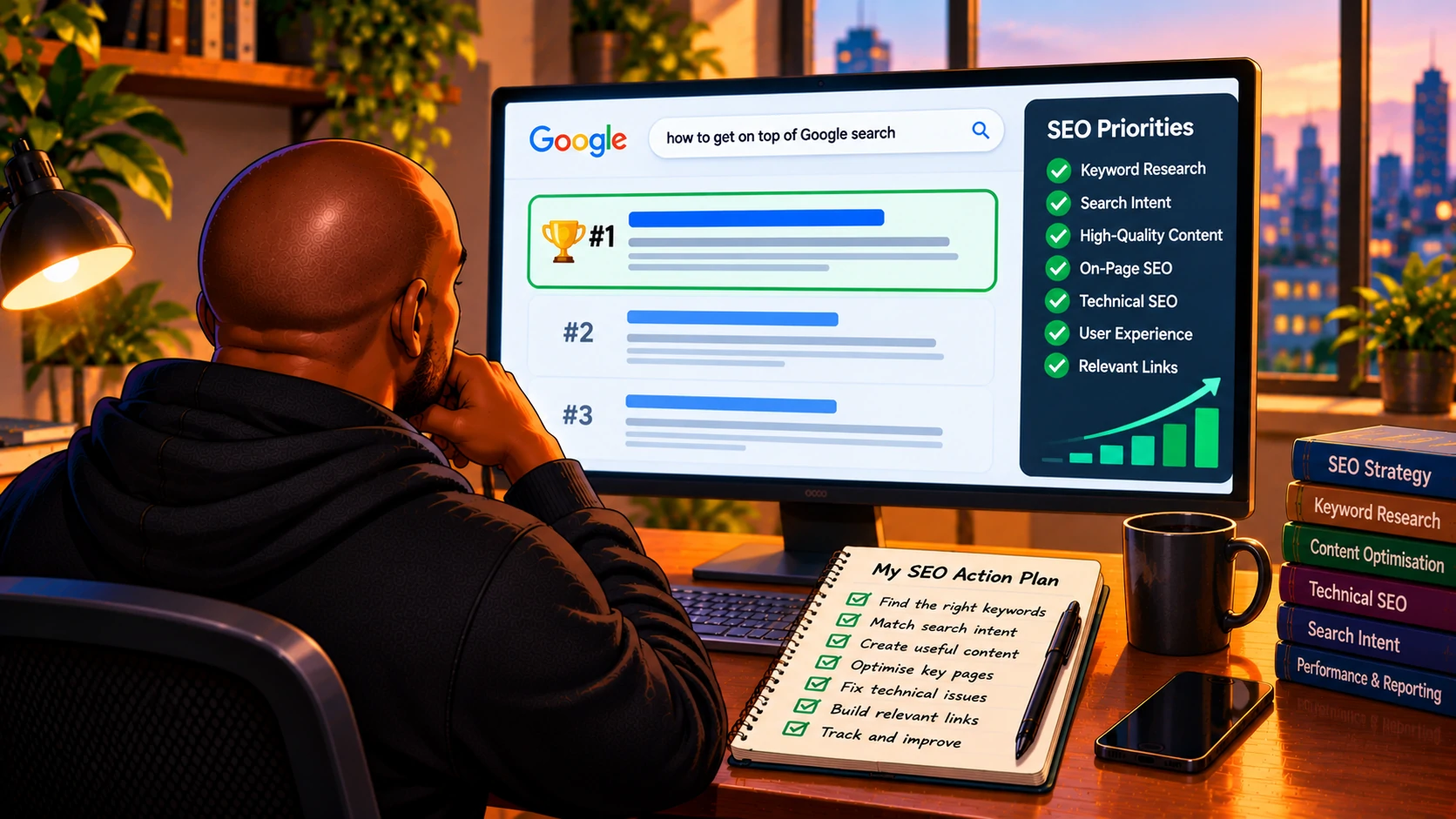
Everybody wants to be number one on Google.
Business owners want their websites above competitors. Bloggers want their articles on the first page. And SEO professionals spend considerable time figuring out why one website ranks above another.
I understand why.
Appearing prominently when someone searches for a product, service, or answer can create valuable opportunities.
But here’s something I’ve learned after years of working in SEO.
Getting to the top of Google isn’t as simple as following a checklist, adding keywords or installing an SEO plugin.
If it were, every website would be number one.
I’ve seen technically excellent websites struggle to rank, lengthy articles attract little traffic and businesses obsess over rankings while overlooking whether those rankings generate enquiries or sales.
That’s why I’d approach the question differently.
Instead of asking only how to get on top of Google Search, I’d ask:
What would make Google consider my website one of the most relevant and useful results for the searches I want to appear for?
That’s the question I’d build my strategy around.
Can You Really Get to the Top of Google Search?
Yes, it’s possible to rank at the top of Google Search.
But nobody can guarantee the number one position.
Google uses multiple ranking systems to determine which results are most relevant and useful for a particular search.
Results can also change depending on the query, location, language, device and search context.
And there isn’t always one universal “top position”.
Some searches display advertisements before organic results. Others include Google Maps, shopping listings, videos, featured snippets or AI Overviews.
So when someone says they want to rank number one, I’d first ask what type of search visibility they’re trying to achieve.
A plumber might want Google Maps visibility.
An e-commerce business might prioritise product listings.
A blogger might want informational articles to rank.
Those objectives require different approaches.
I’ve written about the most important SEO ranking factors because understanding how Google evaluates content is a better starting point than chasing ranking tricks.
1. Start With Relevant Keywords and Search Intent
If I wanted to improve a website’s rankings, I’d begin with keyword research.
But I wouldn’t automatically target the highest-volume keywords.
Imagine you own a small accounting firm in Johannesburg.
You could target “accounting”.
But that’s broad, competitive and doesn’t clearly explain what the searcher wants.
Now consider “small business tax accountant Johannesburg”.
The search volume may be lower, but the intent could be much more relevant.
That’s the opportunity I’d investigate.
How I’d Choose Keywords
I’d consider four things:
- Relevance: Does the keyword match what the website offers?
- Search intent: What is the person trying to accomplish?
- Competition: Which websites rank, and what would it take to compete?
- Business value: Would attracting this audience support the website’s objectives?
I’d also review Google Search Console before creating new content.
Sometimes the best opportunity isn’t a new keyword.
It’s an existing page already receiving impressions for relevant searches.
Match the Content to Search Intent
Different searches require different pages.
| Search query | Likely intent | Suitable page |
|---|---|---|
| What is SEO? | Learn | Informational guide |
| Best SEO tools for small business | Compare | Comparison article |
| SEO agency Johannesburg | Find a provider | Service page |
| Google Search Console login | Navigate | Official destination |
| Buy running shoes online. | Purchase | Product or category page |
Before creating content, I’d review the existing Google results.
Are the top pages guides, service pages, product listings or comparisons?
What questions do they answer?
What’s missing?
I wouldn’t copy competitors.
I’d use the results to understand what Google shows searchers, then create something genuinely useful.
2. Make Sure Google Can Access Your Website
Before chasing rankings, I’d investigate whether Google can properly access the website.
Technical problems can prevent otherwise useful pages from performing.
I’ve encountered websites with important pages blocked, incorrectly redirected or configured in ways that make indexing difficult.
If Google can’t access an important page, adding more keywords won’t solve the problem.
Here’s what I’d check:
- Can Google crawl important pages?
- Are those pages eligible for indexing?
- Are there accidental
noindexdirectives? - Do URLs return appropriate HTTP status codes?
- Are canonical tags configured correctly?
- Can Google access important content on mobile?
- Are valuable pages accessible through navigation and internal links?
I’d use Google Search Console and Screaming Frog to investigate.
But I wouldn’t treat every technical audit warning as urgent.
A broken link on an important service page might deserve immediate attention.
A missing meta description on a low-value archive page probably doesn’t.
I’ve written a more detailed guide on how to make a website SEO-friendly.
My priority would be fixing issues that prevent important pages from being discovered, understood or used.
Not chasing perfect audit scores.
3. Create Content That Deserves to Rank
Once a website is technically accessible, the next question is:
Why should Google rank your page above the alternatives?
It’s not enough to publish an article containing the target keyword.
And writing more words doesn’t automatically make a page better.
Someone searching for a straightforward answer probably doesn’t need a 3,000-word introduction.
But someone researching a complicated subject might appreciate a detailed explanation.
I’d focus on content that:
- Answers the main question clearly.
- Addresses relevant supporting questions.
- Provides accurate information and practical examples.
- Demonstrates appropriate knowledge or experience.
- Avoids unnecessary repetition.
- Offers something beyond generic summaries.
That last point matters.
We’ve reached a stage where publishing another article that says exactly what every competitor says isn’t much of a strategy.
This is especially true when AI tools can generate generic content so easily.
I’ve written about finding original SEO content ideas because businesses need to consider what makes their content worth reading.
Sometimes that’s original research.
Sometimes it’s professional experience.
Sometimes it’s a useful example.
And sometimes it’s explaining something complicated more clearly than competitors.
The goal should be helping the reader.
Not satisfying a content checklist.
4. Optimise Title Tags, Headings and Internal Links
Title tags, headings and internal links remain important parts of on-page SEO.
But I think we sometimes overcomplicate them.
A title tag should describe the page clearly.
An H1 should communicate the main topic.
Supporting headings should help organise the content logically.
And internal links should help readers discover relevant information.
For example, a page targeting “how to get on top of Google Search” might use:
How to Get on Top of Google Search: What Actually Works
That’s clear and relevant.
But repeating the exact keyword in every heading would make the article awkward.
I’d use related phrases naturally, like “improve Google rankings” or “increase search visibility.”
I’d also write useful meta descriptions while remembering that Google may generate different snippets.
Don’t Overlook Internal Linking
Imagine you’ve published articles about keyword research, technical SEO, Google Search Console and website optimisation.
But none of them links to the others.
That’s a missed opportunity.
Internal links help visitors navigate and search engines discover related pages.
For example, someone learning about rankings might benefit from a guide to SEO tools for beginners.
Someone improving a business website might find homepage SEO best practices useful.
I’d also investigate important pages receiving very few internal links.
But I wouldn’t insert links randomly or force exact-match anchor text.
A useful internal link should make sense to the reader before it makes sense to an SEO tool.
5. Build Authority Without Buying Random Backlinks
Backlinks have been part of Google’s ranking systems for years.
But I think link building is one of the most misunderstood areas of SEO.
Some people treat every additional backlink as an automatic ranking improvement.
That’s not how I’d approach it.
A link from a relevant, credible website can be valuable.
Buying hundreds of unrelated links isn’t a strategy I’d recommend.
Google has policies against links created primarily to manipulate rankings.
I’d focus on legitimate ways to earn recognition.
That might include original research, useful resources, genuine industry relationships, digital PR or expert contributions.
A company publishing valuable industry research may attract relevant coverage.
A local business might earn mentions through genuine community involvement.
A specialist might contribute expertise to an industry publication.
Those opportunities are more meaningful than purchasing links based on third-party authority scores.
Metrics such as Domain Authority and Domain Rating can be useful for comparisons, but they’re not Google’s own ranking scores.
I’d rather build relevant, legitimate links than chase a large backlink count without considering quality.
6. Improve Mobile Usability and Website Performance
A website can be responsive and still be frustrating to use.
I’ve seen mobile pages with confusing navigation, difficult buttons, complicated forms and oversized visual elements that push important content out of sight.
Those issues matter.
Google primarily uses the mobile version of website content for indexing, so important information should be accessible on mobile devices.
I’d also investigate performance using Google PageSpeed Insights and Core Web Vitals.
But here’s something I’d emphasise.
A perfect PageSpeed Insights score doesn’t guarantee the number one ranking.
I’d focus on making important pages faster, more accessible and easier to use.
Not obsessively chasing 100/100.
7. If You’re a Local Business, Google Maps Matters Too
If a local business asks how to get to the top of Google, I’d consider Google Maps alongside traditional organic results.
Google says that relevance, distance and prominence primarily influence local rankings.
A business can’t just optimise its website and expect to rank first across the whole city.
The searcher’s location matters.
So does the business’s relevance and prominence.
For an eligible business, I’d prioritise accurate Google Business Profile information, relevant website content, genuine reviews and useful contact details.
I’ve written about how to rank higher on Google Maps and local SEO for small businesses.
I wouldn’t promise a business the number one Maps position in every suburb it serves.
That’s not a realistic way to evaluate local search.
8. Use Google Search Console to Find Ranking Opportunities
If I had to choose one free tool for improving Google Search visibility, I’d start with Google Search Console.
It provides search performance data, including queries, clicks, impressions and landing pages.
And it helps investigate indexing issues.
How I’d Find Opportunities
Imagine a service page is receiving impressions for a relevant keyword but attracting few clicks.
I’d investigate:
- Is the page appearing prominently enough?
- Does it match search intent?
- Is the title descriptive?
- Are competitors offering something more useful?
- Does the page receive relevant internal links?
- Could the content be improved?
I’d be careful not to interpret average position as a fixed ranking.
Search Console reports an average across the impressions included in the selected data.
I’d also avoid assuming every low click-through rate means the title is poor.
Ranking position, search intent and SERP features can all influence CTR.
I’ve discussed Google Search Console vs Google Analytics because understanding the difference between search visibility and website behaviour is important.
Search Console helps identify opportunities.
GA4 helps investigate what visitors do after arriving.
Both have a role.
9. Build a Brand People Recognise
Here’s something that deserves more attention in SEO discussions.
People don’t always click a result simply because it ranks first.
Sometimes they just recognise the brand.
Sometimes they’ve heard about the business before.
Sometimes they trust one company more than another.
That doesn’t mean brand recognition is a single, measurable Google ranking factor.
But brand building can influence how people discover and evaluate websites.
I’ve written about brand positioning through search marketing because SEO and broader marketing should support each other.
A business shouldn’t rely entirely on generic keyword rankings.
It should give people reasons to remember its name.
For me, SEO works better when it supports a recognisable business than when it generates traffic in isolation.
10. What About AI Overviews? Is Ranking Number One Still Enough?
Google’s search results are no longer simply ten blue links.
AI Overviews and other AI-powered experiences can change how information appears and how people interact with search results.
That means strong organic rankings may not always produce the same traffic they once did.
But I wouldn’t respond by abandoning SEO.
I’d continue focusing on useful, accessible content that clearly addresses relevant questions.
I’d also monitor visibility across different search experiences.
I’ve written about SEO vs GEO vs AEO and how to appear in AI Overviews.
No guaranteed technique forces Google to cite your website in an AI Overview.
Good technical SEO, useful information and credible content remain sensible foundations.
And I wouldn’t treat an AI citation as automatically more valuable than a qualified customer enquiry.
Visibility matters.
Business outcomes matter more.
11. Measure More Than Google Rankings
Let’s say a website moves from position eight to position three for an important keyword.
That’s encouraging.
But what if the keyword attracts irrelevant visitors?
Or traffic increases without generating enquiries?
Or the page ranks well for informational searches while the business needs qualified leads?
That’s why I don’t think rankings should be the only measure of SEO success.
| Metric | What I’d measure |
|---|---|
| Organic clicks | Traffic arriving from Google Search |
| Search impressions | Visibility for relevant searches |
| Non-branded queries | Discovery beyond brand searches |
| Landing-page performance | Which pages attract visitors |
| Conversions | Important actions completed |
| Qualified leads | Commercial relevance of enquiries |
| Revenue | Business value where measurable |
I’d also segment performance by branded and non-branded searches, important services, locations, devices and landing pages.
A single traffic number rarely tells the complete story.
I’ve written about how to measure SEO performance because the topic becomes even more important as AI changes search behaviour.
My 90-Day Plan to Improve Google Rankings
If I were starting with an underperforming website, here’s how I’d approach the first 90 days.
| Period | Priority | Expected outcome |
|---|---|---|
| Days 1–30 | Technical audit, Search Console analysis, keyword research and competitor review | Prioritised SEO action plan |
| Days 31–60 | Improve important pages, content, titles, internal links and usability | Optimised priority pages |
| Days 61–90 | Expand relevant content, address remaining issues and review performance | Measured progress and next-quarter priorities |
Days 1–30: Understand the Website
I’d investigate indexing, search queries, landing pages, technical issues and relevant competitors.
I’d also check whether important conversion actions are measured.
The objective is to understand the website before making changes.
Days 31–60: Improve Existing Pages First
I’d prioritise pages with relevant visibility or strong business value.
That might involve content improvements, on-page optimisation, internal links and mobile usability.
I wouldn’t automatically recommend publishing ten new articles.
Sometimes the biggest opportunity is improving what already exists.
Days 61–90: Expand and Evaluate
Once the foundations are stronger, I’d investigate missing content opportunities and evaluate earlier changes.
I’d avoid treating every short-term ranking movement as proof of success or failure.
SEO performance fluctuates, and some improvements take time to appear in search results.
I’d use the evidence to plan the next quarter.
What I’d Avoid When Trying to Rank Higher on Google
| Tactic | Why I’d avoid it |
|---|---|
| Keyword stuffing | Makes content unnatural and creates spam risks |
| Buying manipulative backlinks | Can violate Google’s link spam policies |
| Publishing hundreds of thin AI pages | Risks low-value content and scaled content abuse |
| Creating duplicate location pages | Can create doorway-style content |
| Chasing perfect SEO plugin scores | Doesn’t guarantee rankings |
| Constantly changing titles | Makes performance evaluation difficult |
| Guaranteeing number one rankings | Misrepresents how search works |
I’d also be careful when responding to Google algorithm updates.
Not every decline means a website has been penalised.
Competitors may improve.
Search intent may change.
Google may adjust its systems.
And sometimes apparent declines are influenced by normal fluctuations or reporting differences.
I’ve written about what to do after a Google update because investigating the evidence is more useful than making panicked changes.
Frequently Asked Questions
How do I get my website to the top of Google Search?
Target relevant keywords, understand search intent, ensure important pages are crawlable and indexable, create useful content, improve internal links and build legitimate authority. Monitor performance through Google Search Console and refine your strategy.
Can I get to the top of Google without paying?
Yes. Organic rankings aren’t purchased directly from Google. You can improve SEO using free tools and your own work, although it still requires time and resources.
How long does it take to rank number one on Google?
There’s no fixed timeline or guarantee. Results depend on competition, website quality, relevance and other factors.
Can I pay Google to rank my website number one?
You can pay for Google Ads placements, but that doesn’t purchase a number one organic ranking.
Does submitting my website to Google guarantee rankings?
No. Submitting a sitemap or requesting indexing can help Google discover pages but doesn’t guarantee indexing or rankings.
How do I rank higher on Google Maps?
Focus on accurate Google Business Profile information, relevant services, genuine reviews and a useful website. Local rankings are primarily influenced by relevance, distance and prominence.
Do backlinks still matter for Google rankings?
Yes. Links remain part of Google’s ranking systems, but relevance and legitimacy matter more than simply increasing link counts.
Is SEO still worth doing with AI Overviews?
I believe so. Businesses still need discoverable, useful and credible content, although SEO strategies should increasingly measure business outcomes alongside visibility.
Final Thoughts: Stop Chasing Number One Without Understanding Why
I understand the desire to get to the top of Google.
I’ve spent years reviewing rankings, investigating performance and trying to understand what helps websites become more visible.
And yes, seeing an important keyword move towards the top can be satisfying.
But experience has taught me that a number one ranking isn’t automatically a successful SEO strategy.
You can rank first for a keyword nobody relevant searches for.
You can rank first and attract visitors who never become customers.
And you can rank first today and lose that position tomorrow.
That’s why I’d focus on something more sustainable.
A website Google can access.
Content that addresses search intent.
Pages that support business objectives.
Relevant internal links.
A trustworthy brand.
And measurement that goes beyond just ranking positions.
None of those things guarantees the top spot.
But together, they create a stronger foundation for improving search visibility.
For me, the question isn’t simply “How do I get on top of Google Search?”
It’s “How do I make my website one of the best results for the searches that actually matter to my audience?”
Reaching number one might feel like winning.
But attracting the right visitors and achieving meaningful results is what makes the work worthwhile.
