
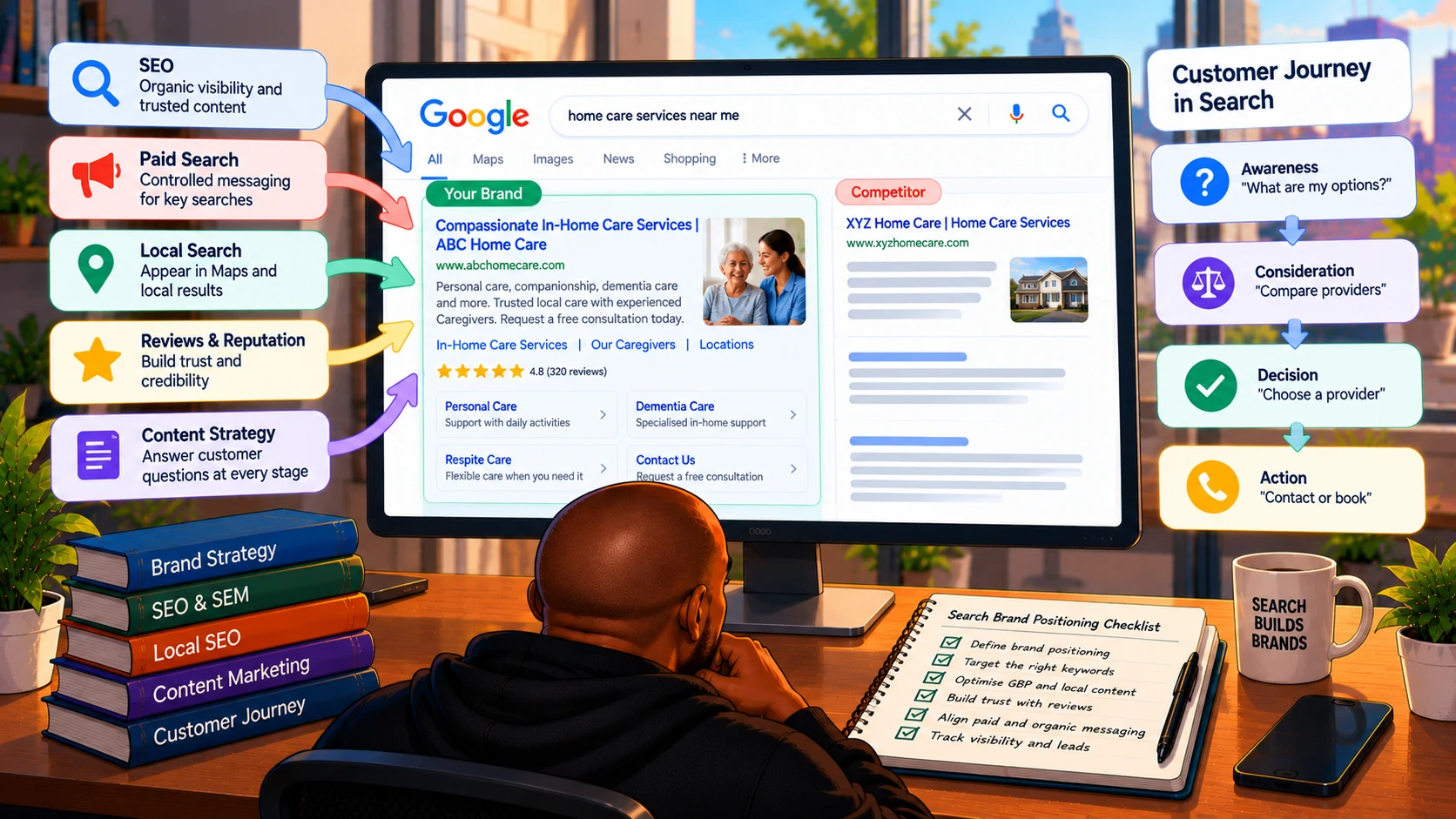
I’ve spent years working in SEO, and one thing I’ve become increasingly interested in is how search results influence the way people perceive a brand.
We spend so much time discussing rankings.
Position one.
Top three.
Page one.
More impressions.
More clicks.
But I sometimes wonder whether we’re paying enough attention to something happening before the click.
What impression does someone form about a business simply by looking at the search results?
Imagine searching for two companies offering the same service.
The first company appears with a well-written homepage, useful service pages, positive reviews, relevant articles and a clear explanation of what makes it different.
The second company has a vague homepage title, outdated information, very little supporting content and a collection of search results that don’t tell you much about the business.
You haven’t visited either website yet.
But you’ve probably already started forming an opinion.
That’s what makes brand positioning strategy using search engine marketing such an interesting topic for me.
Search isn’t just a way for people to discover websites.
It’s also one of the places where people decide what a brand represents, whether they trust it and how it compares with alternatives.
And I think we sometimes underestimate that part of our job.
What Is Brand Positioning in Search Engine Marketing?
Brand positioning using search engine marketing is the process of shaping how a business is discovered, understood and differentiated through organic and paid search results.
It involves aligning the brand’s message, target audience, content, search visibility and customer experience so that people consistently associate the business with the qualities it wants to be known for.
For example, a home care company might want people to recognise it for compassionate, dependable support.
An automotive franchise might want to communicate training, operational support and an established business model.
A specialist technology company might want to be known for its expertise in solving a particular problem.
Those are different positioning objectives.
And they should influence how each business approaches search.
The mistake, in my opinion, is treating brand positioning as something the marketing team handles separately from SEO.
Because when somebody searches for your company, your services or your competitors, the search results become part of your brand presentation.
First, SEO and SEM Aren’t Exactly the Same Thing
Before going further, I think it’s worth clarifying the terminology.
Search engine marketing, or SEM, is often used today to refer specifically to paid search advertising.
SEO focuses on earning visibility in organic search results.
But when discussing a broader search-based brand positioning strategy, I think it’s useful to consider how both organic and paid search contribute to the overall experience.
| Channel | Role in brand positioning |
|---|---|
| Organic SEO | Builds discoverability and communicates expertise through relevant content |
| Paid search | Provides controlled messaging and visibility for selected searches |
| Local search | Connects a brand with its physical locations, reputation and customer experience |
| Branded search | Influences what people see when researching the company |
| AI-powered search | Introduces another environment where brands may be described, compared or cited |
I’m primarily an SEO strategist, so most of my perspective comes from organic search.
But I don’t think you can understand a brand’s position in the market by looking at organic rankings alone.
The customer doesn’t necessarily separate all these channels in their mind.
They just see a search results page.
And they form an opinion.
1. Decide What You Want the Brand to Be Known For
This sounds obvious.
But I think it’s one of the questions that gets skipped when businesses move straight into keyword research.
What should people associate with the brand, exactly?
Affordability?
Expertise?
Convenience?
Premium service?
Local knowledge?
Reliability?
Innovation?
Customer support?
You can’t build a meaningful search strategy around every possible message.
A brand that tries to be the cheapest, most premium, most innovative and most traditional provider simultaneously can end up communicating very little.
I prefer starting with the audience and the actual business proposition.
What does the business genuinely do well?
Who is it best suited to help?
What concerns do those customers have?
What evidence supports its claims?
And what makes it meaningfully different from competitors?
Only after answering those questions would I begin mapping the brand’s positioning to search behaviour.
Because keywords should support the brand’s positioning, not determine it entirely.
2. Understand How Customers Search at Different Stages
Someone searching for a product or service isn’t necessarily ready to buy.
They may still be trying to understand their options.
Let’s use a hypothetical automotive franchise as an example.
One person searches:
Is owning an automotive franchise profitable?
Another searches:
Automotive franchise investment requirements.
Another searches:
Brand A vs Brand B automotive franchise.
And another searches directly for:
Brand A franchise application.
These searches reflect different levels of awareness and consideration.
If the brand only appears when someone searches its name, it may miss opportunities to influence people earlier in their research.
But if it only publishes broad informational content, it may attract traffic without helping qualified prospects move towards a decision.
That’s why I like mapping search intent across the customer journey.
A Simple Search Intent and Brand Positioning Example
| Search stage | Example query | Positioning opportunity |
|---|---|---|
| Problem awareness | How to choose a franchise business | Establish useful expertise |
| Category research | Automotive franchise opportunities | Communicate category relevance |
| Comparison | Automotive franchise vs independent shop | Explain genuine differentiators |
| Brand evaluation | Brand name reviews | Reinforce trust and transparency |
| Decision | Brand name franchise investment | Provide clear next steps |
The objective isn’t to create a page for every possible keyword variation.
It’s to make sure the brand provides useful information at the moments when people are forming opinions.
3. Your Homepage Is Often the First Positioning Statement People See
I find homepages fascinating.
They’re often expected to do everything.
Introduce the company.
Explain the services.
Build trust.
Communicate differentiators.
Help users navigate.
Encourage enquiries.
And somehow do all of that without overwhelming the visitor.
From an SEO perspective, the homepage is also frequently one of the most important pages for branded searches.
That’s why I pay attention to the title tag, meta description, H1, introductory copy and overall messaging.
Imagine a company whose search result says:
Welcome to Our Website | Brand Name.
What does that tell somebody?
Not much.
Now compare that with a clear title describing what the company actually offers.
The second result gives the searcher more useful information before they click.
Of course, Google may rewrite titles or generate different snippets.
But that doesn’t make clear metadata unimportant.
It means we should focus on accurate, descriptive messaging rather than trying to control every word Google displays.
I’ve written about what I look for when reviewing a homepage for SEO.
One of the things I care about is whether someone unfamiliar with the business can quickly understand what it does and why it might be relevant to them.
That’s both an SEO question and a brand positioning question.
4. Use Content to Demonstrate Your Positioning, Not Just Repeat It
There’s a big difference between saying you’re an expert and publishing information that demonstrates expertise.
A company can write:
We’re the industry leader in customer service.
But what does that actually mean?
What evidence supports the claim?
What does the business do differently?
How does that benefit customers?
I think search content becomes much more useful when it explains those things.
For example, a franchise brand that positions itself around training and support could publish detailed information about its training programme, operational resources and the experience of franchise owners.
A local service business that positions itself around transparency could explain its process, pricing considerations and what customers should expect.
A technology company that claims specialist expertise could publish practical explanations, original research or useful technical insights.
The content should help people understand the positioning rather than simply repeat marketing language.
This is one reason I care about finding original SEO content ideas.
If every competitor publishes the same generic articles, it’s difficult for any one brand to establish a distinctive identity.
Originality isn’t just useful for search.
It can help people remember who provided the information.
5. Branded Search Results Are Part of Your Reputation
Here’s an exercise I think every business should do occasionally.
Search your own brand name.
Then search:
Brand name reviews.
Brand name complaints.
Brand name pricing.
Brand name alternatives.
Brand name vs competitor.
Look at what appears.
Not just your own website.
Look at third-party reviews, business profiles, news coverage, discussion forums and competitor comparisons.
What story do those results tell?
Does the information reflect the business accurately?
Are important questions unanswered?
Are there outdated claims?
Do customer reviews reveal recurring concerns?
This isn’t about trying to suppress legitimate criticism.
It’s about understanding what people encounter when they’re researching the brand.
A good brand positioning strategy needs to account for the information a business controls and the information it doesn’t.
You can improve your website.
You can publish accurate information.
You can respond appropriately to customer feedback.
But you can’t legitimately control every independent opinion on the internet.
And I don’t think you should even try.
6. Local Search Can Reinforce or Undermine Brand Positioning
This is particularly important for multi-location businesses.
A national brand might have excellent messaging.
Its homepage looks professional.
Its marketing campaigns communicate reliability.
Its service pages explain the business clearly.
But then someone searches for a nearby location.
One branch has incorrect opening hours.
Another has outdated photographs.
Another has a collection of unanswered complaints.
Another links to a generic homepage that doesn’t explain local services.
Suddenly, the brand experience becomes inconsistent.
That’s one of the challenges I’ve discussed in what managing SEO for multi-location brands has taught me about local search.
Local SEO isn’t only about appearing in Google Maps.
It’s also about making sure the brand promise holds up at the individual location level.
A company can position itself nationally as dependable, but customers judge that dependability through their actual local experience.
And if the local experience contradicts the national message, the positioning becomes less convincing.
7. Paid Search Can Reinforce the Message, but It Can’t Fix a Weak Brand
This is where paid search becomes relevant.
Advertising can help a brand appear for selected searches, communicate specific offers and test different messaging approaches.
For example, a business might test whether prospective customers respond more strongly to messages about convenience, expertise or service availability.
That information could help inform broader marketing decisions.
But paid search has limitations.
You can pay for visibility.
You can’t pay to make a weak proposition genuinely compelling.
If the advertisement promises excellent service but the landing page is confusing, the experience falls apart.
If the brand advertises affordability but hides important costs, customers may lose trust.
If the advertisement promotes a service that isn’t available at the selected location, the campaign creates frustration.
So I’d want the advertisement, landing page and actual business offering to communicate a consistent message.
Paid search can amplify positioning. It shouldn’t invent positioning.
And because advertising involves direct spending, I’d evaluate it through qualified leads, acquisition costs and business outcomes rather than impressions alone.
8. Competitor Research Should Identify Gaps, Not Create Copies
Competitor research is essential.
But I think it’s easy to use it badly.
You look at a competitor.
They have a page about a particular topic.
So you create one.
They have a comparison article.
So you publish something similar.
They target a keyword.
So you target it too.
Eventually, every business in the industry has almost identical content.
Same headings.
Same talking points.
Same promises.
Different logos.
That’s not a strong positioning strategy.
I’d rather use competitor research to understand what the market already communicates and where a brand has something genuinely different to contribute.
Maybe competitors focus heavily on price, while the business has a particularly strong service model.
Maybe everyone publishes introductory guides, but nobody clearly explains the practical decision-making process.
Maybe competitors make broad claims without providing much supporting evidence.
Those gaps can become useful content opportunities.
But only if the brand can credibly address them.
The objective isn’t to be different for the sake of being different.
It’s to communicate a meaningful difference.
9. AI Search Is Making Brand Positioning Even More Interesting
This is where I think the conversation becomes bigger than traditional search engine marketing.
For years, we focused on getting websites to rank.
Now people can ask AI-powered search systems to explain, compare and recommend businesses.
Someone might ask:
Which type of franchise is better for someone without industry experience?
Or:
What should I look for when choosing a home care provider?
Or:
How do these two companies compare in terms of services and reputation?
The AI-generated response may summarise information from multiple sources.
That means a brand’s positioning could be influenced by how clearly and consistently its information is represented across the web.
But I want to be careful here.
We shouldn’t assume that repeating the same brand message across dozens of pages guarantees AI citations or recommendations.
It doesn’t.
I think the more useful approach is to publish accurate, original information that genuinely supports the brand’s positioning.
If a business wants to be known for specialist expertise, its content should demonstrate that expertise.
If it wants to be known for comprehensive training, it should explain what that training involves.
If it wants to be known for local knowledge, its location content should provide meaningful local information.
I’ve written about how generative AI is changing SEO and the future of SEO and AI.
My view is that AI search makes clarity, consistency and credibility more important, not less.
10. Don’t Confuse Brand Awareness With Brand Positioning
I think this distinction deserves more attention.
Brand awareness is about whether people recognise a brand.
Brand positioning is about what they associate with it.
A company might have strong brand awareness but a poor reputation.
Another might be relatively unknown but highly respected within a particular niche.
Search engine marketing can influence both.
Broad informational content might introduce people to a business.
Branded searches might show growing interest.
Comparison content might help explain the brand’s differentiators.
Reviews and independent coverage might influence trust.
But increased search visibility doesn’t automatically mean the brand is becoming better positioned.
Imagine a company receives more branded searches because of negative news coverage.
Branded search demand increases.
That doesn’t necessarily mean the brand’s reputation has improved.
This is why I wouldn’t use branded search volume alone as evidence of successful positioning.
I’d want to understand the context behind that demand.
11. How Do You Measure Brand Positioning Through Search?
This is one of the most challenging parts.
We can measure impressions, clicks, rankings and conversions.
But how do we measure what people actually think about a brand?
Search data can provide useful indicators, but it doesn’t tell the whole story.
Here’s how I’d approach it.
| Metric | What I’d investigate |
|---|---|
| Branded search impressions | Whether searches involving the brand are increasing |
| Branded query themes | What people associate with or want to know about the brand |
| Non-branded search visibility | Whether the brand appears during category research |
| Comparison searches | Whether people are evaluating the brand against alternatives |
| Organic CTR | Whether search listings attract clicks in their SERP context |
| Engagement and key events | What visitors do after discovering the website |
| Qualified leads | Whether search visibility contributes to business opportunities |
| AI mentions and citations | How the brand appears in sampled AI-generated answers |
| Customer feedback and surveys | Whether the intended positioning matches actual perceptions |
I’d be particularly interested in combining Google Search Console, GA4, customer feedback and available CRM data.
Search Console can show changes in branded and non-branded query patterns.
GA4 can help us understand what happens after someone visits.
Customer surveys can provide direct evidence of what people associate with the brand.
And CRM information can help connect marketing activity with qualified enquiries and customers.
No single metric tells the entire story.
I’ve discussed this broader measurement challenge in how to measure SEO performance.
I think brand positioning makes the need for thoughtful reporting even clearer.
Because the question isn’t simply:
Did more people find us?
It’s also:
Did they understand why they should choose us?
12. A Practical Brand Positioning Strategy Using Search Engine Marketing
If I were developing a search-focused positioning strategy, I’d approach it in five stages.
Stage 1: Understand the Brand and Its Audience
Before doing keyword research, I’d establish the intended positioning.
Who is the target audience?
What problems does the business solve?
What makes it genuinely different?
Which claims can it support?
What objections do customers have?
What should someone remember after encountering the brand?
Without that foundation, it’s easy to create a technically sound SEO strategy that communicates a very generic message.
Stage 2: Audit the Existing Search Results
Next, I’d investigate how the brand currently appears.
I’d review branded searches, service-related queries, competitor comparisons, relevant local results and important landing pages.
I’d also examine third-party reviews and other publicly available information that prospective customers might encounter.
The objective would be to identify gaps between the intended positioning and what searchers actually see.
Stage 3: Map Search Intent to the Brand Message
Then I’d group relevant keywords by customer intent.
I’d identify which pages should support early research, comparisons, service evaluation and enquiries.
I wouldn’t force the brand message into every page.
Instead, I’d make sure each page communicates the relevant differentiators naturally.
An informational article should still answer the question.
A service page should still explain the service.
A comparison page should still provide a fair comparison.
Brand positioning should strengthen useful content, not replace it with promotional language.
Stage 4: Improve the Search Experience
This is where implementation begins.
I’d review homepage messaging, important service pages, internal links, metadata, location information, supporting content and conversion pathways.
Where paid search is part of the strategy, I’d want advertising messages and landing pages aligned with the same positioning.
I’d also look for opportunities to strengthen the brand’s wider reputation through legitimate industry involvement, useful information and credible third-party coverage.
Stage 5: Measure, Learn and Refine
Finally, I’d monitor changes in search visibility, branded query behaviour, engagement, qualified enquiries and available customer feedback.
I’d want to understand whether the strategy is reaching the intended audience and whether people are responding to the message.
And I’d be prepared to change the approach if the evidence suggests the positioning isn’t resonating.
A positioning strategy shouldn’t be something written once in a presentation and never questioned again.
It needs to reflect the actual business and the market it’s operating in.
Common Mistakes I Would Avoid
The first is confusing rankings with positioning.
Ranking number one for a keyword doesn’t automatically mean people understand or trust your brand.
The second is trying to own every possible topic.
A business doesn’t need to become a publisher covering everything remotely connected to its industry.
I’d rather see focused content that reinforces a clear identity.
The third is copying competitors.
Competitor research should help identify opportunities, not eliminate everything that makes a brand different.
The fourth is making claims the business cannot support.
Search visibility can amplify a message, but it can also expose inconsistencies between marketing promises and actual customer experiences.
And finally, I’d avoid treating brand positioning as an SEO-only responsibility.
SEO can influence how people discover and understand a business.
But product quality, customer service, pricing, reputation and the actual customer experience all contribute to whether the positioning is believable.
Frequently Asked Questions
What is a brand positioning strategy in search engine marketing?
It’s a strategy for influencing how people discover, understand and differentiate a brand through search results, relevant content, paid advertising and other search experiences. The goal is to communicate a consistent, credible identity to the right audience.
Can SEO improve brand positioning?
Yes. SEO can help a business appear for relevant searches and communicate its expertise, services and differentiators. However, higher rankings alone don’t guarantee that people will develop the intended perception of the brand.
Is paid search necessary for brand positioning?
Not necessarily. Paid search can provide additional visibility and messaging control, but a business can also strengthen its positioning through organic search, useful content, reputation and consistent brand information. The appropriate channel mix depends on the audience, competition and budget.
How long does it take to build brand positioning through SEO?
There’s no universal timeline. Improving individual pages may happen relatively quickly, while building recognition and trust can take much longer. I would measure progress through multiple indicators rather than promise a specific ranking or brand-awareness result.
Does AI search change brand positioning strategies?
It introduces additional ways for people to discover and compare brands. Clear, accurate information and credible third-party references can help make a brand easier to understand, although no particular content tactic guarantees inclusion in AI-generated answers.
Final Thoughts: Search Results Are Part of Your Brand Story
When I started working in SEO, I spent a lot of time thinking about rankings, keywords and traffic.
Those things still matter.
But the longer I work in search, the more interested I become in what visibility actually means for a business.
Someone searches for a service.
They see several companies.
They read a few descriptions.
They notice reviews.
They compare options.
They ask an AI assistant a follow-up question.
And somewhere in that process, they start deciding which brands they trust.
That’s why I think a brand positioning strategy using search engine marketing should go beyond trying to rank first.
The goal should be to make sure people understand what the business offers, who it’s for and why it’s worth considering.
SEO helps create opportunities for discovery.
Paid search can reinforce the message.
Content can demonstrate expertise.
Reviews and independent coverage can influence trust.
And the actual customer experience determines whether the promise holds up.
For me, that’s where search engine marketing becomes much more interesting.
Because a ranking can get somebody’s attention.
But a clear, credible brand position gives them a reason to remember you.
