
I’ve worked in SEO long enough to see certain conversations repeat themselves.
Someone discovers a new ranking factor.
An SEO tool publishes a list of 200 things Google supposedly considers.
A website loses traffic, and suddenly everybody wants to know which ranking factor caused it.
Was it backlinks?
Page speed?
Content length?
E-E-A-T?
Internal links?
Or something Google changed in its latest algorithm update?
I understand the obsession. When your job involves improving organic visibility, you naturally want to understand what influences rankings.
But the longer I’ve worked in search, the less interested I’ve become in treating SEO ranking factors like a checklist where every item carries a fixed number of points.
I don’t think Google works that way.
And I don’t think approaching SEO that way produces the best strategies.
Google uses multiple ranking systems and signals to determine which results are most relevant and useful for a particular search. The importance of those signals can vary depending on the query, the content and the context.
That’s very different from saying every website needs exactly 2,000 words, 15 internal links and a Core Web Vitals score of 100 to rank.
So, here’s how I think about SEO ranking factors, which ones I prioritise, and which popular SEO assumptions I think deserve more scrutiny.
What Are SEO Ranking Factors?
SEO ranking factors are signals and characteristics that search engines use to evaluate and order results for a search query.
They help search engines assess things such as relevance, usefulness, reliability and the relationships between pages.
Google’s guide to Search ranking systems explains that its automated systems use many factors and signals to identify relevant results.
But there’s an important distinction.
Not everything that makes a website better is necessarily a direct ranking factor.
For example:
- A good meta description can make a search result more appealing, but Google doesn’t use the meta description tag as a direct ranking signal.
- Structured data can help Google understand eligible content and enable certain search appearances, but adding schema markup doesn’t automatically improve rankings.
- Better website design can improve usability and conversions, but an attractive design alone doesn’t guarantee higher rankings.
- Publishing more content can expand topical coverage, but the number of articles on a website isn’t a guarantee of authority.
I think this distinction matters because SEO advice often mixes confirmed ranking signals, technical requirements, best practices and speculation.
Those aren’t all the same thing.
My View: SEO Ranking Factors Aren’t All Equally Important
Imagine two websites competing for the same search.
Website A has excellent page speed, perfect heading structure and beautifully optimised images.
But the page barely answers the question.
Website B loads reasonably well, has a clear structure and provides a genuinely useful, relevant answer.
Which one should Google prefer?
I’d expect Website B to have a strong case.
That’s not a prediction about every search result. It’s an illustration of why I don’t think technical perfection can compensate for weak relevance.
Technical SEO matters.
But it should support the purpose of the page.
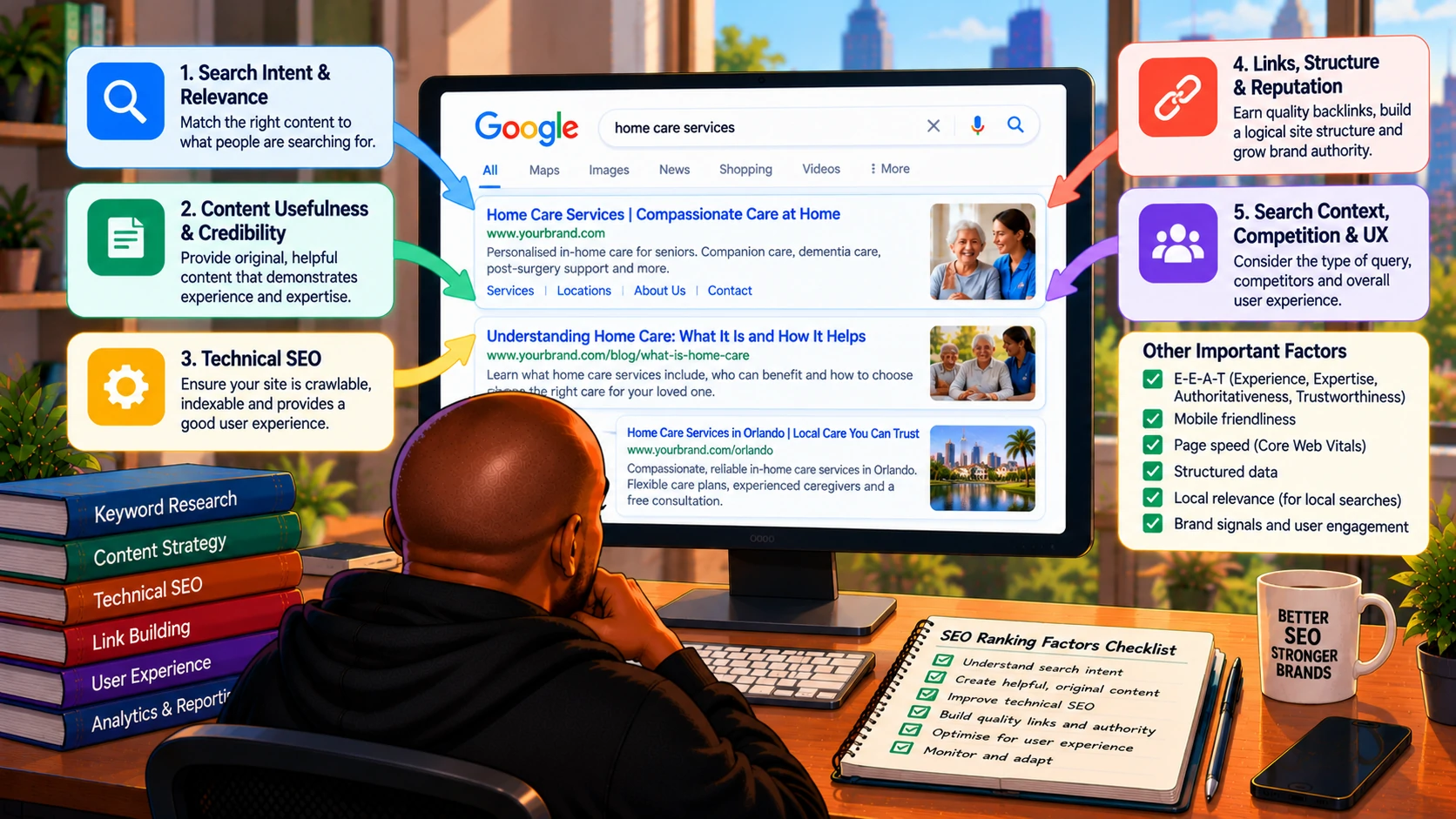
I usually think about SEO performance through five connected areas:
- Search intent and relevance.
- Content usefulness and credibility.
- Crawlability, indexing and technical accessibility.
- Links, website structure and reputation.
- Search context, competition and user experience.
These aren’t Google’s official five ranking categories.
They’re simply how I organise my thinking when I evaluate a website.
1. Search Intent and Relevance Come First
If I had to start anywhere, I’d start with search intent.
What is the person actually trying to accomplish?
Are they searching for information?
Trying to compare options?
Searching for a specific business?
Ready to buy?
Looking for something nearby?
These questions influence what type of page should appear.
Let’s use the keyword “air conditioning services” as an example.
Someone searching for what air conditioning is probably wants an explanation.
Someone searching for air conditioning services in Sandton may be looking for a local provider.
Someone searching for air conditioning costs is likely researching pricing.
Those searches are related, but the intent isn’t identical.
That’s why I don’t believe every keyword should automatically become a blog post.
Sometimes the best page is a service page.
Sometimes it’s a location page.
Sometimes it’s a detailed guide.
And sometimes the right approach is to improve an existing page rather than create another one.
Google uses systems such as BERT, neural matching and RankBrain to better understand language, concepts and the relationships between queries and content.
That means exact keyword matching isn’t the whole story.
I still use primary keywords.
I still optimise title tags, headings and page copy.
But I don’t think repeating a keyword more often is a substitute for satisfying search intent.
My priority is to make sure the right page answers the right question.
2. Helpful, Original Content Still Matters
I know “create helpful content” can sound like generic SEO advice.
But I think the concept becomes more useful when we ask what ‘helpful’ actually means.
Does the page answer the searcher’s question?
Does it provide information they can use?
Does it demonstrate genuine knowledge of the topic?
Does it explain important details that competing pages overlook?
Is the information accurate?
Does it provide original insight, or does it simply repeat what others have already published?
Those are the questions I care about.
I’ve reviewed enough websites to know that content volume and content quality aren’t the same thing.
A business can publish 100 articles and still fail to explain its core services properly.
Another might publish fewer pages but provide substantially more useful information.
Google incorporated its former helpful content system into its core ranking systems in March 2024.
So when people refer to the “Helpful Content Update” as though it’s still a completely separate ranking system, they’re using outdated terminology.
Google’s SEO Starter Guide places significant emphasis on useful, reliable, people-first content.
For me, the practical takeaway is simple.
Don’t publish something merely because a keyword tool says people search for it.
Publish it because you have something useful to contribute.
I’ve written about finding original SEO content ideas because I think originality is becoming one of the biggest challenges in content marketing.
Especially when AI can produce generic articles in seconds.
3. E-E-A-T Matters, but It Isn’t a Single Ranking Score
E-E-A-T stands for:
- Experience.
- Expertise.
- Authoritativeness.
- Trustworthiness.
It’s an important concept in Google’s guidance on evaluating content quality.
But I often see it described as though Google assigns every website an E-E-A-T score.
That’s not how Google describes it.
E-E-A-T itself isn’t a single, directly measurable ranking factor.
Google’s systems use different signals that can help identify content demonstrating qualities associated with E-E-A-T.
And trust is particularly important.
This becomes especially relevant for topics that could affect someone’s health, financial stability or safety.
If a website provides medical advice, for example, the standard of accuracy and credibility should be considerably higher than for an opinion about a football match.
But I don’t think demonstrating experience requires everybody to claim to be an industry-leading expert.
Sometimes it’s about being clear about what you actually know.
On this blog, I write about SEO from professional experience.
When I write about Python or cybersecurity, I make it clear that I’m still learning.
I don’t pretend to have expertise I haven’t developed.
I think that kind of transparency is important.
And it’s a better approach than adding an exaggerated author biography simply because someone thinks it’ll improve rankings.
4. Backlinks and Link Signals Still Have a Role
Every few years, I see another debate about whether backlinks still matter.
My view is that links remain important, but the way we talk about them needs to improve.
Google’s ranking systems documentation confirms that link analysis, including PageRank, remains part of its core ranking systems.
Links help Google understand relationships between pages and can contribute to assessments of relevance and usefulness.
But that doesn’t mean every backlink has equal value.
And it certainly doesn’t mean buying hundreds of links from unrelated websites is a sensible strategy.
I’d rather see a business earn a relevant mention from a credible industry publication than chase a large quantity of questionable links.
For example, a local company might receive coverage for a genuine community initiative.
A specialist business might publish useful research that industry publications reference.
An expert might contribute meaningful insight to a relevant discussion.
Those are legitimate ways to build recognition.
I don’t think link building should be reduced to buying authority metrics.
Third-party scores such as Domain Authority and Authority Score can be useful comparative indicators, but they aren’t Google’s own ranking scores.
That’s an important distinction.
5. Internal Linking Is One of the Most Controllable SEO Improvements
I think internal linking deserves more attention than it gets.
Especially on large websites.
I’ve worked with websites containing hundreds or thousands of URLs where important pages weren’t connected properly.
A service page might exist, but it may receive very few relevant internal links.
A useful blog article might attract organic traffic but never guide readers towards the company’s services.
A location page might be buried several levels deep in the website.
Those are missed opportunities.
Internal links help search engines discover pages and understand relationships between content.
They also help visitors navigate the website.
But I don’t believe in forcing internal links into every paragraph.
The link needs to make sense.
For example, if I’m discussing technical SEO, a link to a relevant technical SEO article may help the reader.
If I’m discussing local SEO, linking to an article about local search performance may be useful.
But adding unrelated links just to reach an arbitrary target doesn’t improve the experience.
I prefer descriptive anchor text that explains what someone can expect after clicking.
That’s a small detail, but one that matters.
6. Crawlability and Indexing Are Fundamental
Here’s something that sometimes gets lost in ranking-factor discussions.
A page can’t compete effectively in Google Search if Google can’t access or index it appropriately.
That’s why technical SEO is foundational.
Before investigating advanced ranking theories, I want to know:
Can Google crawl the page?
Is it indexable?
Does it return the correct HTTP status?
Is the canonical configuration appropriate?
Is important content available in rendered HTML?
Is the page linked internally?
Are robots.txt directives blocking anything important?
Are XML sitemaps accurate?
Does Google consider the page a duplicate of another URL?
These aren’t all direct ranking factors.
Some are requirements or controls that affect whether a page can appear in search at all.
That’s why I distinguish indexing problems from ranking problems.
If a page isn’t indexed, rewriting its meta description probably isn’t the first priority.
If Google is selecting a different canonical URL, I’d investigate duplication and canonical signals.
If an important page is orphaned, I’d review the website architecture.
Technical SEO should help us identify the actual problem before we start changing content.
7. Page Experience and Core Web Vitals Matter, but Don’t Obsess Over Perfect Scores
Page speed is one of those topics where I think SEOs can become too focused on a number.
I’ve seen discussions where the entire objective becomes achieving a perfect PageSpeed Insights score.
But a score of 100 doesn’t automatically make a page more relevant than its competitors.
Google’s Core Web Vitals measure aspects of the user experience.
The three main metrics are:
| Metric | What it measures | Good threshold |
|---|---|---|
| Largest Contentful Paint (LCP) | Loading performance | 2.5 seconds or less |
| Interaction to Next Paint (INP) | Responsiveness | 200 milliseconds or less |
| Cumulative Layout Shift (CLS) | Visual stability | 0.1 or less |
These thresholds are evaluated using real-user data at the 75th percentile where available.
Google’s ranking systems use Core Web Vitals, but good scores don’t guarantee high rankings.
For me, the objective is to provide a fast, stable, usable website.
I don’t want to sacrifice functionality or useful content just to chase a perfect lab score.
I’d also prioritise improvements based on the pages that matter most to users and the business.
A slow service page generating qualified enquiries may deserve attention before an obscure archive page.
That’s not ignoring technical SEO.
It’s making technical SEO more strategic.
8. Mobile Usability Is Essential, but Mobile-Friendliness Isn’t a Magic Ranking Boost
Most websites I work with receive significant mobile traffic.
And for local businesses, mobile can be especially important.
Someone searches for a nearby service.
They open the website.
They want a phone number, directions or a booking option.
If the page is difficult to use on a phone, the experience suffers.
Google primarily uses the mobile version of a website’s content for indexing.
That makes mobile accessibility and content consistency important.
But I wouldn’t tell someone that switching to a responsive design automatically guarantees higher rankings.
I’d focus on whether important content is available, navigation works properly, pages are readable and customers can complete relevant actions.
The objective is to remove barriers.
9. Title Tags and Headings Help Google Understand Pages
I still spend time reviewing title tags.
Not because adding a keyword to a title guarantees a top ranking.
But because titles help communicate what a page is about.
They also influence how a search result may be presented.
A vague title such as:
Welcome to Our Website
doesn’t provide much information.
A descriptive title explaining the service or topic is more useful.
The same principle applies to headings.
A clear H1 and logical heading structure help readers understand the page.
They also provide context to search engines.
But I don’t believe every page needs a rigid formula involving exactly one keyword in every H2.
And I don’t think adding more headings automatically makes a page better optimised.
Structure should serve the content.
Not the other way around.
10. Freshness Matters When the Search Requires Fresh Information
This is another ranking factor that gets misunderstood.
People sometimes assume updating the publication date on an article will improve its rankings.
But Google has systems designed to recognise when a query deserves fresh information.
For example, someone searching for the latest Google algorithm update probably wants recent information.
Someone searching for how to tie a shoelace probably doesn’t need an article published yesterday.
The appropriate level of freshness depends on the topic.
That’s why I don’t recommend updating content simply to change the date.
I’d rather review whether the information is still accurate.
Have recommendations changed?
Are examples outdated?
Are statistics still relevant?
Have new developments made parts of the article misleading?
Does the page need additional information?
A meaningful content refresh can improve usefulness.
Changing a date without improving the content doesn’t achieve the same thing.
11. Local SEO Has Its Own Ranking Considerations
For local businesses, ranking discussions become more complicated.
Google’s local results are primarily influenced by relevance, distance and prominence.
That means a business can rank strongly in one part of a city and poorly in another.
The same keyword can produce different results depending on where someone searches.
That’s why I don’t like reporting a single Google Maps position as though it represents visibility across an entire market.
When reviewing local SEO, I look at business categories, accurate location information, genuine reviews, local landing pages, website relevance and geographic ranking patterns.
I’ve written about what managing SEO for multi-location brands has taught me about local search.
One of the biggest lessons is that local rankings need to be understood geographically.
And even when visibility improves, I still want to know whether that improvement generates business value.
That’s why increasing leads from local SEO is a separate challenge from improving rankings.
12. Structured Data Can Help Search Appearance, but It Isn’t a Ranking Shortcut
I think schema markup is one of the best examples of an SEO tactic being oversold.
Structured data helps search engines understand certain types of information and can make pages eligible for supported rich results.
That’s useful.
But adding schema markup doesn’t automatically improve a page’s organic ranking.
And not every schema type produces a visible Google Search feature.
I’ve seen the industry become overly enthusiastic about markup, particularly when a new rich-result opportunity appears.
Suddenly, websites start adding structured data that doesn’t accurately represent the page.
Or implementing markup simply because a competitor has it.
That’s not how I’d approach it.
I’d use supported structured data where it’s relevant, accurate and consistent with visible page content.
Then I’d validate the implementation.
For me, schema is about helping search engines interpret information correctly.
Not manufacturing authority.
13. Brand Signals and Reputation Are More Complicated Than People Think
I often see claims that branded searches, social media followers or brand mentions are direct Google ranking factors.
I think we need to be careful with those statements.
Google has systems designed to identify reliable and useful information, and reputation can be relevant to how people evaluate a business.
But that doesn’t mean every increase in branded search volume directly boosts rankings.
Or that posting more frequently on social media automatically improves organic visibility.
A brand can receive more searches because of a successful advertising campaign.
It can also receive more searches because of negative publicity.
Those situations aren’t equivalent.
I prefer focusing on building a credible online presence, providing accurate information and earning genuine recognition.
That’s also why I think brand positioning through search engine marketing deserves attention.
Search results influence how people perceive a business, but visibility and reputation aren’t the same thing.
14. Does AI Search Change Google’s Ranking Factors?
This is one of the questions I’m watching closely.
With AI Overviews, AI Mode and other AI-powered search experiences, it’s tempting to assume that Google has introduced an entirely new set of SEO ranking factors.
But I think that conclusion is premature.
Google’s AI search features build on its existing search infrastructure while using additional techniques to identify and present useful information.
That doesn’t mean every traditional ranking factor works identically in every AI-generated response.
And it doesn’t mean appearing in the traditional top ten guarantees an AI citation.
What I wouldn’t do is abandon technical SEO, content quality or relevance to chase unverified AI optimisation tactics.
I’ve explored SEO vs GEO vs AEO because I think the industry is creating new terminology faster than we’re establishing reliable measurement methods.
My approach remains focused on making content accessible, accurate, relevant and genuinely useful.
I’ve also discussed how to appear in AI Overviews.
I think AI search changes how we evaluate visibility, but it doesn’t eliminate the importance of good SEO fundamentals.
15. What About User Behaviour Signals Like CTR and Bounce Rate?
This is another area where I think SEO discussions become too confident.
You’ll hear claims such as:
Improve your CTR and Google will increase your rankings.
Or:
Google Analytics bounce rate is a ranking factor.
I wouldn’t make either claim.
Google uses a range of systems and signals, and its public documentation doesn’t provide a simple formula connecting a website’s GA4 bounce rate or Search Console CTR to ranking improvements.
That doesn’t mean user behaviour is irrelevant to marketing.
Far from it.
CTR can help us understand whether a search result attracts clicks.
Engagement metrics can help us investigate what happens after visitors arrive.
Conversion rates can help us assess whether a page contributes to business objectives.
But those metrics need to be interpreted in context.
A low CTR might reflect a featured snippet, AI Overview, brand preference or a query that doesn’t require a click.
A high bounce rate might occur because someone quickly found the exact information they needed.
So I use behaviour metrics to understand performance.
I don’t treat them as a guaranteed way to manipulate rankings.
16. The SEO Ranking Factors I Would Prioritise First
If I inherited a website tomorrow and needed to improve organic performance, I wouldn’t begin with a list of 200 ranking factors.
I’d investigate the website and prioritise the issues with the greatest potential impact.
Here’s how I’d generally approach it.
| Priority | SEO area | What I’d investigate |
|---|---|---|
| 1 | Crawlability and indexing | Can Google access and index the important pages? |
| 2 | Search intent and relevance | Are the right pages targeting the right searches? |
| 3 | Content usefulness | Does the content answer questions accurately and thoroughly? |
| 4 | Website architecture | Can users and search engines find important pages? |
| 5 | Internal linking | Are related pages connected through useful contextual links? |
| 6 | Credibility and links | Does the website have relevant, legitimate signals of recognition? |
| 7 | Page experience | Are important pages fast, stable and usable? |
| 8 | Search appearance | Are titles, snippets and supported enhancements implemented appropriately? |
| 9 | Local relevance | Where applicable, are business profiles and location pages accurate? |
| 10 | Performance analysis | Which pages and query groups offer the greatest opportunities? |
This isn’t a universal ranking-factor order.
It’s an audit and prioritisation framework.
For one website, technical indexing problems might be the biggest obstacle.
For another, the content may simply fail to satisfy search intent.
For another, important pages may lack relevant internal links.
And for an established website that has recently lost traffic, I’d want to investigate what changed before recommending anything.
That’s where investigating SEO ranking drops becomes important.
I don’t think every decline should trigger a complete website overhaul.
Sometimes the most useful thing an SEO can do is identify what doesn’t need to change.
How I Measure Whether Ranking Improvements Are Actually Working
This is where Google Search Console becomes particularly valuable.
I don’t just want to know whether a tracked keyword moved from position eight to position five.
I want to understand what happened to the page’s overall search performance.
Did relevant impressions increase?
Did non-branded clicks improve?
Did the page begin appearing for more useful queries?
Did important keyword groups gain visibility?
Was the improvement concentrated on one page or spread across several?
And what happened after visitors arrived?
For that second part, I turn to GA4 and other business data.
Because a ranking improvement doesn’t automatically mean the business is getting more value.
I’ve written about how to measure SEO performance.
My view is that ranking data should help explain business performance, not become the entire objective.
If a page gains rankings for irrelevant informational searches but generates no meaningful engagement or enquiries, I’d question how valuable that improvement really is.
On the other hand, a smaller visibility improvement for a commercially important service might be extremely useful.
Context matters.
SEO Ranking Factors: Myths I Think We Need to Stop Repeating
Before wrapping up, here are some assumptions I regularly see in SEO discussions.
| Common claim | My perspective |
|---|---|
| Google has exactly 200 ranking factors | Google doesn’t publish a definitive, fixed list of 200 factors |
| Longer content always ranks better | Content should be as detailed as the search intent requires |
| More backlinks always mean higher rankings | Link relevance, legitimacy and context matter |
| E-E-A-T is a measurable Google score | It’s a quality framework, not a single public ranking score |
| Schema markup directly boosts rankings | It can support understanding and eligible search appearances |
| A perfect PageSpeed score guarantees rankings | Page experience matters, but relevance remains essential |
| Updating publication dates improves rankings | Meaningful freshness depends on the query and actual content |
| Social shares directly increase Google rankings | There’s no basis for treating social share counts as a direct ranking formula |
| Adding more keywords improves relevance | Natural, useful coverage matters more than repetition |
| Every Google update requires immediate changes | Investigate the impact before deciding what to do |
I think a lot of these myths survive because they offer simple answers to complicated questions.
And simple answers are attractive when rankings are unpredictable.
But they can also lead to unnecessary work.
Frequently Asked Questions About SEO Ranking Factors
What are the most important SEO ranking factors?
Google doesn’t publish a universal ranking-factor weighting. In practice, I’d prioritise search relevance, helpful content, technical accessibility, internal linking, legitimate link signals and appropriate page experience.
Is content quality a Google ranking factor?
Google’s ranking systems aim to reward relevant, useful and reliable content. However, content quality isn’t represented by one publicly available score that SEOs can optimise directly.
Are backlinks still important for SEO?
Yes. Google confirms that link analysis, including PageRank, remains part of its core ranking systems. But not every backlink is equally useful, and manipulative link-building practices can violate Google’s spam policies.
Is E-E-A-T a direct ranking factor?
No. E-E-A-T is not a single ranking factor or numerical score. Google’s systems use various signals to help identify content demonstrating qualities associated with experience, expertise, authoritativeness and trust.
Does website speed affect Google rankings?
Google uses Core Web Vitals in its ranking systems, but good scores don’t guarantee high rankings. Website speed and usability should be improved for users, not simply to chase a perfect performance score.
How many ranking factors does Google use?
Google says its ranking systems consider many factors and signals, but it doesn’t provide a definitive public count or a complete weighting formula.
Are SEO ranking factors different for local SEO?
Local search has additional considerations. Google identifies relevance, distance and prominence as the main factors influencing local results, so geographic context can make a significant difference.
Stop Treating SEO Like a Ranking Factor Checklist
After years of working in SEO, I’ve become less interested in memorising ranking-factor lists.
Not because ranking factors don’t matter.
They absolutely do.
But because I think the real skill lies in understanding which issues matter for a particular website.
A page might struggle because it doesn’t match search intent.
Another might have excellent content but poor internal linking.
Another might be blocked from indexing.
Another might face stronger competitors with more established reputations.
And another might rank perfectly well but fail to generate any meaningful business value.
Those problems require different solutions.
That’s why I think good SEO starts with investigation.
Understand the search intent.
Understand the website.
Understand the competition.
Understand what Google is actually showing.
Then identify the improvements most likely to make a difference.
I still pay attention to Google’s ranking systems.
I still follow algorithm updates.
I still use SEO tools to identify opportunities.
But I don’t believe success comes from chasing every supposed ranking factor that appears in an industry article.
For me, the objective is much simpler.
Make the website technically accessible, publish information worth finding, build genuine credibility and help the right audience accomplish what they came to do.
That won’t guarantee position one.
Nothing legitimate can.
But I think it’s a much stronger foundation than trying to reverse-engineer Google through a checklist of SEO tricks.
