
I can’t remember the last time someone told me:
“Bing it.”
We Google things.
Google became so dominant that its brand became a verb.
Need directions?
Google it.
Want to know why your child suddenly refuses to eat something they loved yesterday?
Google it.
Trying to diagnose a strange noise coming from your car even though you know you’ll eventually have to take it to a mechanic?
Google it.
I’ve worked in SEO for years, and Google has naturally occupied most of my attention. When clients talk about rankings, they’re usually talking about Google. When we analyse organic performance, Google Search Console is one of the first places we go.
But Bing has become more interesting to me.
Microsoft’s investment in AI, Copilot, its relationship with the wider Microsoft ecosystem and the changes happening across search have made me reconsider something I probably wouldn’t have spent much time debating a few years ago:
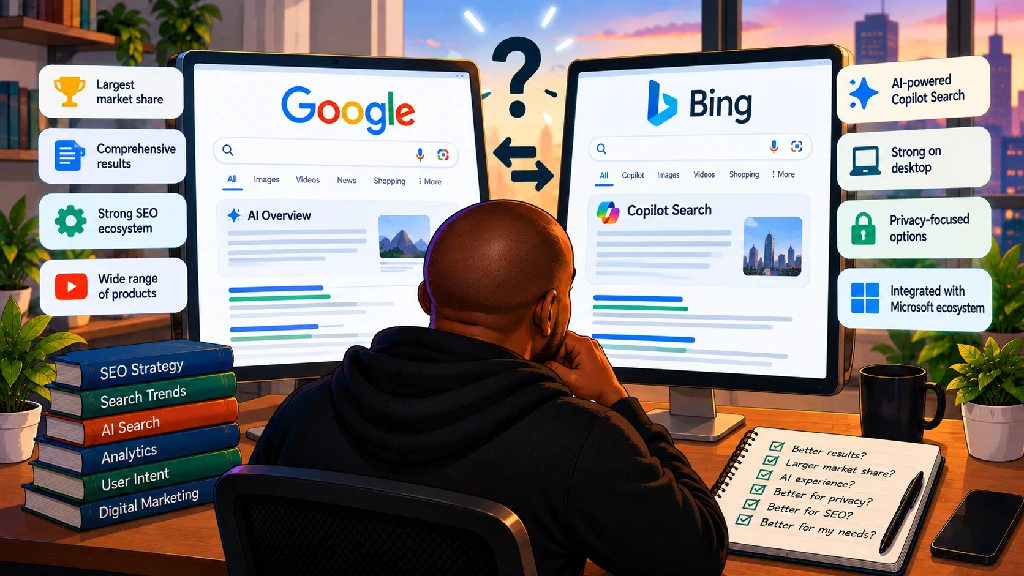
Is Bing better than Google?
My answer?
For most people, probably not overall.
But that’s only part of the story.
Because in 2026, I’m not even sure “which search engine is better?” is still the most interesting question.
Google Is Still Absolutely Dominant
Let’s begin with the most obvious point.
Google is enormous.
That’s not a close race.
It’s not even particularly useful to call it a race.
If I’m developing an SEO strategy and have limited resources, Google is naturally going to receive more attention because that’s where the overwhelming majority of traditional search activity occurs.
But something interesting happens when you look specifically at desktop search.
Still a substantial gap.
But suddenly Bing looks much harder to dismiss.
And that’s my first problem with the usual Google-versus-Bing conversation.
Smaller doesn’t mean irrelevant.
So, Is Bing Better Than Google?
It depends on what you mean by better.
If “better” means:
Which search engine has the largest index?
Which gives me the best results for every query?
Which has the best AI experience?
Which protects privacy better?
Which is better for shopping?
Which is better for images?
Which is better for SEO?
Which works better with my devices?
Those are different questions.
I don’t think there’s a useful universal answer.
For me personally, Google remains my default search engine.
Part of that is probably habit.
I’ve been using it for years. I work in SEO. I use Google Search Console, GA4, Google Business Profile, Google Maps, YouTube and plenty of other Google products.
Google is embedded in how I use the internet.
But that doesn’t automatically mean Bing is an inferior search engine.
Bing Feels Much More Relevant Than It Used To
This is probably the most significant change in my perception.
For a long time, Bing felt like the search engine you accidentally used after setting up a new Windows computer.
You’d open Microsoft Edge.
Search for Chrome.
Install Chrome.
Set Google as the default.
Sorry, Microsoft.
But Bing isn’t standing still.
That matters because the distinction between a search engine and an answer engine is becoming increasingly blurry.
Bing isn’t simply trying to recreate the Google search results page anymore.
It’s participating in the same broader transformation that’s happening across search.
And Google knows that as well.
Google Isn’t Really “Traditional Google” Anymore Either
This is why comparing Bing and Google based purely on ten blue links feels increasingly outdated.
Google Search itself has changed dramatically.
AI Overviews are now deeply integrated into Search, while AI Mode has developed into a conversational search experience capable of handling longer, more complicated and multimodal queries. Google said in August 2026 that AI Overviews had more than 2.5 billion monthly active users, while AI Mode had surpassed one billion monthly users.
So now we have:
Google Search.
Google AI Overviews.
Google AI Mode.
Bing.
Copilot Search.
ChatGPT.
Perplexity.
And other AI assistants and discovery platforms.
The question isn’t only:
Google or Bing?
It’s becoming:
Where do people go when they need an answer?
That’s a much bigger SEO question.
Where I Think Google Is Stronger
Google’s biggest advantage isn’t one individual feature.
It’s the ecosystem.
Search connects naturally with Maps, YouTube, shopping results, images, local businesses and Google’s enormous understanding of web behaviour.
Local search is particularly important to me because I work with multi-location brands.
If I search for:
coffee shop near me
I’m not necessarily looking for an article about coffee shops.
I want businesses.
Locations.
Reviews.
Opening hours.
Directions.
Photos.
Maybe menus.
Google has spent years building an ecosystem around those types of searches.
That’s one reason I’ve written about why SEO still matters in the age of AI search.
Search isn’t only about finding information.
Sometimes it’s about taking an action.
And Google is incredibly strong at connecting search with those actions.
Where Bing Has Become More Interesting
AI is the obvious answer.
But I’m also interested in Bing because of Microsoft’s broader position.
Windows.
Edge.
Copilot.
Microsoft 365.
Enterprise environments.
And increasingly AI systems that need access to fresh information from the web.
That’s where this becomes much more interesting to me as an SEO.
Bing doesn’t necessarily need to beat Google at traditional search to matter.
Microsoft’s search infrastructure can matter because AI systems need the web too.
That’s a very different conversation from market share alone.
Google vs Bing Search Results: Are They Actually Different?
Yes.
Search the same phrase on Google and Bing, and you shouldn’t expect identical results.
Both engines crawl and index the web, but they have their own ranking systems, signals, features and ways of presenting information.
That means a website might rank extremely well on Google and differently on Bing.
As an SEO, I find that useful.
If a page performs strongly in one engine but poorly in another, that’s another data point.
Maybe one engine understands the content differently.
Maybe there are crawling differences.
Maybe authority signals are being interpreted differently.
Maybe the SERP itself is different.
I wouldn’t redesign an entire SEO strategy around every ranking difference.
But I also wouldn’t assume:
“It ranks on Google, so we’re done.”
Is Bing Better for AI Search?
I don’t think I’d make that claim.
Bing deserves credit for moving aggressively into generative search.
But Google has responded very aggressively too.
So rather than declaring a winner, I’m more interested in what both companies are doing to search itself.
Both are moving away from:
Query → ten links → pick one
towards something closer to:
Question → generated response → sources → follow-up → action
That’s a fundamental shift.
It’s also why I’m paying so much attention to how to show up in AI Overviews with SEO.
The search result itself is becoming part of the answer.
Is Google Better for Local Search?
This is where I’d personally still lean heavily toward Google.
And again, my work shapes my perspective.
I spend a lot of time thinking about:
Google Business Profiles.
Local packs.
Reviews.
Location pages.
Geographic rankings.
Directions.
Local intent.
Multi-location brands.
I’ve seen how important Google’s local ecosystem can be for businesses.
A person searching for a nearby service may go from query to Google Business Profile to reviews to directions without following the traditional website journey we used to obsess over.
That’s one of the lessons I’ve learned from managing SEO for multi-location brands.
Bing has local search functionality too.
But if I were running a local business and had to prioritise one ecosystem, Google’s reach would make it very difficult for me to justify ignoring it.
That isn’t necessarily an argument that Google’s product is objectively “better”.
It’s an argument that the audience is much larger.
Those aren’t always the same thing.
Does Bing Have Better Image Search?
This is one area where I’ve often heard people say they prefer Bing.
And I understand why.
Bing has historically put a lot of emphasis on visual search, image presentation and discovery.
But this is where personal preference matters.
Someone searching for visual inspiration might prefer one interface.
Someone looking for a specific factual image might prefer another.
Someone using Google Lens and multimodal search may strongly prefer Google’s ecosystem.
There’s no SEO metric that can tell me which experience you enjoy more.
Try both.
That’s probably a better answer than pretending there’s an objective winner.
What About Privacy?
Neither Google nor Microsoft is a privacy-focused search company in the same way a product such as DuckDuckGo positions itself.
Both companies operate enormous advertising and technology businesses.
If privacy is your primary reason for leaving Google, simply moving to Bing might not address the underlying concern you’re trying to solve.
I’d evaluate the privacy settings and policies of each service based on how you use them rather than assuming:
Not Google = private.
Those aren’t equivalent statements.
Bing’s Smaller Market Share Is Actually Interesting for SEO
This is where I think businesses sometimes make a mistake.
Google has almost 90% worldwide search market share.
So naturally:
Forget Bing.
But let’s flip that around.
And on desktop, its share is much larger.
Would I spend 50% of my SEO budget optimising specifically for Bing?
Probably not without data supporting that decision.
Would I completely ignore Bing?
Also no.
This is where actual analytics should guide strategy.
Look at your traffic.
Look at your audience.
Look at conversions.
Look at devices.
Look at markets.
Look at the value of those visitors.
Five per cent of search volume isn’t automatically five per cent of business value.
That’s the distinction that matters.
Bing Webmaster Tools Deserves More Attention
Most SEOs live inside Google Search Console.
I do too.
But Microsoft also provides Bing Webmaster Tools.
It can help site owners understand how Bing crawls and sees their websites, inspect URLs, monitor search performance and identify SEO issues.
If you’re already doing SEO, connecting another first-party search dataset isn’t exactly a terrible idea.
This is something I think our industry sometimes does badly.
We say:
SEO means search engine optimisation.
Then behave as if the acronym stands for:
Google optimisation.
To be fair, Google’s market share explains why.
But as search fragments across AI platforms and different discovery environments, I think that mindset needs to expand.
Should You Optimise Differently for Bing?
I wouldn’t build a completely separate website for Bing.
Most of the fundamentals I care about remain useful:
Make the website crawlable.
Publish genuinely useful content.
Use clear titles and headings.
Build sensible site architecture.
Use descriptive internal links.
Keep important information accurate.
Earn genuine authority.
Use structured data appropriately.
Provide a good user experience.
Make important entities understandable.
That’s also increasingly how I’m thinking about SEO, GEO and AEO.
We can create endless acronyms and platform-specific checklists.
But eventually we’re trying to accomplish something fairly consistent:
Make our information easy to discover, understand and trust.
The Bigger Question: Does “Best Search Engine” Still Matter?
This is where I think the Google-versus-Bing debate becomes really interesting.
My daughter may grow up searching differently from me.
Maybe she Googles something.
Maybe she asks an AI assistant.
Maybe she takes a picture.
Maybe she talks to her phone.
Maybe she searches TikTok.
Maybe she asks a device to compare five products and buy the best one.
Maybe an AI agent performs the search without her ever seeing a traditional search results page.
We’re already moving in that direction.
Microsoft is building search infrastructure specifically for AI systems and agents.
That’s fascinating.
For most of my SEO career, the question was:
How do we get the website to rank higher?
Now I’m increasingly asking:
How do we make sure the brand is discoverable wherever the search happens?
That’s a much larger problem.
As an SEO, I’m Trying to Become Less Google-Dependent
I don’t mean I’m abandoning Google.
That would make very little sense when Google still controls nearly 90% of worldwide traditional search activity.
What I’m trying to abandon is the idea that Google rankings are the entire definition of search visibility.
I’ve already written about how generative AI is changing the way I approach SEO.
This is part of that change.
I’m interested in:
Google.
Bing.
AI Overviews.
AI Mode.
ChatGPT.
Copilot.
Perplexity.
Local search.
YouTube.
Reddit.
Brand mentions.
Citations.
Reviews.
And wherever else people go when they’re trying to discover something.
I don’t need every platform to be equally important.
I need to understand which ones matter to the audience I’m trying to reach.
So, Is Bing Better Than Google?
For me, Google is still the more useful default search engine overall.
Its scale is unmatched. Its local search ecosystem matters enormously. It’s deeply integrated into the way I work, and the sheer number of people using it makes Google impossible to treat as anything apart from the primary traditional search engine.
But Bing is better than the punchline it sometimes becomes.
Its desktop presence is meaningful.
Its integration with Microsoft’s ecosystem matters.
Copilot has made Bing’s role in AI-powered search much more interesting.
And Microsoft’s investment in web infrastructure for AI means I think Bing’s importance should be measured by more than the number of people manually visiting Bing.com.
That’s what changed my perspective.
A few years ago, I might have looked at Bing’s market share and stopped thinking about it.
Today, I’m asking a different question.
Not:
Can Bing beat Google?
But:
Does Bing need to beat Google to matter?
I don’t think it does.
And as an SEO, that’s probably the part worth paying attention to.
Because the future of search may not belong to one search box anyway.
