
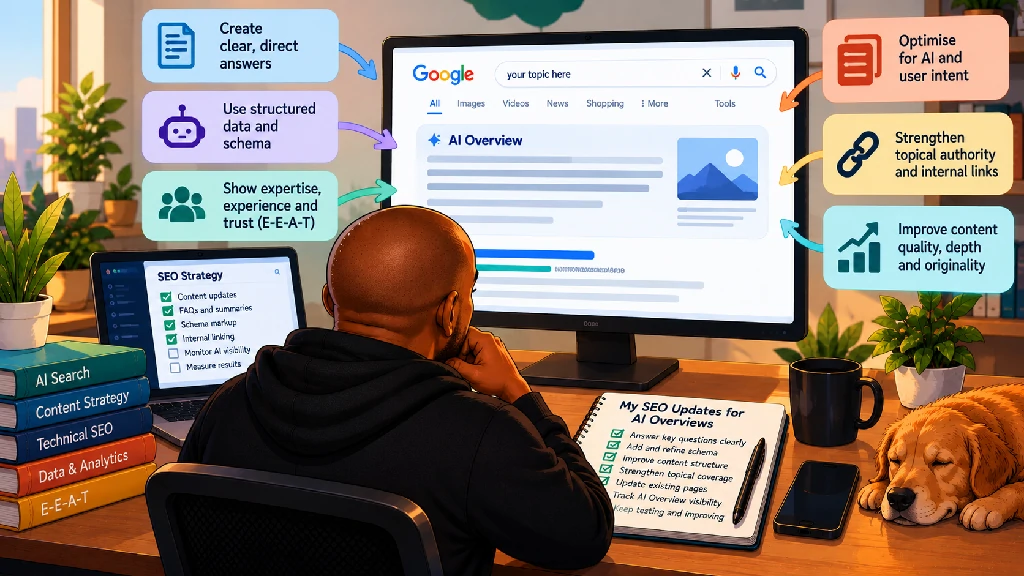
A few years ago, if somebody asked me how to get more visibility from Google, the conversation would have been fairly predictable.
Keyword research.
Content.
Technical SEO.
Internal links.
Backlinks.
Improve rankings.
Get the click.
Those things haven’t suddenly stopped mattering.
But the search result we’re trying to appear in has changed.
Google’s AI Overviews can now answer a question directly at the top of the search results while linking to websites that support or expand on that answer. Google has continued developing the experience, including adding more inline links and ways for users to discover original sources.
That creates a new question for SEOs:
How do you show up in AI Overviews?
I’ve been thinking about this a lot because AI search is increasingly part of the SEO strategies I work on.
And the more I look at it, the less I think the answer is:
“We need to optimise for AI Overviews.”
I think the better question is:
How do we become one of the sources Google considers useful enough to include when constructing an answer?
That’s a much more interesting SEO problem.
First, There Is No Secret “AI Overview SEO”
Let’s get this out of the way.
There isn’t a special piece of schema you can add that says:
Please cite this website in AI Overviews.
There’s no ai-overview="true" tag.
There’s no magic word count.
And creating an /llms.txt file doesn’t automatically make Google select your content.
Google’s own guidance on generative AI search continues to emphasise existing SEO fundamentals rather than a completely separate optimisation system. Its Search documentation specifically says SEO best practices remain relevant to visibility within generative AI features.
I find that reassuring.
I’ve already written about SEO vs GEO vs AEO and what I think actually matters.
My view hasn’t changed much.
The labels are useful for describing how search is evolving.
But I don’t think we should respond by creating three completely separate strategies.
Good SEO is increasingly about making information easy for people, search engines and AI systems to find, understand and trust.
What Does “Showing Up” in an AI Overview Actually Mean?
This distinction matters.
You’re not necessarily trying to make your entire page become the AI Overview.
Google generates the overview.
What we’re interested in as SEOs is whether our website appears as a supporting source or link within that experience.
That changes how I think about optimisation.
Traditional SEO often encourages us to think:
Can this page rank for this keyword?
AI search makes me add another question:
Does this page contain information worth using as part of the answer?
Those aren’t the same thing.
Start With the Question, Not Just the Keyword
This is probably one of the biggest adjustments I’m making.
Let’s say the keyword is:
local SEO
That’s useful.
But what does somebody actually want to know?
They could be asking:
What is local SEO?
How long does local SEO take?
Does local SEO work for franchises?
How do reviews affect local rankings?
How should a multi-location business structure location pages?
What’s the difference between organic and local rankings?
Why does my business rank in one part of a city but not another?
How is AI changing local search?
A traditional keyword list can flatten all of that into search volumes.
AI search makes the questions much more interesting.
Google says its generative search experiences can use query fan-out, where the system issues multiple related searches across subtopics and data sources to develop a response. blog.google
That’s important.
A page doesn’t necessarily need to match one exact phrase repeatedly.
It needs to contribute useful information to the broader subject.
That’s why I’m thinking more in terms of:
Topic → questions → subquestions → evidence → answers
rather than:
Primary keyword → secondary keywords → 1,500 words
Give the Answer Clearly
SEO content has developed a bad habit.
Ask:
How long does SEO take?
And you’ll sometimes get:
In today’s rapidly evolving digital landscape, businesses of all sizes are increasingly recognising the importance of establishing a strong online presence…
Mate.
I asked how long SEO takes.
Answer the question.
If the answer is:
SEO commonly takes several months to produce meaningful results, but the timeline depends on competition, website condition, authority and the type of SEO work being done.
Say that.
Then explain it.
I’ve become much more deliberate about putting clear answers near relevant headings.
It’s not because I believe there’s some magical “AI paragraph length.”
There isn’t.
I do it because clear information is useful to humans and easier for machines to interpret.
That’s just good communication.
But Don’t Turn Your Website Into a Collection of Definitions
There’s a danger here.
Once SEOs hear that AI systems like clear answers, we’re going to end up with millions of pages that look like this:
What is X?
X is…
Why is X important?
X is important because…
What are the benefits of X?
The benefits of X are…
How does X work?
X works by…
Technically clear.
Painfully boring.
And increasingly easy for AI itself to create.
Google’s current people-first content guidance specifically warns against primarily summarising what others have already said without adding substantial value.
That’s where I think the next part becomes much more important.
Give Google Something Worth Citing
This might be the biggest opportunity in AI search.
Ask yourself:
What information on this page could only realistically have come from us?
Maybe it’s:
Original research.
First-party data.
A customer survey.
A case study.
An experiment.
A proprietary methodology.
An expert opinion.
A useful comparison.
Real-world experience.
A dataset.
A quote from someone directly involved.
A statistic your organisation generated.
A process you’ve actually tested.
A strong point of view.
I’ve been trying to apply that principle to this website too.
There are thousands of articles explaining what SEO is.
I don’t need to create article number 100,001.
But I can write about what managing SEO for multi-location brands has taught me about local search.
That’s based on something I’ve actually done.
I can write about moving from SEO Specialist to SEO Manager.
I’ve experienced that transition.
I can document what I’m learning about Python and cybersecurity while being transparent that I’m still learning.
AI makes generic information incredibly cheap.
Experience isn’t cheap.
That should tell us something about where content strategy needs to go.
Show Who Is Behind the Content
This has become more important to me too.
Who wrote this?
Why should I listen to them?
What experience do they have?
Can I verify that they’re a real person?
What else have they written?
What organisation are they connected with?
This isn’t about adding:
“Written by John Smith, World-Leading Expert”
under every article and thinking you’ve solved E-E-A-T.
It’s about building genuine context around the author and organisation.
For my own site, that means connecting articles to my author information, About page, career background and the topics I consistently write about.
It also means knowing my limits.
If I’m writing about SEO, I can speak from professional experience.
If I’m writing about learning cybersecurity, I shouldn’t suddenly pretend I’ve spent ten years running a SOC.
I’ve been very deliberate about that in posts such as What a SOC Analyst Does and my broader cybersecurity learning series.
Credibility sometimes means saying:
I don’t have first-hand professional experience with this part yet.
That’s better than manufacturing expertise.
Build Topical Depth Without Publishing for the Sake of Publishing
This is where topic clusters still make sense to me.
Not because I think publishing 50 articles containing “SEO” automatically makes Google consider me an SEO authority.
But because genuine expertise naturally produces depth.
Look at the subjects I’ve been writing about:
SEO and AI.
AI Overviews.
GEO and AEO.
SEO reporting.
Local SEO.
Multi-location SEO.
Technical SEO.
Career progression in SEO.
Python for SEO.
Automation.
Those subjects connect.
One article can answer a broad question.
Another can explore one part deeply.
Another can provide first-hand experience.
Another can present an experiment.
Internal links connect those ideas.
That’s a much healthier approach than looking at a keyword tool and saying:
We need 87 articles because our competitor has 93.
That’s a good standard regardless of AI Overviews.
Make Important Information Easy to Extract
I don’t mean writing for robots.
I mean structuring information properly.
Use descriptive headings.
Keep related information together.
Use tables when a table genuinely makes comparison easier.
Use lists when you’re actually listing things.
Define technical terms.
Keep facts consistent across pages.
Don’t hide your most important answer underneath twelve paragraphs of introduction.
Use descriptive internal anchor text.
Make important pages discoverable through normal navigation.
This helps people skim.
It helps traditional search engines understand pages.
And it gives AI systems clearer information to work with.
I’ve become much more interested in what I call machine-readable clarity.
Not “writing like a machine.”
Almost the opposite.
Write clearly enough that neither the person nor the machine has to guess what you mean.
Technical SEO Still Matters
This part isn’t particularly exciting, but it matters.
AI hasn’t made crawling and indexing disappear.
If Google can’t access your page properly, your brilliant AI optimisation strategy has a fairly obvious problem.
I still care about:
Crawlability.
Indexability.
Canonicalisation.
Internal links.
HTTP status codes.
JavaScript rendering.
Site architecture.
Mobile experience.
Page performance.
Structured data where appropriate.
XML sitemaps.
But I wouldn’t add every schema type I can find simply because we’re chasing AI visibility.
Structured data should accurately describe what’s actually on the page.
Technical SEO creates accessibility and understanding.
It doesn’t manufacture authority.
Internal Linking May Become Even More Valuable
I’ve always liked internal linking because it’s one of the SEO improvements we have considerable control over.
AI search gives me another reason to care about it.
Imagine I have a broad article about AI and SEO.
Within it, I naturally link to deeper articles about:
AI Overviews.
GEO.
SEO reporting.
Local search.
Content strategy.
Entity optimisation.
Google updates.
Those links create relationships between ideas.
They also help users continue exploring the topic.
I don’t need to cram every possible answer into one enormous article.
I can build a connected knowledge base.
That’s closer to how I want this site to develop.
Your Brand Needs to Exist Beyond Your Website
This idea is something I’ve become increasingly convinced about.
For years, SEO could become extremely website-centric.
Our page.
Our keywords.
Our links.
Our rankings.
But brands exist across the web.
Google Business Profiles.
Social platforms.
Industry publications.
YouTube.
Podcasts.
Reviews.
Directories.
News coverage.
Forums.
Third-party websites.
Other people talking about you.
If your website says you’re the leading expert in something, but nobody else on the internet appears to know you exist, that’s not particularly convincing.
This doesn’t mean creating 100 empty social profiles.
It means developing a genuine footprint.
I’ve written before that one of the ways AI search is changing my SEO strategy is making me think more about brands rather than websites.
I think this becomes increasingly important as discovery fragments across different search and AI environments.
Keep Your Facts Consistent
This point sounds obvious until you work with a large website.
One page says:
Founded in 1998.
Another says 1999.
Google Business Profile has a different phone number.
LinkedIn describes the company differently.
One franchise page says 300 locations.
Another says 350.
An old press release says 275.
Now imagine an AI system trying to answer:
How many locations does this company have?
Which source should it trust?
This experience is one reason I’ve become interested in structured first-party reference pages such as the /ai-info/ page I recently created for my own site.
I don’t believe that creating a page/ai-info/ magically gets a website into AI Overviews.
It doesn’t.
But maintaining a clear first-party source with accurate, current information about an organisation or person makes sense to me as part of broader entity management.
The important part isn’t the URL.
The important part is having consistent, verifiable information.
Don’t Ignore Images and Video
This is another area I think SEOs sometimes underestimate.
Search is becoming increasingly multimodal.
If a subject benefits from:
Original photographs.
Diagrams.
Charts.
Product imagery.
Demonstrations.
Videos.
Maps.
Before-and-after examples.
Use them.
Again, not because adding four images gives you an “AI Overview ranking boost”.
Because occasionally an image explains something better than 500 words.
And increasingly, search can understand and surface that information.
Local SEO Has Its Own AI Overview Opportunity
This is particularly interesting to me because I work with multi-location brands.
Imagine someone asks:
What’s the best type of home care for an elderly parent who needs help a few hours a day?
Or:
Which tyre services do I need before a long road trip?
Or:
What should I look for when choosing a preschool near me?
These aren’t necessarily simple:
service + city
keywords.
They’re conversational problems with local intent.
AI search can combine explanatory information with businesses, places and other sources.
That means local SEO can’t only be:
Location page.
City keyword.
GBP.
Done.
We need rich service information.
Accurate location information.
Reviews.
Strong first-party content.
Clear business entities.
Real-world reputation.
Local relevance.
And consistent information across the ecosystem.
That’s one reason AI search hasn’t made local SEO less important to me.
I think it makes good local entity optimisation even more important.
Google Now Lets People Choose Preferred Sources
This is a development I’m paying attention to.
Google’s Preferred Sources feature allows users to select publications and websites they want to see more from.
In 2026, Google expanded Preferred Sources into AI Overviews and AI Mode. If someone selects a website as a preferred source, the system highlights its content with a “preferred” label within those experiences.
That’s interesting because it introduces another dimension to AI visibility:
Audience loyalty.
SEO has traditionally spent enormous amounts of energy acquiring the first click.
Maybe we need to spend more energy giving people a reason to remember where that click came from.
If someone reads your content and thinks:
That was useful. I want more from this person/site.
that’s becoming valuable in ways that extend beyond a single ranking.
Stop Measuring Only Rankings
This is probably the hardest organisational change.
A client asks:
Are we showing up in AI Overviews?
Okay.
How do we report that?
Traditional SEO gives us comfortable numbers:
Position 3.
2,500 clicks.
120,000 impressions.
CTR 4.2%.
AI visibility isn’t always that clean.
But even with better reporting, we shouldn’t reduce AI visibility to one new dashboard number.
I’m interested in:
AI citations.
Brand mentions.
Source inclusion.
Queries triggering AI experiences.
Landing pages receiving AI-related visibility.
Branded search demand.
Traditional organic performance.
Conversions.
Assisted journeys.
LLM referral traffic.
And whether our brand increasingly appears when people ask questions relevant to what we actually do.
That’s why I’ve been reconsidering how I report SEO success as AI changes the SERP.
Can You Guarantee You’ll Appear in AI Overviews?
No.
And I think SEOs need to be comfortable saying that.
We couldn’t guarantee position one before AI Overviews either.
We can improve eligibility.
We can improve relevance.
We can strengthen authority.
We can make information clearer.
We can create original resources.
We can improve technical accessibility.
We can build stronger brands.
We can monitor what gets cited and learn from it.
But Google ultimately decides whether an AI Overview appears for a query and which sources support it.
Anyone selling:
Guaranteed AI Overview rankings
would immediately make me cautious.
How I’m Approaching AI Overview SEO
After everything I’ve been learning and testing, my approach is becoming fairly simple.
I’m not trying to “hack” AI Overviews.
I’m trying to build websites that deserve to become sources.
That means:
Understand the questions behind the search.
Answer them clearly.
Go deeper where depth is useful.
Provide information competitors can’t simply rewrite.
Use actual experience.
Create original research when possible.
Build topical depth.
Keep facts consistent.
Strengthen author and brand entities.
Make pages technically accessible.
Connect related information through internal links.
Build a genuine presence beyond the website.
Use images, data and video where they improve the answer.
Measure visibility beyond traditional rankings.
And keep testing because this entire environment is still changing.
That’s not particularly revolutionary.
And I think that’s the point.
Maybe AI Overview SEO Is Just Forcing Us to Do Better SEO
Every major change in search seems to create a new optimisation industry.
Voice search SEO.
Featured snippet SEO.
Zero-click SEO.
AEO.
GEO.
AI SEO.
Some of those concepts are genuinely useful.
I’ve adopted plenty of them myself.
But I keep coming back to the same foundations.
Create something useful.
Make it accessible.
Make it understandable.
Demonstrate why it should be trusted.
Give people something they couldn’t get from a hundred interchangeable articles.
Build a brand worth remembering.
Google’s current guidance for people-first content still asks a wonderfully simple question:
Will someone leave your content feeling they’ve learnt enough to achieve their goal?
I think that’s an excellent question for optimising the AI Overview too.
Because if my only goal is getting a paragraph cited by Google’s AI, I’ll probably end up producing content for a machine.
I’d rather create something useful enough that the machine and the person searching both see a reason for it to exist.
That’s how I’m approaching how to show up in AI Overviews with SEO.
Not:
How do I trick Google into citing me?
But:
How do I become one of the best sources Google could choose?
That feels like a much better long-term strategy.
