
One thing I’ve learned from working with local and multi-location businesses is that Google Maps rankings can be frustrating.
A business might rank in the top three when someone searches from one neighbourhood, disappear from the local pack a few kilometres away, and perform completely differently in another part of the same city.
Same business.
Same services.
Same Google Business Profile.
Different results.
I’ve seen this when reviewing local ranking grids, and it’s one of the reasons I don’t like reporting a single local keyword position as though it tells the whole story.
So when someone asks me how to improve Google My Business ranking, I don’t immediately recommend adding more keywords to the business description or publishing Google Business Profile posts every week.
I start by understanding why the business deserves to appear for that particular search, in that particular location, and against those particular competitors.
Google My Business is now called Google Business Profile (GBP), but plenty of people still search for its old name. I’ll use both terms in this article.
The good news is that improving local visibility doesn’t require discovering some secret Google Maps trick.
The less exciting news is that there isn’t one setting you can change to guarantee a top-three ranking.
Here’s how I approach it.
How Do You Improve Your Google My Business Ranking?
To improve your Google My Business ranking, make sure your Google Business Profile is accurate and complete, select the most relevant business categories, maintain genuine reviews, provide useful service and location information, and strengthen your website’s local relevance and reputation.
But that’s only part of the answer.
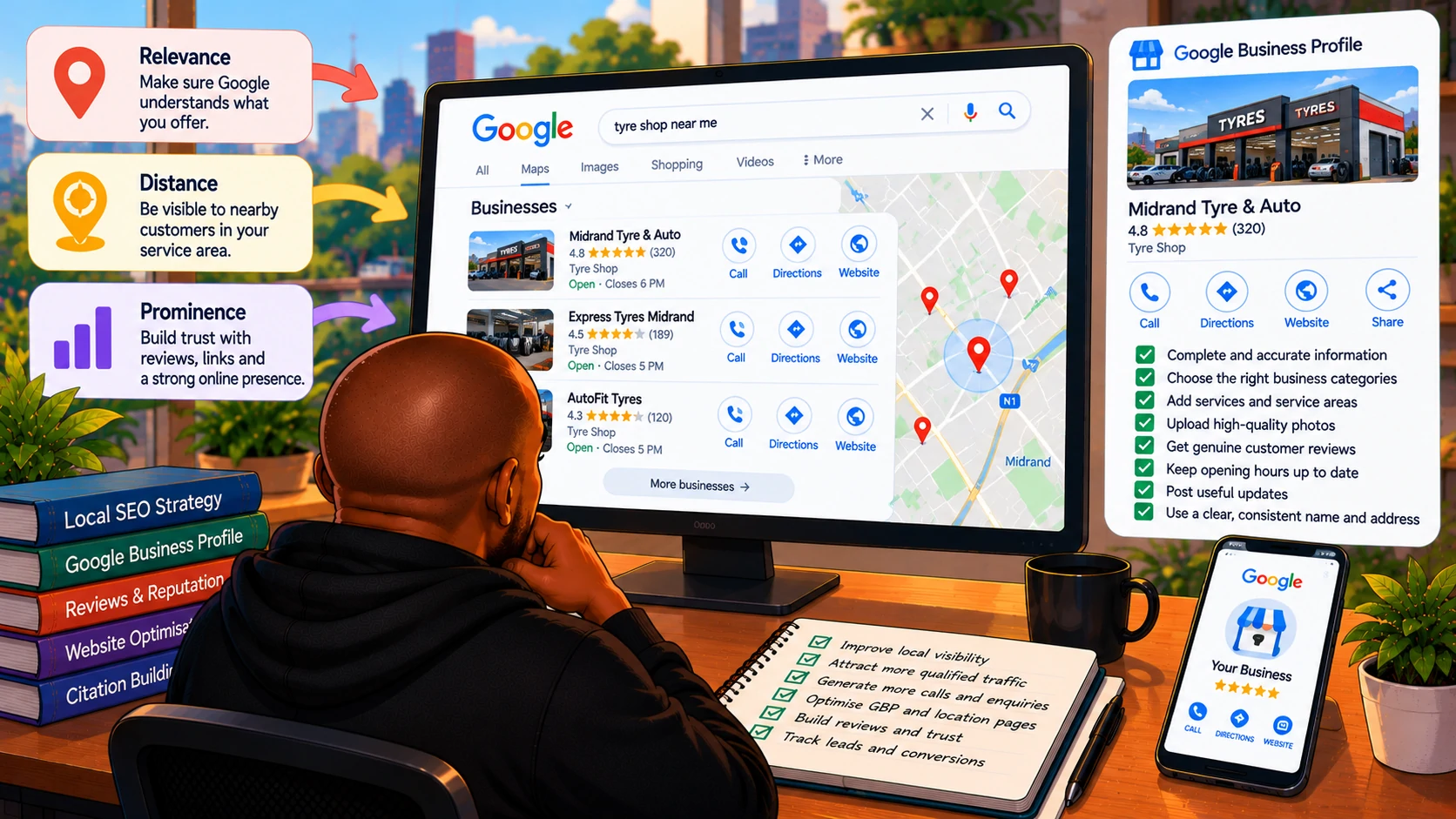
Google’s local results are primarily influenced by three factors:
- Relevance: How closely your business matches what someone is searching for.
- Distance: How far your business is from the location associated with the search.
- Prominence: How well-known or established the business appears to be, including signals such as reviews, links and other information Google can find.
Those are Google’s own broad explanations of local ranking.
And understanding them makes it much easier to distinguish useful local SEO work from the endless collection of supposed Google Maps ranking hacks.
1. Start With the Three Local Ranking Factors
I think this is the most important part of local SEO.
You can optimise a Google Business Profile extensively, but that doesn’t mean Google will show the business everywhere.
Imagine you own a tyre shop in Midrand.
Someone searches for “tyre shop near me” while standing a few streets away.
Your business might be a strong result.
Now imagine someone searches for the same thing from Sandton.
There may be several equally relevant tyre shops that are much closer to them.
You cannot optimise away that geographic reality.
Relevance: Does Google Understand What You Actually Offer?
Relevance is about how closely your business matches the search.
If someone searches for emergency plumbing services, Google needs to understand whether your business provides that service.
That makes accurate business categories, services, website content and other business information important.
Distance: Are You Actually Near the Searcher?
Distance matters, particularly for searches with strong local intent.
You can improve how accurately Google understands your location and service area.
You cannot legitimately make a business physically closer to every potential customer.
That’s why I’m cautious when someone promises that they can make a local business rank number one across an entire city.
Prominence: Is Your Business Established and Recognised?
Prominence concerns how well-known a business is.
Google says factors such as links and reviews can contribute to this assessment.
This is where your broader online reputation matters.
A well-maintained profile is useful.
But local SEO doesn’t exist independently of the rest of your online presence.
Google explains these principles in its official guidance on improving local rankings.
2. Choose the Right Primary Google Business Profile Category
If I were reviewing a poorly performing Google Business Profile, categories would be one of the first things I’d investigate.
Why?
Because categories help explain what the business actually is.
A tyre shop shouldn’t choose a category simply because it contains a popular keyword.
A home care agency shouldn’t select an unrelated healthcare category because a competitor appears to rank well with it.
The category should accurately describe the business.
I also distinguish between primary and additional categories.
The primary category should represent the business’s main activity.
Additional categories can describe other genuine aspects of the business, where appropriate.
But I wouldn’t add every remotely related category just to increase the number of searches the business might appear for.
Google’s category guidance is clear that categories should describe what the business is, rather than every product or service it offers.
My approach: Review the actual services, Google’s available categories and the competitive search results. Then choose the most accurate configuration.
I don’t treat competitor categories as instructions to copy blindly.
3. Complete Your Profile, but Don’t Confuse Completeness With a Ranking Guarantee
This sounds simple, but I’ve reviewed enough local listings to know that basic information isn’t always maintained properly.
Incorrect opening hours.
Outdated website links.
Missing services.
Old phone numbers.
Poor-quality photographs.
Business descriptions that no longer reflect the company.
Sometimes the most useful improvements aren’t complicated.
They’re corrections.
I want a profile that clearly communicates what the business does, where it operates and how customers can contact it.
That includes accurate business details, appropriate categories, genuine photographs, useful service information and up-to-date hours.
For businesses with multiple locations, this becomes even more important.
An incorrect phone number on one profile is a problem.
The same mistake repeated across 150 locations becomes a serious operational issue.
I’ve discussed some of these challenges in what managing SEO for multi-location brands has taught me about local search.
One thing I’d emphasise is that profile completeness is a foundation, not a guarantee of higher rankings.
4. Stop Stuffing Keywords Into Your Business Name
This is one of those local SEO practices that refuses to disappear.
A business is officially called something like:
Midrand Plumbing Services.
But its Google Business Profile suddenly becomes:
Midrand Plumbing Services | Best Emergency Plumber | Blocked Drains | Geyser Repairs Johannesburg.
Why?
Because someone believes adding more keywords to the name will improve rankings.
And in some cases, keyword-stuffed business names appear to perform well.
That’s part of what makes the practice frustrating.
But Google’s rules require business names to reflect the real-world name used consistently in branding and other business materials.
Adding unnecessary keywords or location terms can violate those guidelines.
I wouldn’t recommend risking a legitimate business profile for a short-term advantage.
If the business genuinely has a descriptive name, that’s one thing.
Manufacturing a keyword-heavy name for Google Maps is another.
The right approach is to represent the business accurately.
5. Build a Review Strategy Around Real Customer Experiences
Reviews are one of the most interesting parts of local SEO because they influence more than visibility.
They influence decisions.
Someone might see three businesses in the local pack.
One has a strong collection of recent, detailed reviews.
Another has very few.
The third has repeated complaints about communication and service quality.
Which one is the customer likely to investigate further?
Reviews can contribute to Google’s assessment of local prominence, but they’re also a trust signal for real people.
That’s why I prefer a review strategy built around consistently asking genuine customers for feedback.
Not only when someone is obviously delighted.
Not only when the business expects five stars.
And definitely not by purchasing reviews.
What I Look for When Reviewing Google Reviews
I don’t focus exclusively on average rating.
I also look at review volume, recency, recurring themes, responses and whether the feedback reflects the actual customer experience.
For a home care provider, customers might repeatedly mention caregiver reliability, communication or compassion.
For a tyre shop, they might mention waiting times, pricing transparency or service quality.
That information can help the business understand what matters to customers.
But we need to be careful about treating individual review keywords as a guaranteed ranking technique.
I wouldn’t encourage businesses to script reviews around target keywords.
I’d rather they receive authentic feedback.
The goal is to earn trust, not manufacture ranking signals.
6. Respond to Reviews Without Turning Every Reply Into an SEO Exercise
I’ve seen businesses respond to reviews with paragraphs that sound suspiciously like keyword-optimised landing pages.
A customer says:
“Great service. Very helpful team.”
And the business replies:
“Thank you for choosing our affordable emergency plumbing services in Johannesburg, Gauteng, for blocked drains, geyser repairs and residential plumbing solutions.”
Nobody talks like that.
A review response should sound like a human being acknowledging another human being.
Thank the customer.
Address their feedback.
Respond professionally to concerns.
Avoid exposing personal information.
And where a complaint requires investigation, move the detailed discussion to an appropriate private channel.
Google Business Profile isn’t the place to publish a 200-word keyword strategy disguised as customer service.
7. Your Website Still Matters for Google Maps Rankings
This is one of the biggest misconceptions I encounter.
People think local SEO happens entirely inside Google Business Profile.
It doesn’t.
Your website helps explain your business, services, locations and expertise.
Google also considers information about businesses from across the web.
That’s why I look at the relationship between the Google Business Profile and the website it links to.
Does the landing page clearly describe the business?
Does it explain the relevant services?
Is the location information accurate?
Can customers find contact details?
Is the page accessible to search engines?
Does it provide useful information beyond repeating a city name?
A profile linked to a weak, confusing or irrelevant website may be missing an important opportunity.
This is especially true for businesses with multiple branches.
8. Build Location Pages That Actually Help Local Customers
I’ve spent a lot of time working with multi-location websites, and location pages are one of the areas where I see both enormous opportunity and enormous amounts of unnecessary duplication.
Imagine a business with 100 locations.
It creates 100 pages.
Every page says almost exactly the same thing.
The city name changes.
The phone number changes.
Maybe the address changes.
But the rest of the content is identical.
Now ask yourself:
Does this page genuinely help someone understand that particular location?
A useful location page should answer practical questions.
Where is the business?
Which services are available there?
How can someone contact the team?
Which surrounding areas does it serve?
Are there any genuine location-specific details?
Can customers find directions or request an appointment?
Where relevant, original photographs, staff information and locally relevant FAQs can make the page more useful.
I don’t believe every location page needs to be dramatically different for the sake of uniqueness.
Some shared information is perfectly reasonable.
But there should be enough genuine local value to justify the page.
9. Add Services That Accurately Describe What You Offer
Google Business Profile allows eligible businesses to manage service information.
I consider this useful because it helps explain what the business provides.
But again, accuracy matters.
If a home care agency offers companionship, personal care, and respite care, it should represent those services appropriately.
If a tyre shop offers wheel alignment, tyre replacement and puncture repairs, the service information should reflect what customers can actually book.
I wouldn’t create services for things the business doesn’t offer simply because they have search volume.
And I wouldn’t assume that adding 50 services automatically makes a profile more competitive than one with 15 accurate services.
My preference is to align the Google Business Profile with the website’s actual service information.
That creates a more consistent experience for both Google and potential customers.
10. Build Local Prominence Beyond Google Business Profile
This is where local SEO starts looking more like traditional SEO.
Google’s local ranking guidance explicitly mentions links and other web information when discussing prominence.
So I don’t think a local business should focus exclusively on its GBP dashboard.
I also care about whether the business has a credible presence across the web.
That might include relevant local organisations, industry associations, genuine partnerships, community involvement, reputable directories and useful coverage from local publications.
Not because every mention is automatically a ranking boost.
And not because businesses need hundreds of directory submissions.
The objective is to build a legitimate, recognisable presence.
For example, a local business involved in a community initiative might earn genuine local coverage.
That’s more meaningful to me than submitting the business to 200 questionable directories simply because a citation-building checklist recommends it.
The broader principle is straightforward.
Be a real business with a real reputation, not just a well-optimised Google listing.
11. Google Business Profile Posts and Photos: Are They Ranking Factors?
This is where I think local SEO advice sometimes becomes unnecessarily confident.
You’ll see recommendations like:
Publish three Google Business Profile posts every week to improve your rankings.
Or:
Upload ten photos every month to boost your Google Maps position.
But I haven’t seen convincing evidence that following an arbitrary posting schedule guarantees better rankings.
Google encourages businesses to add photographs and videos because they help customers understand the business.
That’s a legitimate reason to use them.
A restaurant can show its food.
A tyre shop can show its workshop, too.
A home care business can introduce its team where appropriate and with permission.
A hotel can show its rooms and facilities.
These things may influence whether somebody chooses the business.
But I wouldn’t confuse improving the customer experience with proving a direct ranking benefit.
The same applies to GBP posts.
They can communicate news, updates, events and relevant offers.
That’s useful.
But I wouldn’t make weekly posting the highest priority if the business has incorrect categories, poor location pages or unresolved verification issues.
Not every activity inside Google Business Profile carries equal SEO value.
12. Use GeoGrid Tracking Instead of Relying on One Local Ranking
This is one of the most significant changes in how I approach local SEO reporting.
Traditional rank tracking might tell you:
Keyword: tyre shop near me — Position 3.
But position three from where, exactly?
Someone searching near the business?
Five kilometres away?
Across the city?
Local rankings vary geographically, so a single position can be misleading.
GeoGrid tracking helps visualise rankings across multiple points within a defined area.
What I find useful is identifying patterns.
Maybe the business ranks strongly near its location but struggles farther away.
Maybe visibility is weak in a particular direction.
Maybe a competitor consistently dominates one part of the city.
Maybe rankings improve across several grid points after a period of work.
That tells a more complete story than a single ranking.
But I still wouldn’t treat GeoGrid rankings as the final measure of success.
This brings me to my next point.
13. Better Google Maps Rankings Don’t Automatically Mean More Leads
This is something I’ve become increasingly conscious of as my SEO responsibilities have grown.
A business might improve its Google Maps visibility significantly.
But what happens next?
Are more people calling?
Are they requesting directions?
Are they visiting the website?
Are enquiries increasing?
Are those enquiries qualified?
Are customers actually booking services?
I’ve written an entire article about how to increase leads from local SEO and why rankings are only half the job.
My view is simple.
Rankings are useful because they create opportunities for customers to discover a business.
But discovery is not the same as conversion.
A business could rank well and still lose customers if its reviews raise concerns, no one answers the phone, or its website makes booking unnecessarily difficult.
That’s why I want local SEO reporting to connect visibility with actual business outcomes.
14. What About AI Overviews and Local SEO?
This is another reason I think local SEO is becoming more interesting.
People aren’t only searching for short phrases like:
plumber near me.
They may ask more complicated questions about what services they need, what to expect, how to compare providers and which options are available locally.
Google’s AI search experiences can change how those questions are answered.
That creates new opportunities for businesses with useful, accurate information.
But I wouldn’t abandon traditional local SEO to chase AI visibility.
A business still needs an accurate Google Business Profile, relevant service pages, trustworthy information and a strong local presence.
I’ve written about how Google’s AI Overviews are changing local SEO and how we measure it.
One of the challenges is that visibility doesn’t always result in a traditional website click.
Someone may discover a business through an AI-generated answer, search for the brand later, read reviews and then call directly.
That makes attribution more complicated.
That’s also why I don’t think you can measure SEO success through rankings alone.
15. How Long Does It Take to Improve Google My Business Rankings?
I wish there were a simple answer.
There isn’t.
Some changes can be processed relatively quickly.
Other improvements may take weeks or months to influence performance, if they influence it at all.
And some businesses face geographic or competitive limitations that profile optimisation alone can’t solve.
If the business is far from the searcher, that distance still matters.
When competitors have stronger local prominence, simply improving the profile’s completeness may not suffice.
Correcting an irrelevant category may help Google understand the business better, if the business is targeting one.
But I wouldn’t promise that changing a category on Monday will produce a top-three ranking by Friday.
SEO doesn’t work on a guaranteed timetable.
I’ve discussed that uncertainty in the advantages and disadvantages of SEO.
Local SEO is no exception.
What I Would Do First to Improve a Google Business Profile
If I were reviewing a business struggling with local visibility, I’d prioritise the work in this order.
| Priority | Action | Why I’d do it |
|---|---|---|
| 1 | Verify eligibility and profile accuracy | Establish a compliant foundation |
| 2 | Review primary and secondary categories | Improve relevance to actual services |
| 3 | Check address, hours and service area | Correct misleading or incomplete information |
| 4 | Review website and location landing pages | Strengthen local relevance and usability |
| 5 | Evaluate reviews and customer feedback | Understand reputation and trust |
| 6 | Investigate local competitors and GeoGrid rankings | Identify realistic visibility opportunities |
| 7 | Strengthen legitimate local prominence | Build a credible wider web presence |
| 8 | Review GBP interactions and business leads | Measure whether improvements matter |
I wouldn’t automatically recommend every possible optimisation.
The right priorities depend on what the business actually needs.
For one business, correcting categories might be important.
For another, the real problem might be weak location pages.
For another, rankings might already be strong, but customers aren’t converting.
That’s why I prefer investigating before recommending changes.
Frequently Asked Questions About Google My Business Rankings
Can I pay Google to rank my business higher on Maps?
No. Google states that businesses cannot request or pay for better organic local rankings. Advertising is separate from organic local ranking.
Does adding keywords to my Google Business Profile name improve rankings?
Keywords in business names may appear associated with strong local visibility, but adding words that aren’t part of your real-world business name violates Google’s guidelines. I wouldn’t recommend it.
Do more Google reviews improve local rankings?
Google says review quantity and positive ratings can help local rankings. But reviews should be genuine, and businesses should never buy or manipulate them.
Does posting regularly on Google Business Profile improve rankings?
There’s no reliable basis for promising a direct ranking increase from a particular posting frequency. Posts can be useful for communicating with customers, but I wouldn’t prioritise them over relevance, accuracy and reputation.
Can a service-area business rank across an entire city?
It may appear in different parts of its service area, but visibility depends on relevance, distance, prominence and competition. Adding a large service area doesn’t guarantee strong rankings everywhere.
Does my website affect Google Maps rankings?
Your website can help Google understand your services, locations and wider online prominence. Google also considers information from elsewhere on the web, including links. A useful, accurate website is an important part of a broader local SEO strategy.
Final Thoughts: Stop Chasing Google Maps Hacks
I understand why people search for ways to improve Google My Business rankings.
Local visibility can be incredibly valuable.
For some businesses, appearing in the local pack can put them directly in front of someone who is ready to call, visit or book.
But I think our industry sometimes makes local SEO more complicated than it needs to be.
We chase posting frequencies.
We obsess over adding keywords to every available field.
We look for secret ranking signals.
We compare dozens of minor profile features.
Meanwhile, the fundamentals still matter.
Is the business legitimate?
Is its information accurate?
Does Google understand what it offers?
Is it relevant to the search?
Is it close enough to the customer?
Does it have a credible reputation?
Does the website provide useful local information?
And when somebody discovers the business, is it easy for them to become a customer?
After working with multi-location brands, I’ve become convinced that good local SEO is less about finding one magical ranking factor and more about getting dozens of important details right.
Some of those details influence visibility.
Others influence trust.
Others influence conversions.
All of them contribute to the broader customer experience.
So when someone asks me how to improve Google My Business ranking, my answer isn’t to find the latest Google Maps trick.
It’s to understand why the business isn’t performing as well as it should, fix the problems we can actually control, and measure whether those improvements create meaningful results.
Because the goal isn’t simply to be number one on Google Maps.
It’s to be the business people find, trust and choose.
