
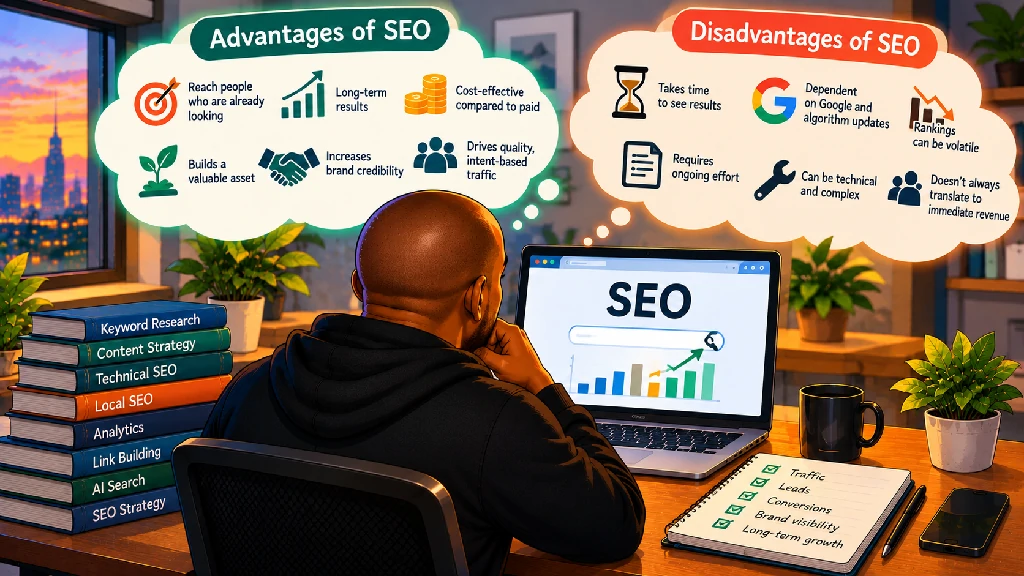
I’ve built a large part of my career around SEO.
So you might expect me to tell you SEO is one of the greatest marketing channels ever invented, every business needs it, and anyone who doesn’t invest in it is making a terrible mistake.
I don’t think it’s that simple.
SEO has some incredible advantages.
It also has disadvantages that people in our industry don’t always talk about enough.
I’ve worked in digital marketing for more than eight years, across different websites, industries, countries and types of businesses. I’ve watched pages go from practically invisible to generating meaningful organic traffic. I’ve also watched rankings disappear, strategies take months to produce results, Google updates turn reports upside down, and perfectly reasonable SEO recommendations sit in a development queue for what feels like an entire geological era.
And now AI is changing search again.
So if someone asked me about the advantages and disadvantages of SEO, I wouldn’t give them the usual:
Advantage: Free traffic.
Disadvantage: Takes time.
Both statements contain some truth.
Neither really explains what it’s like to rely on SEO as a marketing channel.
Here’s how I see it.
First, What Is SEO Actually Trying to Do?
SEO is about making it easier for people to discover your business, content, products or information through search.
Traditionally, that mostly meant Google and other search engines.
Someone searches.
Your website appears.
They click.
You hopefully give them what they were looking for.
That basic idea still exists.
But search is becoming broader.
Google has AI Overviews and other AI-powered experiences. People ask ChatGPT questions. They use Reddit, YouTube, TikTok, Maps and other platforms during discovery.
I’ve written before about whether SEO still matters in the age of AI search, and my answer is yes.
But what we mean by “search visibility” is becoming more complicated.
That’s important when weighing SEO’s advantages and disadvantages, because we’re no longer optimising for the same internet I started working with.
Advantage: SEO Lets You Meet People Who Are Already Looking
This is still one of my favourite things about search.
Someone searches:
emergency plumber near me
They probably have a plumbing problem.
Someone searches:
best accounting software for small businesses
They’re probably evaluating software.
Someone searches:
how much does a franchise cost
There’s likely some level of interest in franchise ownership.
Compare that with advertising, where you’re interrupting someone who may have had absolutely no intention of thinking about your product five seconds earlier.
Search begins with the user expressing intent.
That doesn’t mean every keyword produces a customer.
Far from it.
But SEO allows businesses to appear at the moment someone is actively looking for information, a product, a service or a solution.
That’s powerful.
Disadvantage: Search Intent Doesn’t Automatically Mean Business Value
This is where keyword research can become misleading.
A keyword gets 10,000 searches per month.
Great.
But what are those people actually trying to accomplish?
Traffic is easy to celebrate.
Useful traffic is harder.
I’ve seen websites attract visitors through informational content that looked fantastic in an SEO report but contributed very little to the actual business.
That’s why I’ve become less interested in chasing search volume just for the sake of it.
I’d rather understand:
Who is searching?
Why?
What do they need?
Where are they in their journey?
What happens after they land on the website?
Does this query relate to what the business actually does?
A ranking isn’t valuable simply because a keyword has search volume.
Advantage: SEO Can Compound Over Time
This is one of the biggest differences between SEO and many forms of paid acquisition.
Create a genuinely useful page today, and it could potentially attract visitors for years.
Improve your internal linking.
Build authority.
Earn relevant links.
Improve technical foundations.
Develop useful service pages.
Strengthen your local presence.
Publish information people genuinely need.
The individual improvements can begin reinforcing each other.
One strong page can support another through internal links.
Brand recognition can increase.
Links accumulate.
More queries appear in Search Console.
Existing pages can be updated instead of constantly starting again.
That’s what makes SEO interesting as a long-term investment.
You’re building an asset rather than simply purchasing another impression.
Disadvantage: SEO Can Be Painfully Slow
And here’s the other side of compounding.
It takes time.
Sometimes a lot of time.
You can improve a page today and see movement relatively quickly.
Another page might take months.
A new website may need time to establish authority.
A competitive query may require substantially more work than expected.
A technical fix may require pages to be recrawled and reprocessed.
And sometimes you do good work, but nothing dramatic happens.
Such scenarios can be frustrating for businesses expecting:
We paid for SEO in October. Where are the leads?
SEO doesn’t operate on a guaranteed timetable.
That’s one of the reasons expectation-setting is such an important part of the job.
Advantage: Organic Visibility Can Reduce Dependence on Paid Traffic
I don’t like describing SEO traffic as “free”.
SEO isn’t free.
Someone has to research.
Write.
Develop.
Analyse.
Optimise.
Design.
Manage the website.
Build digital authority.
Create assets.
Fix technical problems.
Sometimes several people are involved.
There is a cost.
The difference is that you generally aren’t paying Google for every organic click.
If a strong landing page attracts relevant visitors month after month, you don’t receive an invoice from Google every time somebody clicks the organic result.
That can make SEO a valuable part of a diversified acquisition strategy.
Disadvantage: You Don’t Control Google
This is probably one of SEO’s biggest weaknesses.
You can control your website.
You cannot control Google’s algorithm.
Google can change how results are ranked.
It can change the SERP layout.
It can introduce new features.
It can display more ads.
It can show maps.
Shopping results.
Videos.
Forums.
AI-generated answers.
Your number-one ranking doesn’t guarantee the same visibility forever.
And rankings themselves can change.
I’ve written about what I think you should actually do when Google rolls out an update because algorithm volatility is simply part of working in SEO.
That dependency matters.
If 90% of your business comes from one search engine, that’s a business risk even when SEO is performing brilliantly.
Advantage: SEO Forces You to Understand Your Customers
Good keyword research isn’t just about keywords.
It’s market research.
People tell Google what they want every day.
They ask questions.
Describe problems.
Compare products.
Search for prices.
Look for alternatives.
Add locations.
Search for reviews.
Express concerns.
Sometimes the language customers use is entirely different from the language businesses use internally.
That’s valuable information.
Search data can help shape website navigation, FAQs, product descriptions, service pages, content strategy and even how a business talks about what it offers.
One reason I still like keyword research after all these years is that it allows you to study human behaviour beneath the spreadsheets.
Disadvantage: SEO Can Become Obsessed With Search Engines
I’ve seen this happen plenty of times.
People become so focused on “SEO content” that they forget someone eventually has to read it.
The keyword must appear here.
Add another H2.
Please ensure the article is 2,000 words, as the competitor’s is 1,800.
Insert three internal links.
Add FAQs.
Mention the city twelve times.
Congratulations.
We’ve optimised all the humanity out of the page.
Search engines matter.
Of course they do.
But if somebody reaches your page and thinks:
Who talks like this?
we’ve probably gone too far.
This is something I’m becoming even more conscious of with AI-generated content.
Publishing technically optimised words has never been easier.
Creating something worth reading hasn’t become easier at all.
Advantage: SEO Improves More Than Rankings
Some of the best SEO work improves the website itself.
Technical SEO might uncover:
Broken links.
Redirect problems.
Duplicate pages.
Slow performance.
Poor internal linking.
Indexation issues.
Confusing site architecture.
Missing metadata.
JavaScript problems.
Mobile usability issues.
Content gaps.
When I’m reviewing a homepage for SEO, I’m not only asking whether Google can rank it.
I’m asking whether the page clearly explains the business.
Can people find important services?
Can they find locations?
Is there evidence they should trust the company?
Is there a sensible next step?
Good SEO frequently overlaps with good websites.
Disadvantage: SEO Often Depends on People Outside the SEO Team
This is something you understand much better once you’ve managed SEO rather than simply produced recommendations.
Finding the problem isn’t always the hard part.
Implementing the solution can be the hard part.
The SEO team identifies a technical issue.
Development needs to fix it.
Content needs updating.
Legal needs to approve something.
Design needs to change a template.
The client needs to provide information.
Someone needs access.
Someone else needs to approve the ticket.
Then the release gets delayed.
Suddenly, a five-minute SEO recommendation has taken six weeks to travel through project-management software.
SEO touches so many parts of a website that success often depends on collaboration.
The best SEO strategy in the world is useless if nobody can implement it.
That’s one of the biggest lessons I’ve learned moving from SEO Specialist to SEO Manager.
Advantage: Local SEO Can Connect Search Directly to Real-World Actions
This is especially important to me because I’ve spent a lot of time working with local and multi-location businesses.
Local search can be extremely close to a real-world decision.
Someone searches for a dentist.
A home care provider.
A preschool.
A tyre shop.
A restaurant.
A plumber.
They aren’t necessarily researching something they’ll purchase six months from now.
They might need somewhere to go today.
A strong local presence can lead to:
Calls.
Directions.
Bookings.
Website visits.
Store visits.
Enquiries.
That’s why I see Google Business Profile, reviews, local landing pages and accurate business information as much more than little SEO tasks.
They’re part of the customer journey.
My experience managing SEO for multi-location brands has made me appreciate how valuable that visibility can become at scale.
Disadvantage: Local SEO Gets Complicated at Scale
Managing one location is one thing.
Managing hundreds is another.
Now you’re dealing with:
Hundreds of Google Business Profiles.
Hundreds of location pages.
Reviews.
Duplicate listings.
Incorrect opening hours.
Different services.
Different markets.
Local competitors.
Different ranking performance.
Franchisees.
Brand standards.
Local content.
Suddenly:
“Optimise our local SEO”
isn’t one task.
It’s an operational system.
And small inconsistencies multiply quickly when you’re managing a large footprint.
Advantage: SEO Results Can Be Measured
SEO gives us a lot of data.
Google Search Console can show queries, pages, clicks, impressions, CTR and average position.
Analytics can show what happens after people arrive.
Local SEO platforms can help track geographic rankings.
Crawlers can analyse technical conditions.
Rank trackers can monitor keywords.
We can compare periods.
Segment branded and non-branded traffic.
Analyse landing pages.
Track conversions.
I’ve even started experimenting with Python for SEO data analysis and automation because there’s so much information available.
That’s a huge advantage.
But it creates another problem.
Disadvantage: SEO Attribution Is Getting Harder
A person searches for something.
Reads your article.
Leaves.
Sees your brand again somewhere else.
Asks ChatGPT a related question.
Searches your company name two weeks later.
Reads reviews.
Visits your website.
Leaves again.
Finally converts through another channel.
Who gets the credit?
That’s becoming increasingly difficult to answer.
AI-generated search experiences make this even more complicated because someone may discover your brand without ever clicking your website.
That’s why I’ve been thinking differently about how we report SEO success when AI is changing the SERP.
Clicks still matter.
Traffic still matters.
Leads and revenue definitely matter.
But the customer journey isn’t always:
Keyword → organic click → conversion.
Maybe it never really was.
We just had cleaner reports.
Advantage: SEO Can Build Trust Before Someone Contacts You
Imagine you’re considering two companies.
You search for a question.
One company has a genuinely useful answer.
Later you search for something else.
They appear again.
Then you search their brand.
Their website looks credible.
Their reviews are strong.
Their business information is consistent.
Eventually you contact them.
SEO didn’t necessarily create trust by itself.
But search visibility gave the business repeated opportunities to demonstrate expertise.
This is particularly important for expensive, complicated or high-trust decisions where customers research before buying.
Disadvantage: Rankings Can Create False Confidence
Being number one feels good.
I’ve been doing SEO long enough to admit that.
There’s something satisfying about watching a target keyword climb.
But rankings can become vanity metrics.
Number one for what?
How many people search it?
What intent does it represent?
Does it generate relevant traffic?
Does that traffic convert?
What does the SERP actually look like?
Is an AI Overview above you?
A local pack?
Shopping results?
Videos?
Four ads?
Being in position one in a ranking tool doesn’t necessarily mean you’re receiving the attention you’d expect.
That’s why SEO reporting needs context.
Advantage: SEO Rewards Businesses That Build Useful Information
One thing I still like about SEO is that businesses often have information customers genuinely need.
The problem is that the information may be trapped inside people’s heads.
A salesperson knows the questions prospects always ask.
Customer service knows what confuses customers.
Franchise development knows what prospective franchisees worry about.
Technicians understand problems nobody has explained properly online.
Local teams know their communities.
SEO can help turn that knowledge into discoverable information.
And I think that becomes even more important as generative AI changes search.
Disadvantage: AI Can Answer the Question Without Sending the Click
This is probably the most interesting disadvantage emerging right now.
Historically, the exchange was fairly obvious.
A website creates useful information.
Google indexes it.
Someone searches.
Google sends the click.
AI-powered search changes that relationship.
A search engine or AI assistant may use information from multiple sources to construct an answer directly.
The user gets what they need without necessarily visiting every source involved.
That doesn’t mean creating useful content suddenly becomes pointless.
But it changes what visibility looks like.
I’ve already changed parts of my SEO strategy because of AI search for exactly this reason.
I’m thinking more about brands, entities, citations, mentions, original information and becoming a trusted source — not only getting a blue link clicked.
Advantage: SEO Skills Transfer Surprisingly Well
This one is more personal.
SEO has taught me much more than SEO.
I’ve learned about:
Websites.
HTML.
Servers.
DNS.
HTTP.
Analytics.
Content.
Data.
UX.
Marketing.
Business.
Project management.
Communication.
APIs.
Local businesses.
And increasingly AI.
Those foundations are part of the reason I’ve become interested in Python and cybersecurity.
I’ve written about how SEO and cybersecurity are more connected than I thought.
The same is happening with programming.
SEO sits at an interesting intersection between marketing and technology.
If you’re curious enough, there are a lot of directions you can go from there.
Disadvantage: SEO Never Really Lets You Finish Learning
Depending on your personality, this might actually be an advantage.
Google changes.
Web technology changes.
Search behaviour changes.
SERPs change.
AI changes.
Analytics changes.
Tools change.
Best practices change.
Things I considered normal SEO work eight years ago aren’t necessarily how I’d approach the same problem today.
That means you can’t learn SEO once and declare yourself finished.
For me, that’s part of the appeal.
But if you want a profession where the rulebook stays comfortably unchanged for ten years, SEO might become exhausting.
So, Do the Advantages of SEO Outweigh the Disadvantages?
For me, yes.
I’ve built my career around it, so perhaps I’m not the most neutral person to ask.
But I also don’t think every business should blindly pour money into SEO simply because someone said organic traffic is important.
SEO makes the most sense when people genuinely search for what you offer, when organic visibility can contribute to meaningful business outcomes, and when you’re prepared to invest long enough to build something worthwhile.
It becomes much less attractive when expectations are unrealistic.
If you need immediate results tomorrow, SEO probably shouldn’t be your only strategy.
If you’re unwilling to improve your website, producing a 70-page SEO audit isn’t going to save you.
If you only care about rankings and never measure whether those rankings contribute to the business, you’re missing the point.
And if your entire strategy depends on Google behaving exactly the same way forever, you’re taking a risk.
The Biggest Advantage and Disadvantage of SEO Might Be the Same Thing
SEO is constantly changing.
That’s frustrating.
It’s also what makes the work interesting.
When I started, the job felt much more centred around traditional search engines, rankings, keywords, links and websites.
Those things haven’t disappeared.
But now I’m thinking about AI-generated answers.
Entities.
Brand visibility.
Local ecosystems.
Automation.
Python.
Structured information.
How machines understand businesses.
How people discover brands without necessarily clicking them.
I’ve written before that SEO isn’t dead, but the job of an SEO is changing.
That’s probably the best way I can summarise both sides of SEO.
Its biggest disadvantage is that you can never completely control it.
Its biggest advantage is that this uncertainty forces you to keep learning.
And after nearly a decade working in digital marketing, I think that’s one of the reasons I’m still here.
SEO has never given me the luxury of knowing everything.
It has given me an excellent reason to stay curious.
