
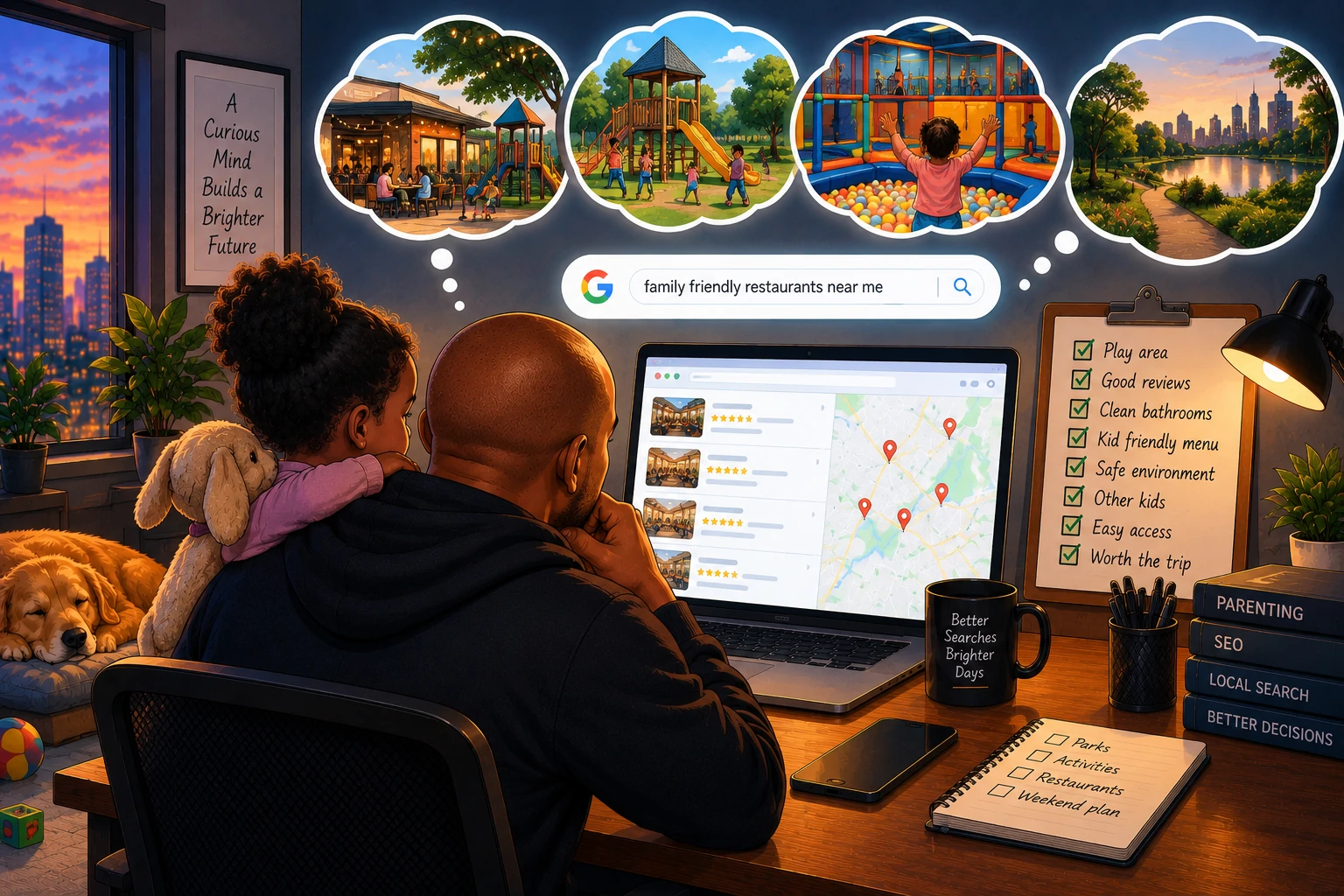
There are many things nobody really prepares you for when you become a father.
One of them is how much time you’re going to spend on Google.
Your child coughs twice in a way you haven’t heard before?
Google.
There’s a strange rash?
Google.
She suddenly doesn’t want to eat something she loved three days ago?
Google.
“Is this normal for a three-year-old?”
Google.
Then there are the less stressful searches.
Things to do with kids near me.
Restaurants with play areas.
Kids’ activities this weekend.
Family friendly restaurants near me.
Places to take a toddler in Johannesburg.
Indoor play areas.
Outdoor activities for kids.
Your search behaviour changes completely once you become a parent.
Before having my daughter, choosing a restaurant could be as simple as:
Is the food good?
Cool.
Let’s go.
Now?
I’m conducting what sometimes feels like a full local SEO audit before we leave the house.
And the funny thing is, I can’t switch that part of my brain off.
I’ve been working in SEO for nearly ten years, so when I’m searching as a father, I’m still searching like an SEO.
It turns out that this has actually been incredibly useful.
Having a Child Changes What “Good” Means
My daughter is turning four, and she’s our only child.
Because she doesn’t have siblings at home to play with, my wife and I try to make sure that weekends include opportunities for her to get out, play, and, importantly, interact with other children.
So we’re constantly looking for places.
Restaurants with playgrounds.
Kids’ activity centres.
Parks.
Family-friendly venues.
Places where she can run around and just be a kid.
And this experience has completely changed how I evaluate businesses.
A restaurant I would consider excellent when I’m going there alone isn’t necessarily somewhere I’d take my daughter.
The food can be amazing.
The service can be great.
The place can look beautiful.
But then I start asking different questions.
Does it have a play area?
Is the play area actually safe?
Is it visible from the seating area?
Are there other children there?
Is there somewhere she can comfortably use the toilet?
Are the bathrooms clean?
Is the environment appropriate for young children?
Do other parents recommend it?
Suddenly, a five-star rating isn’t enough.
I’ve Learned Not to Trust the Stars on Their Own
This is where knowing local SEO has probably changed my behaviour the most.
I don’t see:
★★★★★ 5.0
and automatically think:
This place must be amazing.
My next question is:
How many reviews?
Five stars from ten people means something very different to me from 4.6 stars across 2,000 reviews.
That’s not me saying those ten reviews are fake.
They might be completely genuine.
But I don’t have enough information yet.
Maybe the business recently opened.
Maybe it’s genuinely fantastic.
Or maybe most of those first reviews came from people close to the business.
I need more context.
So I dig deeper.
And this is where my SEO brain starts taking over.
I Actually Read the Reviews
Not just the first three.
I look at the volume.
Then the rating.
Then I look at recent reviews.
Sometimes I’ll specifically look at the lower-rated reviews.
And most importantly, I look for reviews from people who seem to have visited with children.
Parents notice things other customers don’t.
Someone visiting with friends might write:
Great food. Great atmosphere. Will definitely come back.
Useful.
But a parent might tell me:
The play area was clean.
There was someone supervising the kids.
The playground equipment needs maintenance.
There weren’t enough high chairs.
The children’s menu was good.
The bathrooms weren’t clean.
It was difficult getting a pram through the entrance.
The kids loved it.
The outdoor area gets very hot in the afternoon.
That’s information I can actually use.
Because I’ve learned something since becoming a father:
Parents don’t play around when it comes to their kids.
If something is wrong, somebody is going to mention it.
I Pay Much More Attention to Toilets Than I Ever Thought I Would
I never imagined I’d reach a point in my life where bathroom facilities could influence where I eat.
Then I had a daughter.
Now it’s genuinely part of my decision.
There are places I could visit alone where the toilet situation isn’t ideal, but I wouldn’t be particularly bothered.
I’m an adult.
I’ll survive.
When I’m there with my daughter, it’s completely different.
Is there a toilet nearby?
Is it clean?
Is it accessible for a child?
Are the facilities gender-specific or unisex?
Is there enough space for me to help her if she needs me?
This is where reviews and photos become ridiculously useful.
Sometimes the official website won’t tell you any of this.
The Google Business Profile might.
And another parent almost certainly will if it was a problem.
That’s why I don’t just search for businesses anymore.
I investigate them.
Google Business Profile Has Probably Cost Some Businesses My Money
This is where my professional life and parenting really collide.
I understand Google Business Profile.
I know what I’m looking at.
And I know how much information a business can control there.
So when I find an incomplete profile, I’m immediately less confident.
Wrong hours?
That’s a problem.
Hardly any photos?
I’m wondering what the place actually looks like.
No recent reviews?
Interesting.
Customer questions left unanswered?
Not ideal.
Business information inconsistent?
Now I’m investigating.
And sometimes I’ll travel further because I trust another location more.
There’s a Spur about 2 km from where I live.
But sometimes I’ll drive to one in Centurion that’s around 8 km away instead.
Same brand.
Same basic proposition.
One is significantly closer.
From a pure proximity perspective, the nearest location should win.
But it doesn’t always win me.
What I’ve seen on the Business Profiles, what customers have said, the pictures, the reviews and the overall impression of the locations influence that decision.
I’ve already done my research before getting into the car.
And most of the time, when I’ve made those decisions carefully, I’m not disappointed.
That’s something multi-location brands need to understand.
Your locations aren’t only competing against other brands. Sometimes they’re competing against each other.
This Has Changed How I Think About Multi-Location SEO Too
Working in multi-location SEO, we talk a lot about consistency.
Correct opening hours.
Categories.
Reviews.
Photos.
Location pages.
Local content.
NAP information.
All the normal local SEO stuff.
But becoming a parent has made me experience those things much more from the customer’s side.
Imagine a restaurant brand has 50 locations.
The national brand can be excellent.
But I’m not visiting the national brand.
I’m visiting one location.
I don’t care that another branch 30 kilometres away has brilliant service.
I need to know what happens at the one I’m considering taking my daughter to this Saturday.
That’s why individual location reputation matters so much.
One location might have 4.7 stars and hundreds of recent positive reviews.
Another location from exactly the same brand might have recurring complaints about service, cleanliness or its children’s facilities.
Those are two completely different customer experiences hiding underneath the same logo.
Local SEO exposes that.
Photos Have Become One of My Favourite Research Tools
Business owners should pay attention to this.
I look at your photos.
Not just the beautiful professional photos you uploaded when the location opened.
I want customer photos.
Show me what this place actually looks like on a Saturday afternoon.
I want to see the playground.
The seating.
The outside area.
The food.
The space.
Sometimes I’m practically doing reconnaissance.
Can I sit somewhere and still see my daughter playing?
Does that “large children’s play area” mentioned on the website actually look large?
Does the place look crowded?
Does it look maintained?
That’s the funny thing about user-generated content.
Businesses can describe themselves however they want.
Customers show you what they experienced.
Then I Check Social Media
Google isn’t the end of my research.
I’ll look at Instagram.
Facebook.
TikTok sometimes.
Wherever people are talking about the place.
Social media is particularly useful because people love taking pictures.
Or, as we’re supposed to call everything now:
content.
Someone went there for lunch?
Content.
Their child is playing?
Content.
Food arrives?
Content.
Birthday party?
Content.
And that’s useful for me.
I’m not only looking at what the business posts.
I’m looking at comments.
Tagged posts.
Customer pictures.
Videos.
What are people saying?
Does the real customer experience match the polished brand account?
You can learn a surprising amount about a business this way.
I Think This Is Where Search Is Going Anyway
The way I research somewhere to take my daughter is probably a good example of why I’ve stopped thinking about SEO as just Google rankings.
My journey might look something like this:
Google search.
Map results.
Google Business Profile.
Reviews.
Customer photos.
Website.
Instagram.
Maybe TikTok.
Back to Google.
Then possibly AI.
That’s one decision.
Which source gets credit for the conversion?
Good luck.
But that’s how people actually make decisions.
We move between platforms.
We verify information.
We compare.
We look for evidence.
And when the decision involves our children, I think we’re even more careful.
Now AI Has Joined My Parenting Research Team
AI makes this even more interesting.
I can ask ChatGPT, Claude or whatever your poison is:
What are some good places around Johannesburg where I can take a four-year-old this weekend?
Then I can make the question increasingly specific.
Somewhere outdoors.
Within a certain driving distance.
Restaurants with children’s play areas.
Something appropriate if it’s raining.
Places where she’ll have opportunities to interact with other kids.
And AI can dramatically shorten the discovery process.
But knowing SEO has also taught me not to blindly accept the first answer.
AI can be wrong.
Information can be outdated.
Businesses close.
Opening hours change.
A place that was great two years ago might have deteriorated.
A playground might no longer exist.
So even if AI gives me the initial recommendation, I’ll verify it.
I’ll search the business.
Open the Business Profile.
Check the latest reviews.
Look at the photos.
Check the website.
Look at social media.
AI helps me discover.
It doesn’t remove my need to verify.
Knowing SEO Has Made Me More Sceptical Online
I don’t mean sceptical in a negative way.
More deliberate.
SEO teaches you to think about why information appears in front of you.
Why does this business rank first?
Does being first automatically make it the best?
No.
Why does this restaurant have five stars?
How many people reviewed it?
When?
Why does the website say it’s “the best family restaurant in Johannesburg”?
According to whom?
Are the pictures recent?
Does the information match across platforms?
What are customers saying?
Knowing how search works makes me less likely to treat rankings as recommendations.
That’s an important distinction.
Google showing me something first doesn’t automatically mean Google is telling me it’s the best option for my daughter.
It’s my job to make that final decision.
Becoming a Father Has Actually Made Me Better at Understanding Local Search
This is something I didn’t expect.
Working in SEO teaches me about local search professionally.
Being a father teaches me about it as a customer.
Those are different perspectives.
When I’m doing an SEO audit, I might notice that a business hasn’t uploaded recent Google Business Profile photos.
Professionally, I understand why that’s worth improving.
As a father looking for somewhere to take my daughter, I understand the frustration behind it.
I want to see the place.
When I recommend that a business responds to reviews, I understand the reputation benefit.
But when I’m reading reviews as a parent and see the owner thoughtfully responding to a concern another parent raised, that means something different.
When I recommend accurate opening hours, it’s an SEO task.
When I’ve packed everything, put my daughter in the car, driven somewhere and discovered the business isn’t actually open?
Now it’s personal.
That’s why I think working in local SEO becomes much more interesting when you stop looking at everything through rankings.
There are real people behind those searches.
If You Run a Local Business, Please Take Your SEO Seriously
And I don’t only say this as someone who has spent nearly ten years working in SEO.
I’m saying it as a father.
Your Google Business Profile matters.
Your reviews matter.
Your recent reviews matter.
Your photos matter.
Your opening hours matter.
Your website matters.
Your location page matters.
Your social media presence matters.
Your responses to customers matter.
And if you’re a family-friendly business, information about children matters.
Don’t just write:
Family friendly.
Tell me why.
Do you have a play area?
What ages is it suitable for?
Is it indoors or outdoors?
Do you have high chairs?
Children’s menus?
Changing facilities?
Accessible bathrooms?
Can parents see the play area from the restaurant?
Can I host a child’s birthday there?
Show me pictures.
Keep those pictures current.
Answer those questions before I have to dig through 150 reviews looking for another parent who did.
That’s good marketing.
That’s good local SEO.
And increasingly, that’s good information for AI systems too.
Local SEO Is Really About Trust
The older I get in this industry, the less interested I am in reducing SEO to rankings.
Especially local SEO.
When I’m deciding where to take my daughter this weekend, I don’t care whether you ranked position one because your title tag was slightly better optimised than the restaurant below you.
I’m trying to answer a much more important question:
Can I trust this place with my family?
Search gets you into consideration.
Your Business Profile gives me information.
Reviews give me other people’s experiences.
Photos give me evidence.
Your website fills in the gaps.
Social media gives me another perspective.
AI might help me discover you.
Then I make the decision.
And sometimes I will happily drive an extra six kilometres past one location to visit another because everything I found during that process made me trust the second location more.
That’s the part of local SEO I think businesses sometimes underestimate.
The ranking gets you seen.
The information gets you chosen.
Nearly ten years working in SEO has taught me how search engines work.
Becoming a father has taught me something equally useful:
what people are actually looking for when the search really matters to them.
And when it’s your child?
Trust me.
You read the reviews.
A Few Places I’ve Found Along the Way
Since I’ve spent this whole article talking about how I use search, reviews, Google Business Profiles and social media to decide where to take my daughter, I thought I should mention a few places that have actually passed my test.
None of these are sponsored recommendations or businesses I’m promoting. They’re simply places I’ve discovered through the kind of research I’ve described above, visited or considered as a parent, and think other parents around Johannesburg, Midrand and Centurion may enjoy too.
Lory Park — Midrand
Lory Park is one of my favourites when I want the day to be about more than sitting at a restaurant while my daughter plays. There are animals, a dedicated kids’ play area and weekend experiences such as reptile and owl encounters and big-cat talks. It’s the kind of outing where she gets to run around, see something new and ask a million questions afterwards. For me, that’s a successful Saturday.
Kidz Fun House Play Centre — Edenvale
This is the type of place I look for when the main objective is simple: let the kids play. Kidz Fun House is an indoor playground with a toddler corner, giant slides, an obstacle course, playhouses, a sandpit, a sensory room, and other activities, plus its own café. I particularly like places like this because my daughter gets to interact with other children, rather than the entire outing revolving around us entertaining her.
Parque
Parque is another one I’d include from my own list of places I’ve found while searching for somewhere to take my daughter. What I like about discovering places like this is that they’re exactly why I don’t stop at Google’s first result. I’ll go through the Business Profile, photos, recent reviews and what other parents are saying before deciding whether somewhere deserves a weekend visit. That’s basically the entire point of this article: good local SEO can turn a business I’d never heard of into somewhere my family actually visits.
The Fun Factory Morning Glen — Sandton
The Fun Factory at Morning Glen works particularly well when I want the best of both worlds: somewhere we can eat while my daughter has something specifically designed for her. The venue is positioned as family-friendly and has a kids’ menu, high chairs and changing facilities. This is the kind of information I now pay attention to before choosing a restaurant because “kid-friendly” means much more to me than simply allowing children through the door.
Kiowa Spur — Centurion
This is probably the best example of the point I made earlier about being willing to drive further for a particular branch of the same brand. Kiowa Spur is at Centurion Lifestyle Centre and has a dedicated kids’ play area; Spur’s official listing also specifically highlights children’s activities and play facilities. There may be another Spur closer to me, but local reviews, photos and what I can learn about an individual branch influence which one gets my business. Same brand, same menu, different local experience.
And I’m Still Looking
These aren’t necessarily the “five best places for kids in Gauteng”. I don’t think I could confidently make that claim, and that isn’t really the point.
They’re places that have made it onto my family’s list.
And we’ll keep finding more.
That’s one of the unexpected benefits of having a child approaching four. Every weekend gives us an excuse to discover another part of Johannesburg, Pretoria, Centurion, Midrand or somewhere in between.
Sometimes Google will find it for me.
Sometimes another parent will mention it in a review.
Sometimes Instagram will show it to me.
Increasingly, AI might introduce me to it.
But before I put my daughter in the car?
You already know I’m reading those reviews.
