
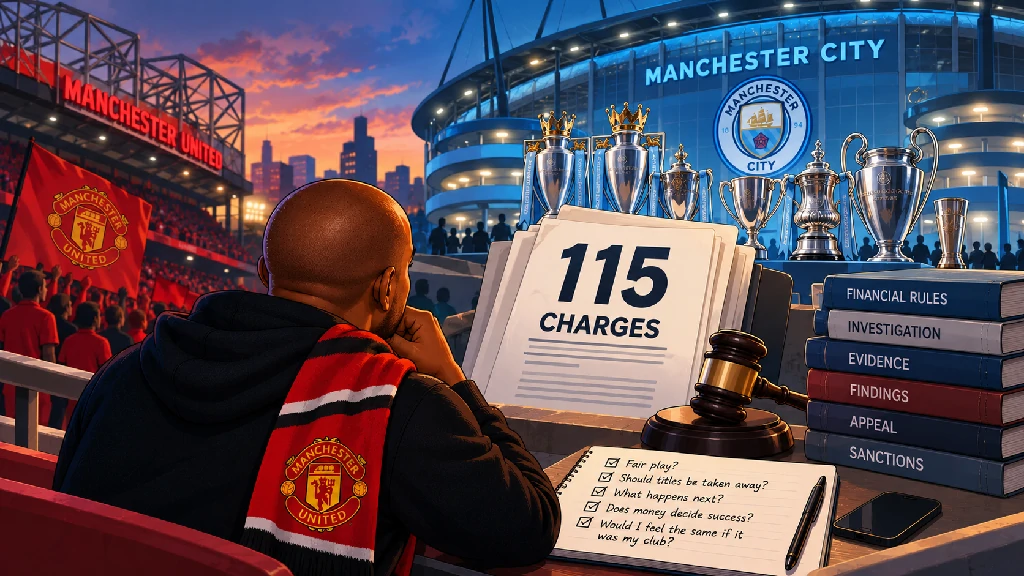
I support Manchester United.
I think that’s probably the first thing you should know before reading anything else.
I’ve watched Manchester City dominate English football while my own club has spent enormous amounts of money trying to remember how to compete for the Premier League title.
I’ve watched City play some beautiful football. I’ve watched Pep Guardiola build an extraordinary team. I’ve watched United spend millions on players who sometimes looked like they’d only met each other in the tunnel before kick-off.
And now we’re here.
Manchester City’s famous 115 charges are no longer simply allegations awaiting an initial verdict.
On 29 September 2026, the Premier League announced that an independent commission had found City guilty of serious financial-rule breaches spanning nine seasons. According to the league, the arrangements artificially increased the club’s reported revenue and reduced its reported costs by more than £900 million.
As someone who works in SEO, I’m constantly following industry news, analysing trends and trying to understand what changes actually mean.
Football is supposed to be my escape from all that.
Apparently, even football now requires me to read financial reports, legal arguments and regulatory statements.
But this story raises questions that go far beyond Manchester City.
Did financial irregularities contribute to their dominance?
What happens to the teams that finished behind them?
Should titles be taken away?
Are football’s financial regulations actually fair?
And perhaps the most uncomfortable question of all: if Manchester United had operated under the same circumstances, would I be demanding exactly the same punishment?
I want to explore those questions from the perspective of a football fan who happens to support City’s biggest local rivals.
Not a lawyer.
Not a financial expert.
Just a Manchester United supporter who thinks football has some difficult questions to answer.
This article reflects developments reported up to 30 September 2026. Manchester City disputes the findings and has indicated its intention to appeal. No final sanction has been announced.
First, What Are Manchester City’s 115 Charges Actually About?
For years, we’ve been hearing about Manchester City’s 115 charges.
It’s almost become part of football vocabulary.
Manchester United fans mention it whenever City win something.
City fans respond by pointing towards their trophies.
Arsenal and Liverpool supporters join the conversation.
Then everybody argues until the next match.
But the underlying case is considerably more complicated than the number suggests.
The Premier League’s investigation examined financial reporting and compliance across nine seasons, from 2009/10 to 2017/18.
According to the commission’s findings, City used commercial agreements that did not accurately reflect the underlying financial arrangements. Some sponsorship payments recorded as commercial revenue were actually funded in substantial part by the club’s ownership group.
The commission also identified arrangements that understated costs, including issues involving image rights, and concluded that City had submitted misstated accounts and significantly breached applicable spending limits. It upheld three of four allegations concerning the club’s failure to cooperate with the investigation.
In simpler terms, the commission found that City’s published financial position did not accurately reflect where significant amounts of money were coming from or what the club was spending.
And this wasn’t a disagreement about a few pounds.
The Premier League reported that the relevant schemes inflated revenue and reduced costs by more than £900 million across the affected period.
That’s the figure that caught my attention.
Nine hundred million pounds.
As a Manchester United supporter, I’m accustomed to seeing my club spend extraordinary amounts of money without necessarily improving the football.
But even by modern football standards, that is a staggering amount.
It’s also important to understand that the commission’s findings are not yet the end of the process.
Manchester City has rejected the conclusions and indicated that it intends to appeal. The commission will address sanctions separately, subject to the continuing proceedings.
So the question is no longer simply whether the Premier League can establish serious breaches at the initial hearing.
It’s whether those findings will survive any appeal and, if they do, what consequences should follow.
How Did We Get Here? A Brief Timeline
- 2009–2018 – The period under investigation: The commission examined financial arrangements covering the 2009/10 to 2017/18 seasons. Its findings concerned commercial revenue, costs, financial reporting and compliance with spending regulations.
- 2018 – Leaks and the Premier League investigation: Reporting based on leaked documents brought City’s financial arrangements under renewed scrutiny. The Premier League began its investigation in December 2018.
- 2020 – UEFA’s separate case: UEFA imposed a European competition ban, but the Court of Arbitration for Sport subsequently overturned it. That decision did not resolve the Premier League’s separate investigation.
- February 2023 – The Premier League brings charges: After years of investigation, the league formally referred more than 100 alleged rule breaches to an independent commission.
- September–December 2024 – The hearing: The independent commission held a 42-day hearing, concluding in December 2024.
- 29 September 2026 – The commission’s findings: The Premier League announced that the commission had upheld the serious financial charges and most of the non-cooperation allegations.
- 2 October 2026 – Appeal deadline: Manchester City has until this date to exercise its right to appeal. Sanctions remain undecided.
Timeline based on the Premier League’s official statement and Associated Press reporting.
What interests me about this timeline is how much football has happened while the investigation has continued.
Managers have come and gone.
Players have retired.
Supporters have celebrated championships.
Other clubs have rebuilt their squads several times.
Some of the people who were involved in football during the original period under investigation are no longer involved with their clubs.
Yet the potential consequences are only now becoming clearer.
That’s one of the biggest problems with a case of this magnitude.
How do you correct something in football when the seasons, players and opportunities involved are already part of history?
Did the Financial Irregularities Help Manchester City Dominate English Football?
This is the question I keep coming back to.
If a club’s financial reporting allowed it to operate beyond the spending limits that applied to its competitors, surely that provided some form of advantage.
The commission concluded that City would have breached both Premier League and UEFA spending limits by a substantial amount if the relevant agreements had been reported accurately.
That’s an important finding.
But here’s where I think we need to distinguish between a financial advantage and footballing success.
Money can help you assemble a competitive squad.
It can help you attract exceptional managers, develop facilities, recruit talented players and build an organisation capable of competing consistently.
But money doesn’t guarantee trophies.
And as a Manchester United supporter, I’m painfully qualified to discuss that last point.
We’ve spent enormous amounts of money.
We’ve signed expensive players.
We’ve appointed different managers.
We’ve repeatedly announced exciting new eras.
And we’ve spent far too many seasons watching other teams compete for the biggest trophies.
If spending money automatically created successful football teams, Manchester United would have considerably more recent Premier League titles.
So I find two things entirely compatible.
Manchester City assembled some extraordinary teams that played exceptional football.
And the commission’s findings raise serious questions about whether the financial conditions under which the club built its success were fair.
One doesn’t automatically cancel the other.
I can acknowledge the brilliance of City’s football while questioning the financial arrangements behind the organisation.
The difficult part is establishing precisely how much of that sporting success resulted from the financial advantage.
We can’t replay those seasons under different financial conditions.
Would City still have signed certain players?
Would they have retained the same squad?
Would they have appointed the same managers?
Would other clubs have won more trophies?
Nobody can answer those questions with certainty.
But the inability to reconstruct an alternative history doesn’t mean the financial findings are irrelevant.
If financial regulations matter, then gaining an advantage by breaching them must matter too.
Manchester United Have Spent Plenty. What’s Our Excuse?
This is where I think United supporters need to be careful.
It’s very tempting to blame Manchester City’s financial situation for everything that has happened to us.
Unfortunately, that would let our own club off the hook.
City’s financial arrangements didn’t force Manchester United to make poor recruitment decisions.
They didn’t force us to change managers repeatedly.
They didn’t determine our football strategy.
They didn’t make us sign players who struggled to justify their transfer fees.
Those were our own problems.
I’ve watched Manchester United spend enormous sums of money without consistently building teams that look capable of challenging for the title.
Meanwhile, other clubs have demonstrated that recruitment, management, coaching and organisational stability matter just as much as having an expensive squad.
That is why I don’t believe we can automatically conclude that Manchester United would have dominated English football if City’s financial arrangements had been different.
Football doesn’t work like that.
Nevertheless, there’s a difference between failing to use your resources effectively and competing against an opponent that has breached the financial rules.
United’s mistakes don’t excuse City’s breaches.
And City’s breaches don’t excuse United’s mistakes.
Both things can be true.
What Punishment Could Manchester City Face?
This is where the discussion becomes particularly interesting.
And it’s important to separate what the rules permit from what people on social media would like to see.
The Premier League has confirmed that the commission will consider sanctions in a separate hearing. Its disciplinary rules allow a range of measures, including fines, points deductions and other sporting sanctions. No specific punishment has been announced.
Reports and legal commentary have discussed possibilities ranging from substantial financial penalties to points deductions, relegation or even expulsion. However, the actual sanction and the effect of any appeal remain uncertain.
Here’s how I understand the main possibilities being discussed.
| Possible punishment | What it could mean |
|---|---|
| Financial penalty | City could be required to pay a substantial fine. |
| Points deduction | Points could be removed, potentially affecting league position or survival. |
| Relegation | City could lose its place in the Premier League, depending on the sanction imposed. |
| Expulsion | An especially severe sporting sanction could remove the club from the competition. |
| Historical title removal | A much-debated possibility, but not an announced punishment or an established outcome in this case. |
| Compensation claims | Other clubs may explore legal action if they believe they suffered demonstrable losses. |
These possibilities shouldn’t be mistaken for a confirmed menu of punishments that will necessarily be imposed. Some, particularly the removal or reassignment of historical titles, raise complicated questions that extend beyond the sanctions expressly highlighted in the Premier League’s statement.
Would a fine be enough?
Personally, I struggle to see how a fine alone would adequately address misconduct involving financial reporting on the scale established by the commission, assuming the findings survive appeal.
If the issue concerns financial advantages, a financial penalty might simply become another business expense.
That raises an obvious question.
What happens when the financial benefit associated with breaching a rule potentially exceeds the eventual penalty?
The answer matters well beyond Manchester City.
It affects how every club approaches compliance.
What about a points deduction?
Points deductions have a direct sporting impact.
Unlike a fine, they affect the league table.
They can influence European qualification, relegation and competitive outcomes.
However, there’s a timing problem.
If breaches occurred years ago, does removing points from a future season adequately address the consequences of the original misconduct?
The players and managers involved may have changed.
The club’s competitors may have changed.
The financial circumstances may have changed.
And supporters who watched their teams finish second years earlier don’t get those seasons back.
Could relegation or expulsion happen?
These are among the more severe outcomes being discussed.
Relegation would have major financial and sporting consequences. Expulsion would be even more disruptive.
But the severity of a punishment is not the only consideration.
It also has to withstand legal scrutiny, reflect the established breaches and comply with the competition’s disciplinary framework.
City’s expected appeal means the process could continue for some time.
Whatever happens, this is unlikely to be a simple matter of announcing a punishment and moving on.
Should Manchester City Be Stripped of Their Titles?
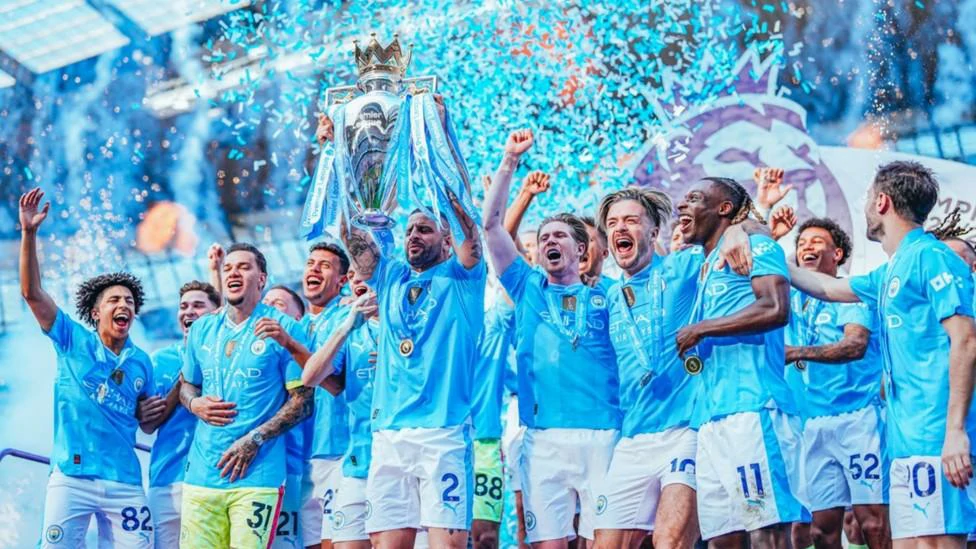
This is probably the most emotionally charged question for supporters.
And, as a Manchester United fan, I understand why people are discussing it.
Imagine waking up to discover that your club has been awarded a Premier League title from a season that ended years ago.
Technically, another trophy.
Another championship in the record books.
Another opportunity for supporters to remind their rivals about it.
But would it feel like winning the Premier League?
I genuinely don’t know.
Football isn’t just about the final table.
It’s about the experience.
The important victories.
The difficult away matches.
The title-deciding moments.
The celebrations.
The parade.
The feeling of watching your team achieve something special.
You can’t recreate those experiences years later.
And that’s what makes retrospective punishment so complicated.
Removing a title from one club doesn’t automatically recreate the championship experience for another.
Would the runners-up actually want those titles?
This is something I’d genuinely like to hear supporters discuss.
Imagine being a Liverpool, Arsenal or Manchester United supporter and being told your club is now officially recognised as the champion of a season that ended years ago.
Would you celebrate?
Would you buy the commemorative shirt?
Would you add the title to your social media bio?
Would the club organise a parade?
Or would it feel like receiving an award for a competition you never got to celebrate winning?
I suspect supporters would have very different reactions.
Some would argue that if a championship was achieved through serious financial breaches, correcting the official record would be appropriate.
Others might prefer the title to remain unawarded rather than being reassigned.
And some would argue that the actual football results should remain part of history, with any punishment recorded separately.
There are reasonable arguments to examine in each position.
But here’s another complication.
What about the team that finished third?
If the runner-up had finished first under different circumstances, would its remaining fixtures have unfolded in exactly the same way?
What about transfer decisions, injuries, confidence and the pressure of a title race?
Changing the final league table doesn’t recreate the season.
You can change a historical record. You can’t replay the football.
That’s why any decision involving historical titles would require considerably more thought than simply moving every team up one position.
Is Financial Fair Play Actually Fair?
This is where I think the conversation needs to move beyond Manchester City.
Because even if we establish that a club breached financial regulations, there’s another question worth discussing.
Are the regulations themselves designed in a way that creates a genuinely competitive league?
Financial Fair Play, or FFP, is often used as an umbrella term for football’s financial regulations. However, UEFA’s rules and the Premier League’s domestic financial framework are separate systems.
The underlying idea is relatively straightforward.
Clubs shouldn’t be allowed to spend recklessly without regard for their financial sustainability.
That sounds reasonable.
We’ve seen enough examples of football clubs experiencing serious financial difficulties to understand why sustainability matters.
But here’s the problem.
A club with an enormous existing commercial operation has access to financial resources that a smaller club simply doesn’t possess.
If spending limits are tied closely to revenue, the established clubs begin with a structural advantage.
They have bigger stadiums.
Larger international audiences.
More valuable sponsorship agreements.
Stronger commercial operations.
And often decades of success behind them.
How does a smaller club close that gap?
Are Financial Regulations Protecting the Biggest Clubs?
Imagine owning a smaller Premier League club.
You have ambitious owners who want to invest.
You want to improve your squad.
You want to challenge for European qualification.
Eventually, you might even dream of winning the Premier League.
But the clubs you’re competing against already generate substantially more revenue.
If the regulations limit your spending relative to your existing financial position, how quickly can you realistically catch them?
That’s the uncomfortable part of the debate.
Financial regulations can protect clubs from unsustainable spending.
But depending on how they’re designed, they can also make it more difficult for ambitious challengers to close the gap.
Those two things aren’t mutually exclusive.
And I don’t think the solution is simply to allow every wealthy owner to spend unlimited amounts of money.
That creates another problem.
Football clubs could become increasingly dependent on owners who might eventually lose interest, withdraw funding or encounter financial difficulties themselves.
The challenge is finding a system that encourages investment without allowing clubs to gamble with their survival.
I’d be interested in seeing more discussion about mechanisms that allow smaller clubs to invest sustainably in infrastructure, academies and long-term development while maintaining meaningful controls on financial risk.
Because if the only clubs capable of consistently competing are those that already have the largest revenues, we need to ask how competitive the competition really is.
Could Financial Regulations Actually Encourage Cheating?
This is another difficult question.
If the financial regulations make it challenging for smaller clubs to compete with established giants, could that create incentives to manipulate financial reporting?
Potentially.
But an incentive is not an excuse.
And it doesn’t establish that clubs generally cheat because of FFP.
The Manchester City case illustrates why regulators scrutinise whether commercial revenue reflects genuine underlying transactions. The commission found that City’s arrangements disguised ownership funding as commercial income and understated costs, enabling the club to appear compliant with spending limits.
That exposes a weakness that any revenue-based regulatory system must address.
How do you distinguish legitimate commercial growth from arrangements designed primarily to increase the amount a club is permitted to spend?
And how do you enforce those distinctions consistently?
If clubs believe the financial benefits of manipulating the system are substantial, while the consequences are uncertain or delayed, the regulations risk losing credibility.
However, abandoning financial regulation entirely would introduce different risks.
I don’t think the debate should be reduced to a choice between unrestricted spending and rules that preserve the existing hierarchy.
There should be room to discuss a system that promotes both sustainability and meaningful competition.
The Biggest Problem Might Be How Long This Has Taken
One thing that genuinely bothers me about this entire situation is the timeline.
The Premier League began investigating Manchester City in December 2018.
The formal complaint came in February 2023.
The hearing concluded in December 2024.
The commission’s findings were announced in September 2026.
And the sanctions process still hasn’t concluded.
That’s almost eight years between the beginning of the investigation and the announcement of the commission’s core findings.
Eight years is an eternity in football.
Entire squads can be rebuilt during that period.
Managers can arrive, win trophies and leave.
Clubs can qualify for European competitions, miss out on revenue and change their entire business strategies.
The longer these proceedings continue, the harder it becomes to address their sporting consequences.
I understand that a case involving complex financial arrangements, extensive evidence and serious allegations requires a thorough process.
Due process matters.
Manchester City must have the opportunity to challenge the findings.
But football also needs a regulatory system capable of reaching decisions within a timeframe that remains meaningful to the competition.
Otherwise, we risk having rules that are theoretically enforceable but practically incapable of correcting sporting outcomes when they matter.
And that’s a problem regardless of which club is involved.
What About the Clubs That Finished Behind Manchester City?
This is another aspect of the story that deserves attention.
The Premier League isn’t just a competition for trophies.
League positions determine European qualification, prize money, commercial opportunities and, in some circumstances, the ability to attract or retain players.
A single league position can have significant financial consequences.
So if a club gained an advantage through serious financial breaches, what happens to the other clubs that competed during the affected period?
Reuters has reported that the findings could open the door to compensation claims from clubs that believe they suffered losses, although any such claims would face complex legal and evidential questions.
Proving financial loss is one thing.
Proving what would have happened on a football pitch under different circumstances is considerably harder.
Would another club have qualified for the Champions League?
Would it have signed a particular player?
Would its manager have kept his job?
Would its commercial revenue have increased?
These are hypothetical questions.
And hypothetical football results are difficult to translate into financial compensation.
Nevertheless, I think this issue deserves serious consideration.
The impact of financial misconduct in a sporting competition potentially extends beyond the club responsible.
Its competitors may also be affected.
What Punishment Would Actually Be Enough?
This is where I find myself torn between being a football supporter and trying to think about the wider consequences.
The Manchester United supporter in me understands the temptation to demand the most dramatic punishment imaginable.
Relegation.
A massive points deduction.
Stripped titles.
Every possible sanction.
And perhaps a few more invented by angry supporters on social media.
But punishment shouldn’t be decided by rival supporters.
It needs to be based on the established misconduct, the relevant rules, the evidence and a defensible disciplinary process.
The commission has made serious findings. Manchester City disputes them and has the right to appeal. Until that process and the sanctions hearing are complete, nobody can say with certainty what the final consequences will be.
For me, the most important questions are whether the eventual outcome addresses any established sporting advantage, whether the punishment is proportionate and whether the rules can be enforced consistently across clubs.
A punishment that looks spectacular but cannot survive an appeal would achieve very little.
And a punishment that leaves the underlying competitive questions unanswered could damage confidence in the regulations.
The Premier League has an enormous responsibility here.
Not just to Manchester City.
Not just to the clubs that competed against them.
But to the credibility of its competition.
Would I Feel Differently if This Were Manchester United?
Probably.
That’s the uncomfortable reality of being a football supporter.
We like to believe we’re completely objective until our own club is involved.
If Manchester United were facing these findings, I’d probably be reading every legal argument available, questioning the evidence and hoping the appeal succeeded.
I’d also be annoyed by Manchester City supporters making jokes about it.
Football supporters are wonderfully predictable.
But I hope I’d still recognise that financial regulations need to apply consistently.
There’s little point demanding strict enforcement when a rival breaches the rules while looking for exceptions when our own club is involved.
And Manchester United’s financial resources and historical success make us part of the wider debate about whether the current financial system favours established clubs.
We can’t criticise the advantages enjoyed by other wealthy clubs without acknowledging our own.
My Final Thoughts: Did Money Buy Manchester City’s Success?
I don’t think this question has a simple yes-or-no answer.
Money can create opportunities.
It can help build an extraordinary squad, recruit exceptional coaches and develop a world-class football operation.
But money alone doesn’t win matches.
Manchester United have demonstrated that rather painfully.
Manchester City’s players still had to perform. Their managers still had to make decisions. Their teams still had to defeat their opponents.
At the same time, the commission’s findings establish that City’s financial arrangements breached spending limits by a substantial amount during the period investigated. If those findings survive appeal, they raise serious questions about the financial conditions under which the club developed its competitive strength.
Acknowledging the quality of City’s football doesn’t make those questions disappear.
And recognising the seriousness of the financial findings doesn’t mean we can confidently reconstruct who would have won every affected competition.
I also don’t think this story should end with Manchester City.
It should force football to examine how its financial regulations work.
Can smaller clubs realistically challenge the established giants?
Can wealthy owners invest without putting clubs at unnecessary financial risk?
Can regulators distinguish genuine commercial growth from disguised funding?
Can investigations be completed quickly enough for sporting sanctions to remain meaningful?
And can the Premier League enforce its regulations consistently, regardless of a club’s wealth, reputation or influence?
Those questions will remain relevant long after the Manchester City case reaches its conclusion.
As for Manchester United, we have our own problems to solve.
Even if City were stripped of every title they won during the affected period, that wouldn’t automatically make United a better football team.
It wouldn’t undo years of questionable recruitment or disappointing performances.
And I certainly wouldn’t want us to depend on another club’s punishment as our strategy for returning to the top.
I want to watch Manchester United win the Premier League again.
On the pitch.
With a properly built team.
Against the strongest possible opposition.
And preferably while Manchester City finish somewhere considerably lower.
Some things about being a football supporter will never change.
Editor’s note: This article reflects the commission’s findings and the publicly reported position as of 30 September 2026. Manchester City has indicated its intention to appeal. Any subsequent appeal decision, sanction or other legal development may change the position described here.
