
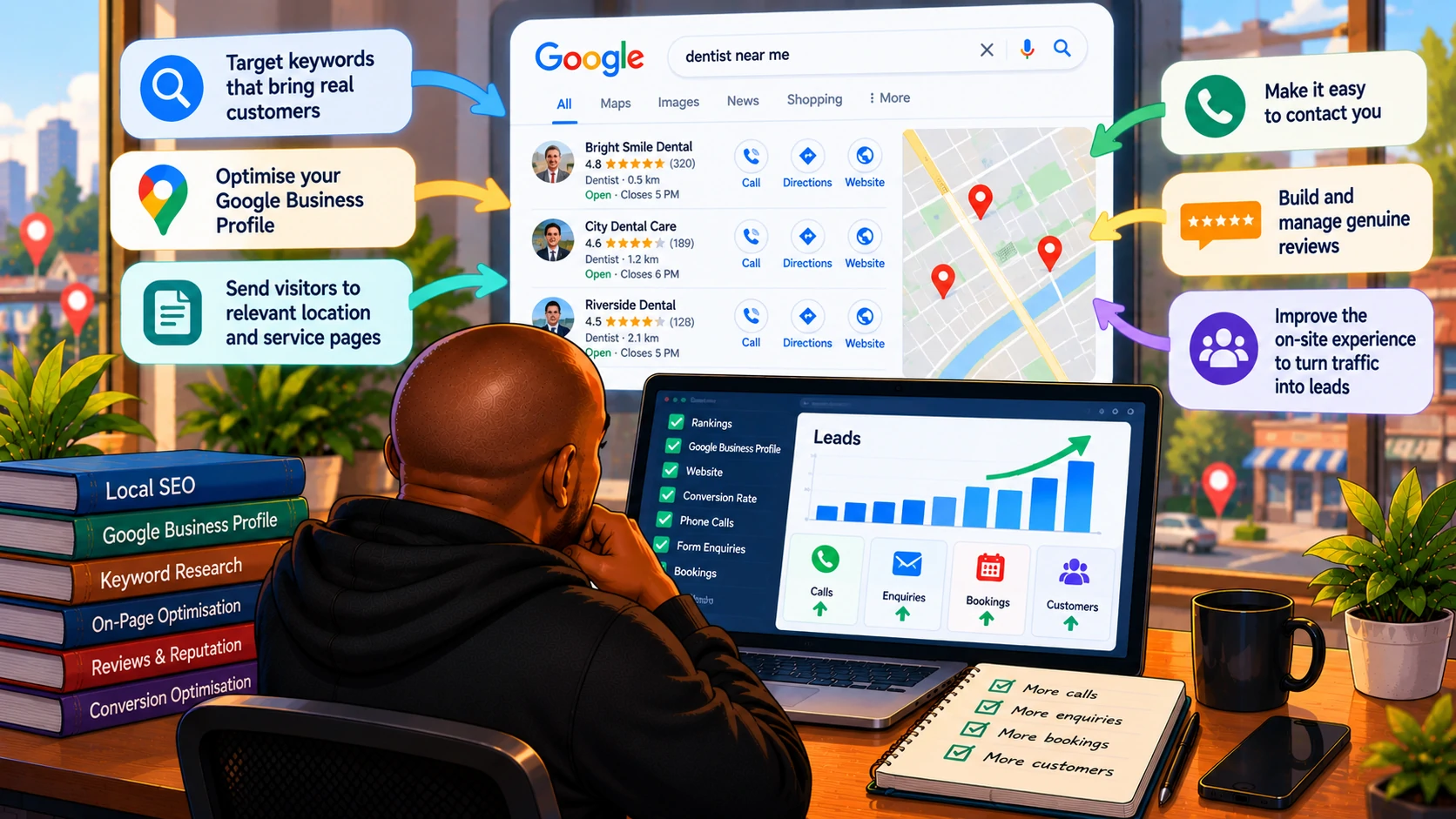
I’ve worked with enough local and multi-location businesses to know that a good local SEO report doesn’t always mean a satisfied client.
You can show improvements in Google rankings.
More visibility on Google Maps.
More impressions.
Better geographic coverage.
More traffic to location pages.
And then somebody asks the question that really matters:
“That’s great, but are we getting more leads?”
It’s a fair question.
After all, businesses don’t invest in local SEO just to appear on a map. They want more phone calls, enquiries, bookings, appointments and customers.
And after working on local SEO strategies for businesses across different markets, I’ve become increasingly convinced that increasing leads from local SEO is as much about what happens after someone discovers your business as it is about getting discovered in the first place.
You can rank well and still lose customers.
You can attract traffic and still generate very few enquiries.
You can have an optimised Google Business Profile and still make it unnecessarily difficult for someone to contact you.
So here’s how I approach local SEO when the goal isn’t just better rankings but more actual business opportunities.
First, Local SEO Traffic and Local SEO Leads Aren’t the Same Thing
Let’s start with something that sounds obvious.
A website visit is not a lead.
Neither is an impression.
Neither is a ranking.
Those metrics help us understand visibility, but they don’t tell the whole story.
Imagine two local businesses.
Business A gets 2,000 organic visits per month and generates 20 enquiries.
Business B gets 800 organic visits and generates 40 enquiries.
Which one would you rather own?
Assuming those enquiries are equally valuable, probably Business B.
That’s why I try not to judge local SEO performance on traffic alone.
I want to understand what people do after finding the business.
Do they call?
Complete a contact form?
Book an appointment?
Request directions?
Ask for a quote?
And ultimately, do those enquiries become customers?
Google Business Profile interactions such as calls, website clicks and direction requests can provide useful signals, but they aren’t all confirmed leads or completed sales.
That distinction matters when reporting results.
1. Target Keywords That Suggest Someone Actually Needs Your Service
One of the easiest ways to waste SEO resources is to chase keywords simply because they have impressive search volumes.
For local businesses, I pay particular attention to commercial and action-orientated search intent.
Consider these searches:
- What is a dental implant?
- Dental implant cost in Johannesburg
- Dental implant specialist near me
- Book a dental implant consultation
All four are related.
But the person making each search could be at a very different stage of their decision.
The first person may simply be researching.
The last person may be ready to book.
That doesn’t mean informational keywords are worthless. They can help people understand a service and become familiar with a business.
But if the objective is to increase leads from local SEO, I’d prioritise pages and queries with a clear connection to services people can enquire about.
This is especially important when SEO resources are limited.
I’d rather improve a service page that already attracts qualified enquiries than publish ten generic articles with no clear connection to the business.
2. Treat Your Google Business Profile Like a Customer Touchpoint
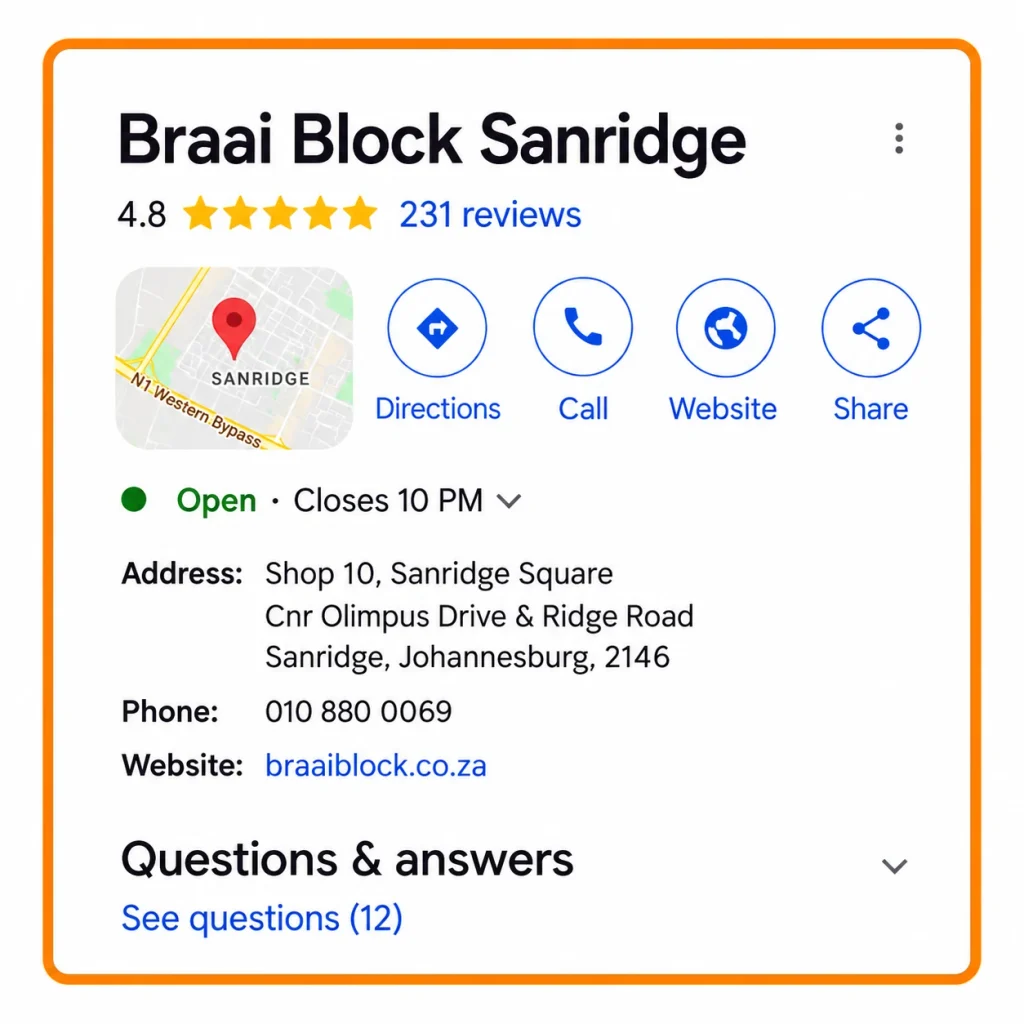
I think we sometimes underestimate how much happens directly inside Google’s local search results.
Someone searches for a nearby service.
They see the local pack.
They compare businesses.
They look at reviews.
Check opening hours.
View photographs.
Tap the call button.
And possibly never visit the website.
From an SEO perspective, that’s important.
A website isn’t always the final destination.
Sometimes the Google Business Profile is where the customer makes the decision.
That’s why I pay attention to the basics: accurate business details, appropriate categories, genuine service information, current opening hours, useful photographs, relevant website links and consistent contact information.
I also look at the experience from the customer’s perspective.
If someone finds this business right now, do they have enough information to take the next step?
Google’s own local ranking guidance explains the importance of relevance, distance and prominence in local results.
But appearing in those results is only the beginning.
Your listing still needs to give somebody a reason to choose you.
3. Stop Sending Every Local Visitor to the Homepage
This is one of the biggest opportunities I look for when reviewing multi-location websites.
A business operates in several cities.
It has different services.
Different locations.
Different customer needs.
But nearly every local search journey leads to the same generic homepage.
Now the visitor has to figure everything out.
Does this company serve my area?
Does this particular location offer what I need?
Where is the phone number?
How do I book?
Is there a nearby branch?
A useful location page can answer those questions much faster.
For example, a home care company with offices across multiple states shouldn’t rely entirely on one national page to explain every local service.
Individual location pages can help visitors understand local coverage, available services, contact details and what to expect.
I’ve written about what managing SEO for multi-location brands has taught me about local search.
One of the biggest lessons is that scale doesn’t remove the need for local relevance.
It makes local relevance harder to maintain.
What should a good location page include?
At minimum, I’d want the page to clearly communicate the location, services, areas served, how to contact the business and why someone should consider that particular location.
Where appropriate, it should also contain genuine local details, helpful FAQs, photographs, customer feedback and a clear next step.
Not every location needs an enormous essay.
And copying the same 1,500 words across 100 city pages while swapping the city name isn’t what I’d call a useful local strategy.
The goal is to make each page genuinely helpful to someone looking for that location.
4. Make It Ridiculously Easy to Contact the Business
This is where local SEO starts overlapping heavily with conversion rate optimisation.
And I think it’s one of the most overlooked parts of generating leads.
Imagine somebody finds your service page.
They’re interested.
They’re ready to enquire.
Then they encounter a form asking for:
First name.
Last name.
Email.
Phone.
Company name.
Job title.
Industry.
Budget.
How did you hear about us?
A detailed explanation of their problem.
Their preferred communication method.
Their favourite childhood memory.
Okay, maybe not that last one lol
But you get my point.
Some businesses make enquiries unnecessarily difficult.
If the customer is ready to contact you, don’t create ten additional reasons for them to leave.
For local service websites, I generally want to see a visible phone number, a straightforward contact form, clear calls to action and an obvious way to find the nearest location.
On mobile, click-to-call functionality can be especially useful.
The right conversion path depends on the business.
A dentist may want appointment bookings.
A plumber may want phone calls.
A franchise business may need a longer qualification form.
The point is to match the contact process to the customer’s actual needs.
5. Reviews Can Influence Whether Someone Contacts You
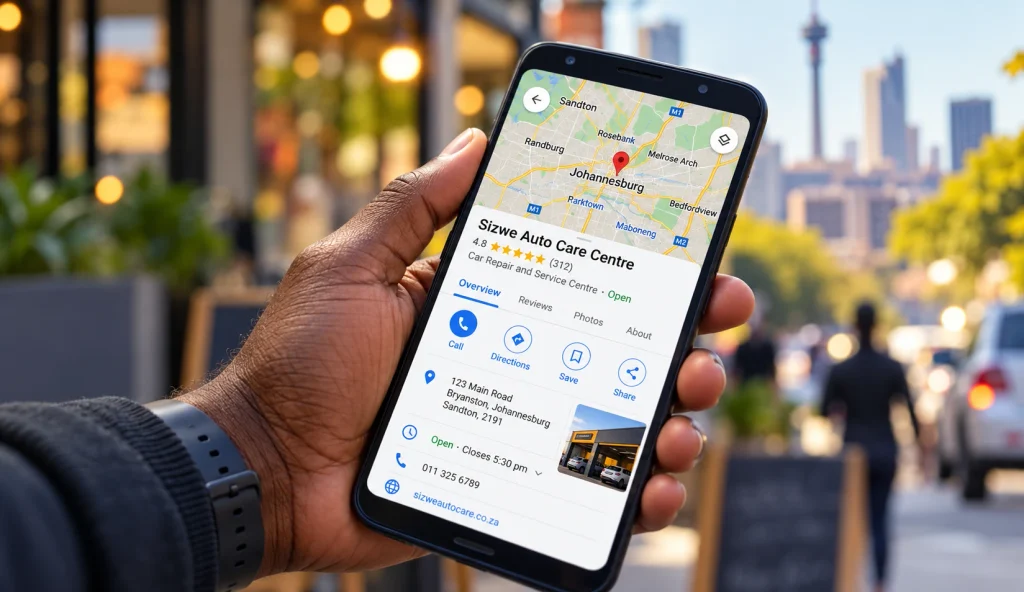
I find online reviews particularly interesting because they sit between visibility and conversion.
A business can rank well.
It can have a good website.
Its services can be exactly what the customer needs.
But if the reviews raise concerns, the customer may choose somebody else.
This is especially important for businesses where trust plays a major role.
Think about home care.
Healthcare.
Childcare.
Home repairs.
Financial services.
These aren’t always decisions people make casually.
Reviews help prospective customers understand other people’s experiences.
But I don’t think businesses should obsess only over their average star rating.
I’d also look at the content of the reviews.
What are customers praising?
What complaints appear repeatedly?
Are there concerns about communication?
Reliability?
Pricing?
Staff professionalism?
Service quality?
And how does the business respond?
A review strategy should be about improving and reflecting the customer experience, not manufacturing five-star ratings.
Google also prohibits fake engagement and certain forms of review manipulation under its Business Profile policies.
The objective is genuine trust.
Not simply a higher number beside some stars.
6. Answer the Questions People Ask Before They Enquire
This is where content can contribute directly to lead generation.
Someone may be interested in your service but still have concerns.
How much does it cost?
How long does it take?
What happens during the first appointment?
Do you serve my area?
Do I need to prepare anything?
Is the service covered by insurance?
What makes your approach different?
If your website doesn’t answer those questions, the visitor may leave to find the answers elsewhere.
And sometimes they won’t come back.
This is why I like service-page FAQs when they’re based on actual customer questions.
Not because adding FAQs guarantees a rich result or AI citation.
It doesn’t.
But because useful answers can remove uncertainty.
One thing I’d encourage local businesses to do is speak to their customer-facing teams.
Ask:
What do people always ask before they book or enquire?
Those questions are often more valuable than another generic keyword list.
And the answers can improve both organic relevance and conversion.
7. Internal Linking Should Help People Find the Right Service
Internal linking is one of those SEO activities that sounds simple until you look at a large website.
A business might have:
A homepage.
Twenty service pages.
Fifty blog posts.
Thirty location pages.
Several resources.
A contact page.
But the pages aren’t connected in a way that makes sense.
Someone reads an article about a service.
The article doesn’t link to the service page.
They visit a location page.
It doesn’t clearly link to the services available there.
They read a national service page.
It doesn’t help them find a nearby office.
That’s a missed opportunity.
I don’t add internal links simply to distribute ranking signals.
I also want to make the next useful step obvious.
If somebody is reading about dementia care, for example, a relevant link to the company’s dementia care service page may help them move from research to enquiry.
If somebody is reading about a tyre service, a link to nearby locations could help them find where to book.
Internal linking should connect information with actions that genuinely make sense.
8. Track Leads Properly Before Claiming SEO Success
This is probably one of the most important parts of the entire process.
I’ve encountered situations where analytics reports looked convincing until we started asking what was actually being tracked.
A thank-you page loads.
A key event fires.
The dashboard reports a conversion.
But was it a genuine form submission?
Was the event duplicated?
Did somebody refresh the thank-you page?
Was the form submission successful?
Did the lead come from organic search?
Was the enquiry qualified?
These questions matter.
If your tracking is unreliable, your SEO conclusions may be unreliable too.
For local SEO, I’d want a measurement framework that distinguishes between visibility, interactions, enquiries and actual business outcomes.
| Metric | What it helps us understand |
|---|---|
| Local search impressions | Search visibility |
| Google Business Profile interactions | Actions taken on the listing |
| Organic landing-page visits | Website traffic from search |
| Phone calls | Potential enquiries, depending on call quality |
| Successful form submissions | Recorded enquiries |
| Appointment bookings | Stronger commercial intent |
| Qualified leads | Enquiries that meet business criteria |
| Customers or revenue | Actual business impact |
I wouldn’t report every click-to-call action as a confirmed lead without appropriate verification.
And I wouldn’t assume every form submission is a valuable enquiry.
That’s why I’m increasingly interested in connecting SEO data with CRM information where possible.
I’ve explored similar challenges in how to report SEO success when AI is changing the SERP.
The principle is the same.
We need to measure outcomes, not simply celebrate activity.
9. Use Local SEO Data to Find Conversion Opportunities
One of my favourite parts of SEO is investigating what the data is telling us.
Imagine a location page receives a lot of impressions.
Its average position improves.
Organic traffic increases.
But enquiries remain flat.
That tells me something.
It doesn’t automatically tell me the answer, but it gives me a place to investigate.
Maybe the page attracts the wrong search intent.
Maybe the contact form is difficult to use.
Maybe the phone number isn’t prominent.
Maybe the content doesn’t answer important questions.
Maybe competitors have stronger reviews.
Maybe tracking is broken.
Or maybe enquiries are increasing through Google Business Profile rather than through the website.
I’d want to investigate before making changes.
Now imagine another page receives relatively little traffic but generates a high proportion of qualified leads.
That page might deserve more attention.
Could we improve its visibility?
Strengthen internal links?
Expand relevant service information?
Improve its title and description?
Build more useful supporting content?
This is why I prefer conversion-informed SEO prioritisation rather than treating all traffic growth as equally valuable.
10. Don’t Forget the Human Side of Lead Generation
Here’s something SEO alone can’t fix.
A business can rank number one.
Have excellent reviews.
A beautiful website.
A perfectly optimised contact form.
And still lose customers because nobody answers the phone.
Or because enquiries sit unanswered for two days.
Or because the person responding doesn’t provide useful information.
That’s not an SEO problem in the narrow sense.
But it affects whether SEO generates business value.
If we’re going to measure SEO based on leads and customers, we need to acknowledge the operational factors involved.
How quickly does the business respond?
Are calls answered?
Are missed calls followed up?
Are enquiries routed to the correct location?
Can customers book outside office hours?
Are leads being qualified consistently?
This aspect becomes especially important for franchises and multi-location businesses.
One location might respond within minutes.
Another might take two days.
Both could receive similar organic visibility but produce very different commercial results.
You can’t fix that with another H2 heading.
11. What About AI Search and Local Leads?
This is the part I’m watching closely.
People aren’t only searching:
plumber near me
They’re asking more detailed questions.
Who can help with a particular plumbing problem?
What should I check before hiring someone?
Which type of service do I need?
What should I expect to pay?
AI-powered search experiences can answer some of these questions directly and point people to relevant sources or businesses.
That creates opportunities, but it also complicates measurement.
A customer might discover a business through an AI-generated answer, research it further, read reviews and then make a branded search before contacting the company.
The original discovery source may not receive the credit.
I’ve written about how to show up in AI Overviews because I think this changes how we approach content and visibility.
For local businesses, my priorities remain fairly practical.
Accurate business information.
Useful service pages.
Clear location details.
Genuine reviews.
Strong local relevance.
Original information.
A trustworthy online presence.
And easy ways to contact the business.
I don’t think we need to abandon local SEO fundamentals to participate in AI search.
But we do need to understand that the path from discovery to enquiry may be becoming less direct.
How I Would Prioritise Local SEO Work to Generate More Leads
If I inherited a local business website tomorrow and the owner said:
“We don’t just want more traffic. We want more enquiries.”
I wouldn’t immediately start publishing blog posts.
I’d begin by understanding the existing situation.
Which services generate the most valuable customers?
Which locations are performing well?
Where are the leads currently coming from?
Are forms and phone calls tracked correctly?
Which pages attract commercial-intent searches?
Where do people abandon the enquiry process?
How strong is the Google Business Profile?
What are customers saying in reviews?
Are the location pages useful?
Once I understand those things, I will prioritise improvements based on their potential impact.
A Practical 30-day Starting Plan
Week 1 — Understand the leads:
Audit GA4 key events, form tracking, call measurement, Google Business Profile performance and available CRM data. Identify which services and locations generate valuable enquiries.
Week 2 — Fix the conversion barriers:
Review the highest-value service and location pages on mobile. Improve contact visibility, form usability, calls to action, location discovery and obvious trust gaps.
Week 3 — Improve commercial search visibility:
Optimise relevant Google Business Profiles, strengthen high-intent service pages, improve internal links and address important local information gaps.
Week 4 — Measure and refine:
Compare lead quality and conversion rates with the baseline, verify tracking, review underperforming locations and build the next month’s priorities from the findings.
I wouldn’t promise that every business will see a measurable increase in leads within 30 days.
Some improvements may produce quick results.
Others may take longer.
The purpose of the first month is to establish reliable measurement, remove obvious barriers and make informed decisions about what to improve next.
So, How Do You Actually Increase Leads From Local SEO?
I think the answer is less glamorous than people expect.
You need to be visible when the right people search.
You need to provide them a reason to trust your business.
You need to make the next step easy.
And you need to measure whether those interactions become genuine business opportunities.
That’s it.
Of course, achieving those things involves keyword research, Google Business Profile optimisation, location pages, technical SEO, content, reviews, internal linking, analytics and conversion improvements.
But those are the methods.
They’re not the goal.
After years of working in SEO, I’ve become less impressed by a ranking report that doesn’t explain what the business is getting from that visibility.
Don’t get me wrong.
I still enjoy seeing rankings improve.
I still like finding a page sitting in position eleven and figuring out how to move it higher.
I still enjoy analysing local ranking grids and identifying areas where a business has low visibility.
That’s part of the job.
But I’ve learned that the most useful question often comes after all that work.
What happened because we improved visibility?
Did more people contact the business?
Did more appointments get booked?
Did the quality of enquiries improve?
Did previously underperforming locations start generating opportunities?
Did the business actually grow?
That’s how I want to evaluate local SEO.
Because the objective isn’t to win a screenshot of the Google Maps results.
It’s about helping the right customers find the right business — and making it easy for them to take action.
