
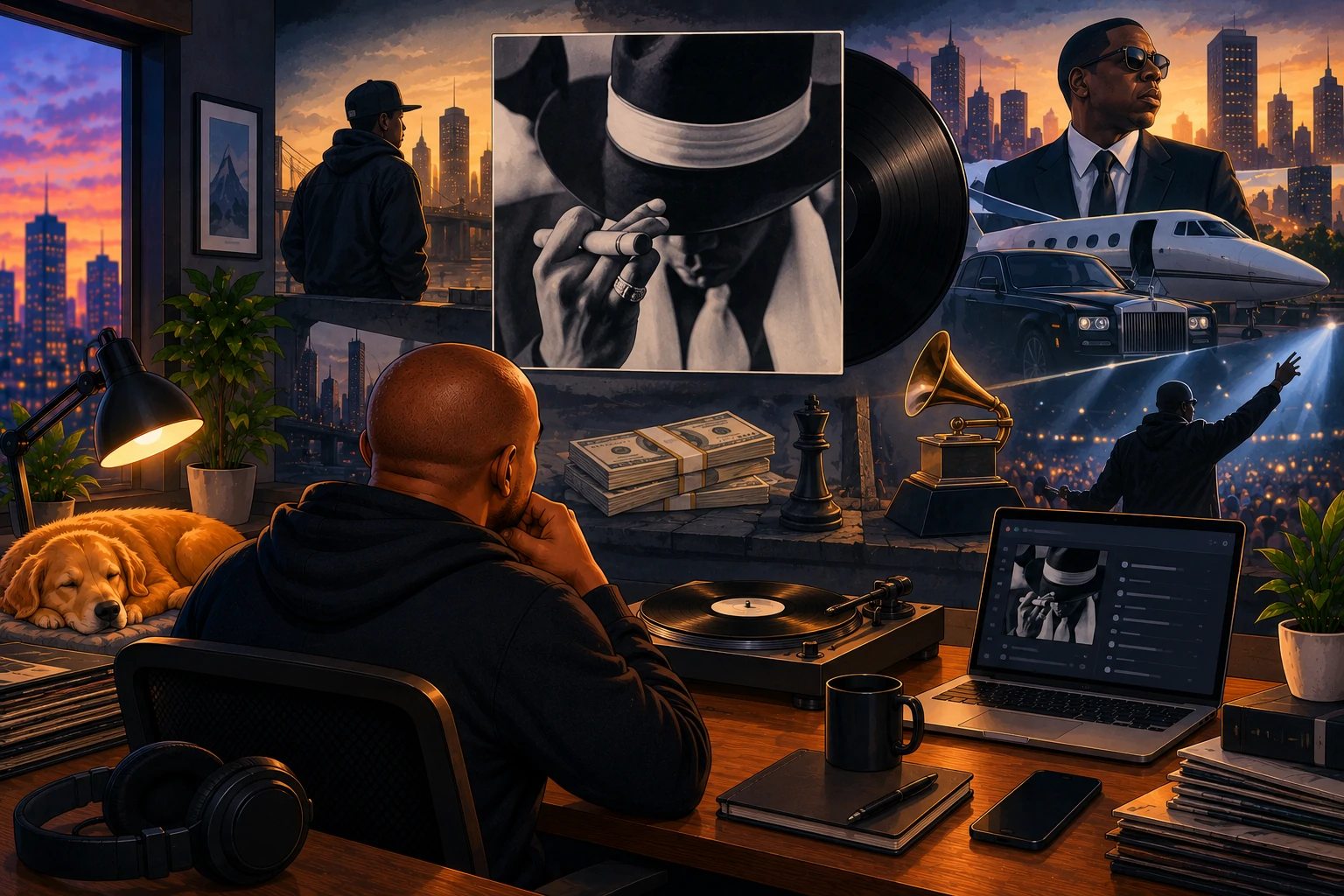
Thirty years later, I listen to Reasonable Doubt differently.
Of course, I still hear the bars.
The production.
The storytelling.
The confidence.
The hunger.
But now I hear something else.
Manifestation.
Not manifestation in the social media sense, where you write something on a vision board and wait for the universe to deliver it.
I’m talking about a man describing the life he believed he’d have before the rest of the world had much evidence he’d have it.
That’s what makes Reasonable Doubt so fascinating to listen to in 2026.
Jay-Z wasn’t a superstar when the album came out on June 25, 1996. He wasn’t even signed to one of the major labels that had rejected him. He, Damon Dash and Kareem “Biggs” Burke had created Roc-A-Fella because the traditional industry wasn’t exactly lining up to bet on him.
The album sold around 43,000 copies in its first week and peaked at No. 23 on the Billboard 200. Jay recently reflected that simply getting the album released felt like proof of concept to them, even when the wider industry didn’t see it that way. (British GQ)
Thirty years later, he’s celebrating that same album by performing in stadiums.
That’s crazy when you really think about it.
And it makes me wonder:
Is Reasonable Doubt the greatest manifestation album in hip-hop history?
He Didn’t Rap Like an Underdog
This might be my favourite thing about the album.
Most debut albums have some version of the underdog story.
I’m coming.
They’re sleeping on me.
One day I’m going to make it.
Give me a chance.
Watch what happens.
Jay didn’t really sound like that.
He sounded like he’d already arrived.
That’s the strange thing about Reasonable Doubt when you listen to it knowing what happened over the next 30 years.
The reality surrounding Jay-Z in 1996 said:
New rapper.
His raps said:
Mogul.
The industry said:
We’re not sure about this guy.
Jay sounded like the decision had already been made.
In his 2026 GQ interview, he said something that perfectly explains the mentality. He remembered being rejected, but not allowing those rejections to convince him that he wasn’t good enough. His reaction was basically that the people rejecting him simply weren’t seeing the vision.
That’s Reasonable Doubt.
It doesn’t sound like someone asking permission to become successful.
It sounds like someone describing the success before everyone else can see it.
The Money Talk Sounds Different 30 Years Later
Obviously, money has always been part of hip-hop.
And Reasonable Doubt is full of it.
Luxury.
Cars.
Jewellery.
Champagne.
Designer clothes.
Expensive tastes.
Financial ambition.
The fascinating part isn’t simply that Jay talked about being rich.
Rappers have been doing that forever.
It’s the scale of what eventually happened.
The person talking about wealth on Reasonable Doubt didn’t just become a successful rapper who could afford nice cars.
He became the first hip-hop billionaire.
Forbes declared him hip-hop’s first billionaire in 2019, pointing to a portfolio that stretched far beyond record sales: Rocawear, liquor, art, real estate, Tidal and investments, among other assets.
That’s what makes listening back so entertaining.
The luxury on Reasonable Doubt doesn’t sound like a fantasy anymore.
If anything, some of it now sounds modest.
This man was rapping about expensive tastes before he’d even released a commercially dominant album.
Eventually he became wealthier than the lifestyle he was describing.
It Wasn’t Just “I Want to Be Rich”
That’s an important distinction.
Jay wasn’t only imagining money.
He was imagining ownership.
That might be the real manifestation running through his career.
When the labels wouldn’t sign him, the solution was Roc-A-Fella.
If the traditional door wouldn’t open, build another door.
That mentality became bigger than music.
Rocawear followed. The 40/40 Club followed. Roc Nation followed. Investments followed. Sports management followed. Tidal followed. His business interests kept expanding. Forbes noted years ago how the entrepreneurial blueprint that started around Reasonable Doubt eventually grew into an empire around his intellectual property.
That’s why calling Jay-Z a rich rapper doesn’t really describe what happened.
He became a businessman who happened to also be one of the greatest rappers ever.
And somehow, listening to Reasonable Doubt, that person already seems to exist.
The bank account just hadn’t caught up yet.
Even the Way He Talked About Art Aged Differently
Here’s another small detail I love.
Jay was referencing Picasso on Reasonable Doubt in 1996.
Years later, art became part of his actual investment portfolio and public identity. Forbes would eventually analyse the enormous value of the artists mentioned throughout his music. (Forbes)
Again, I’m not saying Jay sat down in 1996 and wrote a 30-year investment plan into his album.
That’s not the point.
The point is that the tastes, ambitions and worldview he was rapping about weren’t temporary characters he invented for an album.
He grew into them.
Or maybe they were already him, just without the resources.
And Then There’s Memphis Bleek
This might be my favourite full-circle story on the entire album.
On Coming of Age, we’re introduced to Memphis Bleek.
A kid.
Literally.
Bleek was only around 15 when he recorded the song. The late DJ Clark Kent (may his soul rest in peace) recalled making the teenager rhyme for hours before deciding he should appear on the record. (SPIN)
Think about that for a second.
We’re listening to the first Jay-Z album.
Jay himself hasn’t become JAY-Z yet.
And he’s already introducing the next generation.
He’s already playing the role of the older guy bringing someone else through.
Bleek would go on to release multiple albums, become a recognised artist in his own right and remain part of Jay’s story decades later.
What’s even more interesting is something Bleek has said about that period.
He apparently had an offer from Capitol Records that included a $75,000 signing bonus—life-changing money given his circumstances at the time.
He turned it down.
Why?
Because he believed in Jay.
Bleek recalled essentially being told, “What if Roc-A-Fella never becomes what Jay thinks it can become?”
He took the chance anyway. (PodScripts)
Imagine making that decision when Reasonable Doubt is the evidence.
Now imagine looking at Roc Nation 30 years later.
That’s belief.
The People Around Him Might Be the Bigger Manifestation
Money is easy to measure.
Albums.
Businesses.
Net worth.
Stadiums.
But there’s another part of Reasonable Doubt that interests me more as I’ve gotten older.
The people.
Ty Ty Smith is referenced in Jay’s world all the way back in the Reasonable Doubt era.
Thirty years later, Ty Ty is still there.
Not “we occasionally take a picture together” there.
Family there.
On Beyoncé and Jay-Z’s FRIENDS, Jay describes the level of trust with one devastatingly simple line:
“Ty-Ty take care of my kids.”
That’s about as high as friendship goes.
The wider verse explains that they were present for each other through deaths in their respective families, and Jay places Ty Ty among the tiny circle of people he considers closer than ordinary friendship. (E! Online)
Think about that journey.
From Brooklyn.
Before the billions.
Before Beyoncé.
Before Roc Nation.
Before stadium tours.
Before all of it.
Still there.
We talk so much about Jay’s ability to build wealth that sometimes I think we overlook his ability to maintain certain relationships across completely different versions of his life.
That’s a different kind of success.
Maybe That’s What Reasonable Doubt Was Really Manifesting
The obvious answer is wealth.
But listen to the album again.
It’s bigger than money.
It’s a worldview.
Loyalty.
Taste.
Ambition.
Ownership.
Confidence.
Competition.
Survival.
Friendship.
Business.
Becoming something larger than your circumstances.
The album doesn’t feel like Jay asking:
“Can I become successful?”
It feels like he’s already decided what his life is supposed to look like and is trying to close the distance between his current reality and that vision.
That’s probably why the album has aged so well.
He Wasn’t Actually Winning Yet
This is the part that makes everything else important.
It’s easy to be confident after everybody agrees you’re great.
It’s easy to talk like a mogul when Forbes is calculating your net worth.
It’s easy to believe in your company when thousands of people work inside the ecosystem you’ve created.
Try doing it when record labels keep saying no.
Jay recently said not getting the record deal ultimately became one of the biggest blessings of his career because it forced them to build differently. (The FADER)
That’s hindsight.
But Reasonable Doubt lets us hear the person before the hindsight existed.
That’s why I keep coming back to the word manifestation.
We know the ending.
He didn’t.
Not for certain.
He believed it anyway.
Thirty Years Later, He’s at Yankee Stadium
And this is where the whole thing becomes almost too perfect.
July 10, 2026.
Yankee Stadium.
Jay-Z celebrating 30 years of Reasonable Doubt.
The following night was dedicated to 25 years of The Blueprint. Yankee Stadium officially announced the two anniversary concerts earlier this year. (MLB.com)
Imagine telling the guy releasing Reasonable Doubt independently in 1996:
Thirty years from now, New York is going to celebrate this album with you at Yankee Stadium.
Not a club.
Not a theatre.
Yankee Stadium.
In his city.
At 56 years old.
For an album that initially sold 43,000 copies in its first week.
If I wrote that into a movie, someone might tell me the ending was too obvious.
Then London
And it wasn’t just New York.
This month Jay brought the anniversary celebration to Tottenham Hotspur Stadium in London.
The Financial Times described a stadium-scale production with a live band, strings, horns, fireworks and guests including Lauryn Hill, Wyclef Jean, Giggs and Idris Elba.
Again:
56 years old.
Debut album turns 30.
Still doing stadiums.
There was a time when hip-hop artists weren’t even expected to have careers this long.
Now we’re watching them perform music recorded when some members of the audience weren’t even born.
Then Paris
On September 10, Jay took the celebration to Stade de France.
Justin Timberlake even joined him for a rare performance of Holy Grail.
The official Stade de France listing marked the event as sold out.
New York.
London.
Paris.
Thirty years after the debut.
I don’t know what the 1996 version of Jay would have considered the ceiling.
But I’m fairly certain this qualifies as getting close to whatever he was imagining.
Hip-Hop Grew Up
And maybe this is the part of the story I love most.
Jay didn’t age out of hip-hop.
Hip-hop aged with Jay.
And with us.
For a long time, hip-hop was treated as youth culture.
Young artists.
Young audiences.
What’s new?
Who’s next?
Who’s hot right now?
Artists reaching their forties were almost treated like they were ancient.
There wasn’t much of a blueprint, no pun intended (triple entendre, don’t even ask me how), for what a 50-something stadium-level rapper was supposed to look like.
We’re building that now.
The people who bought Reasonable Doubt in 1996 are older.
The people who discovered Jay through The Blueprint are older.
The people who came in during The Black Album are older.
The kids who heard Empire State of Mind are adults.
And we’re still listening.
That’s beautiful to me.
Hip-Hop Doesn’t Have to Throw Away Its History
Rock fans can watch a band perform songs from 40 years ago, and nobody finds that strange.
A 70-year-old can love the Rolling Stones without someone asking why they’re listening to “old music”.
Hip-hop deserves that same relationship with its history.
We don’t have to stop loving the music because we’re no longer 20.
And artists don’t have to disappear because the audience has grown older.
There will always be young rappers pushing the genre forward.
There should be.
Hip-hop needs that energy.
But there is also room for legacy.
For catalogues.
For anniversary shows.
For parents taking their children to see the artists they grew up listening to.
For someone in their fifties standing in Yankee Stadium rapping songs they first heard when they were in their twenties.
That’s what a mature genre looks like.
Maybe Reasonable Doubt Wasn’t an Album About Having Made It
Maybe it was an album about already seeing yourself there.
That’s different.
Jay didn’t have the biggest sales.
He didn’t have the major-label machine.
He wasn’t the biggest rapper in New York.
Biggie was alive.
Pac was alive.
Nas had Illmatic.
The competition was ridiculous.
Yet Jay entered the conversation sounding like he owned the building.
Eventually, he did.
The wealth arrived.
The businesses arrived.
The No. 1 albums arrived.
The global recognition arrived.
The stadiums arrived.
The friendships survived.
The kid from Coming of Age grew up.
The independent label became part of a much larger business story.
And the album that wasn’t an immediate blockbuster became important enough for people to gather at Yankee Stadium 30 years later to celebrate it. (JAŸ-Z30 – Media)
So is Reasonable Doubt the greatest manifestation album of all time?
Maybe.
I’m a Jay-Z fan, so I’m obviously not an impartial judge.
But name another debut album where you can listen 30 years later and draw this many straight lines between what the artist imagined, the person he presented himself as, the people he brought with him, and the life that eventually followed.
That’s what makes the album special to me.
It isn’t just that Jay-Z told us he was going to be successful.
He rapped like success was already his reality and the rest of the world was simply late to finding out.
Thirty years later, thousands of people are standing inside stadiums shouting those words back at him.
Maybe that’s manifestation.
Maybe that’s unbelievable self-belief.
Maybe that’s just the hustler mentality that made Reasonable Doubt what it is.
Whatever you want to call it, I’m glad hip-hop has been around long enough for us to see the ending.
And I’m even happier that we’re finally reaching a point where the music doesn’t have to belong only to the young.
We grew up.
Jay grew up.
Hip-hop grew up.
The records came with us.
Thirty years later, Reasonable Doubt doesn’t just sound like an album about the life Jay-Z wanted.
It sounds like a preview.
Long live Reasonable Doubt.
And long live hip-hop.
