
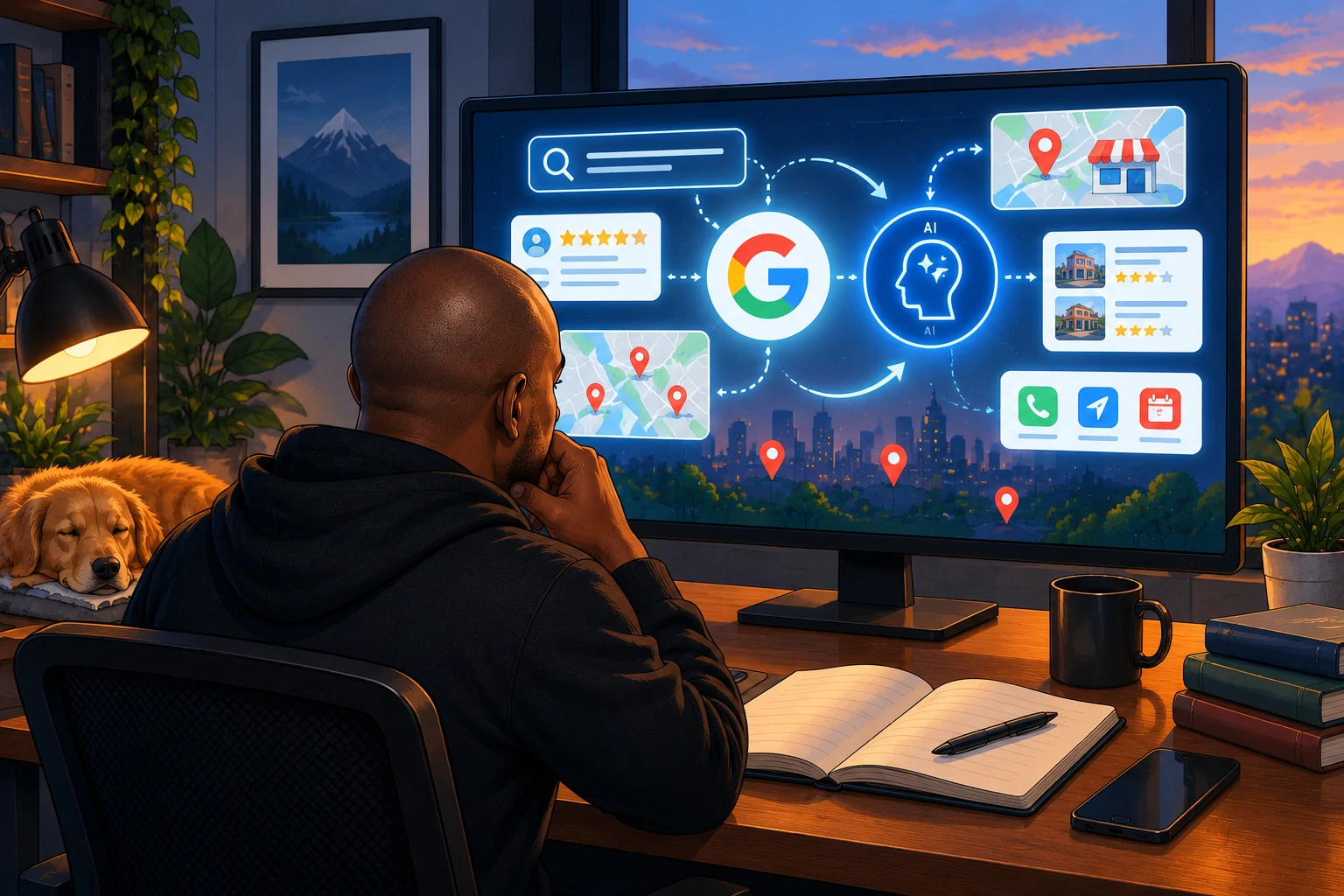
I’ve been working in SEO long enough to have watched it supposedly die several times.
Social media was going to kill it.
Voice search was going to kill it.
Zero-click searches were going to kill it.
Then ChatGPT arrived, AI Overviews started taking up more space in Google, AI Mode changed how some searches look, and suddenly we were having the same conversation again.
Does SEO still matter if AI can answer the question without sending someone to a website?
I think it does.
But my answer is probably biased by the kind of SEO I spend a lot of time working on.
Multi-location SEO.
Local search.
Franchise brands.
Google Business Profiles.
Businesses where the goal isn’t necessarily to get someone to read a 2,000-word article.
Sometimes the goal is much simpler:
Find the nearest location. Call them. Get directions. Book something. Visit the business.
And when I look at SEO through that lens, it’s difficult for me to see it disappearing.
If anything, I think AI is making some parts of local SEO more important.
AI Can Answer Questions. It Can’t Make Location Irrelevant.
Let’s use a simple example.
Someone searches:
“home care near me”
They aren’t looking for a 1,500-word definition of home care.
They’re trying to find someone who can provide care in their area.
Or:
“preschool near me”
“auto repair near me”
“dentist open now”
“coffee shop near me”
“tyre shop in Pretoria”
These searches have a physical reality attached to them.
The searcher is somewhere.
The businesses are somewhere.
They have opening hours.
Reviews.
Addresses.
Service areas.
Phone numbers.
Availability.
Reputations.
AI can change the interface around that information.
It can summarise it.
Compare businesses.
Recommend options.
Potentially help someone make the decision faster.
But it still needs to understand which businesses exist and which ones are relevant to that person.
That’s local search.
Google itself still says local results are primarily influenced by relevance, distance and prominence.
AI doesn’t magically make those questions disappear.
This Is Why I Think Local SEO Is in an Interesting Position
A lot of the anxiety around AI search comes from looking at informational SEO.
And I understand why.
If someone searches:
“How often should I service my air conditioner?“
an AI-generated answer could potentially satisfy that query without the person visiting a website.
That’s a legitimate concern.
But what happens next?
Maybe the next search is:
“air conditioning repair near me.”
Now we’re playing a different game.
The first query is informational.
The second has local and potentially transactional intent.
And that distinction matters enormously.
I’ve worked on enough multi-location SEO campaigns to know traffic isn’t always what I care about most.
If organic sessions fall 5% but calls, directions, bookings or qualified leads increase, I’m not going into a client meeting announcing that SEO has failed.
I care about the business outcome.
AI search is forcing us to think harder about that.
Google Business Profile Might Matter More, Not Less
This is probably one of the strongest reasons I’m not buying the “SEO is dead” argument.
Google Business Profile sits incredibly close to the actual customer decision.
Think about what someone can potentially see without visiting your website:
Business name.
Address.
Opening hours.
Phone number.
Reviews.
Rating.
Photos.
Services.
Directions.
Website.
Products in some cases.
Other information about the location.
For many local searches, the business profile isn’t supporting the customer journey.
It is the customer journey.
And Google says Business Profile information can appear across both Search and Maps. It also sources local business information from the official website, third parties, user contributions such as reviews and photos, business owners, and Google’s own interactions with places.
That’s important in an AI world.
Because AI systems need information.
Your local SEO job increasingly becomes making sure business information is accurate, consistent, useful, and understandable wherever machines and customers encounter it.
Reviews Are Becoming More Than a Conversion Factor
Reviews have always mattered in local SEO.
If I’m choosing between two businesses and one has a 4.8 rating from hundreds of customers while the other has 3.1 stars, that’s probably going to influence me.
But AI adds another layer.
Google says that review count and review score CAN contribute to local prominence. (I said “CAN“)
Google is also already using AI to analyse reviews and create summaries of common customer sentiment and themes in local listings.
Think about what that means.
A review isn’t only something another human might read anymore.
It can become part of the information machines use to summarise what customers think about a business.
That’s fascinating to me.
If hundreds of customers consistently mention that a particular location has friendly staff, quick service or excellent communication, that isn’t just reputation management.
It becomes structured evidence about what people associate with that location.
This is where local SEO, reputation management and AI search start overlapping.
Multi-Location SEO Makes the Problem Much Bigger
Now imagine managing this for one business.
Not too bad.
Now imagine 50 locations.
Or 200.
Or 500.
That’s where things get interesting.
I’ve spent a lot of time working with multi-location and franchise brands, and one of the biggest lessons I’ve learned is that scale exposes inconsistency very quickly.
One location has the correct hours.
Another doesn’t.
One Google Business Profile uses the right category.
Another has an old category.
One location page has genuinely useful local information.
Another looks like someone copied the first page and changed the city name.
One location has hundreds of recent reviews.
Another hasn’t received one in six months.
One franchise location responds to reviews.
Another ignores them.
One page clearly explains the services available locally.
Another assumes the national website has already done the job.
From a traditional SEO perspective, those inconsistencies can affect local performance.
From an AI-search perspective, I think they become even more interesting.
Because now we’re asking machines to understand:
What does this brand do?
Where does it operate?
Which services does this specific location provide?
What do customers think about this location?
Is the information consistent across the website, Google Business Profile and the wider web?
Multiply that by 500 locations.
That’s not less SEO.
That’s a much bigger information-management problem.
Your Location Pages Still Matter
I’ve never liked location pages that exist purely because someone wanted to rank for:
[SERVICE] + [CITY]
You know the type.
Same 700 words.
Same headings.
Same stock image.
The city name changed twenty times.
Publish.
Repeat for another 100 locations.
Technically, you now have local pages.
But are they actually useful?
AI search makes me think we need to push much harder toward genuine local usefulness.
A strong location page should help someone understand that particular business.
What services are available?
Where exactly is it?
Which communities does it serve?
When is it open?
How can someone contact it?
What makes that location different?
Are there local reviews or testimonials?
Who operates the location?
Are there useful directions or landmarks?
Are there location-specific FAQs?
Does this location offer something another location doesn’t?
That creates something much more valuable than a doorway page with a city name inserted into a template.
And remember: Google explicitly says that information used in Business Profiles can come from crawled web content, including the business’s official website.
The website and Business Profile aren’t two separate SEO strategies.
They help Google understand the same real-world business.
The National Brand Still Matters Too
This is another lesson multi-location SEO has taught me.
You can’t think only at the location level.
A franchise brand might have hundreds of individual locations, but they’re all connected to a larger entity.
The national website helps establish:
Who is this company?
What does it offer?
Why should people trust it?
What services does it provide?
Where does it operate?
What expertise does it have?
Then the location pages answer:
What does that mean for someone in my area?
I think AI search makes that relationship even more important.
The national site builds understanding of the brand.
The local pages establish geographic relevance.
Google Business Profiles connect those entities with physical locations.
Reviews provide customer-generated evidence.
Citations, links and mentions reinforce the wider footprint.
Structured data can help machines interpret some of those relationships.
That’s not how I thought about local SEO when I first started.
I would have thought much more in terms of:
“How do we rank this location for this keyword?”
Now I’m increasingly thinking:
“How do we make this entire network of locations easy for search engines, AI systems and customers to understand?”
That’s a different problem.
AI Search Doesn’t Mean Keywords Suddenly Don’t Matter
I still do keyword research.
I still look at rankings.
I still optimise pages.
I still care about titles, headings, internal links and technical SEO.
I’m not throwing all of that away because someone invented the acronym GEO.
What has changed is how I interpret the information.
Take something like:
“elderly care near me”
The keyword tells me something useful.
But I also want to understand the broader intent.
What questions does someone ask before reaching that search?
What services are they comparing?
What terminology do they use?
Does Google show a map pack?
Does it show AI-generated information?
Which businesses appear?
What do their reviews say?
Which directories are present?
Which brands keep appearing across different searches?
The keyword becomes the beginning of the investigation rather than the entire strategy.
Local Search Has Always Been About More Than the Website
This is why I think local SEOs might actually be better prepared for AI search than we realise.
We’ve never been able to rely entirely on the website.
We’ve always had to think about:
Google Business Profile.
Reviews.
Maps.
Directories.
Local citations.
Links.
Location pages.
Photos.
NAP consistency.
Local relevance.
Brand reputation.
Proximity.
The real-world business.
Google’s own guidance makes this explicit: prominence can be informed by things such as links, articles, directories and reviews, while relevance depends partly on detailed business information.
In other words, local SEO has always required us to think beyond ten blue links.
AI search is pushing the rest of SEO in a similar direction.
The Website Isn’t Dead Either
There’s another argument I keep seeing:
“If AI answers everything, businesses won’t need websites.”
I don’t buy that.
The website is still one of the strongest sources a business controls.
Your Google Business Profile belongs inside Google’s ecosystem.
Your social profiles belong to social platforms.
Your reviews are written by customers.
Your Reddit mentions belong to Reddit.
Your website is where you can explain the business properly.
And for multi-location brands, it’s where you can create the architecture connecting:
brand → services → states/regions → locations → local services.
It gives search engines something crawlable.
It gives AI systems information.
It gives customers somewhere to verify what they’ve discovered elsewhere.
And Google explicitly identifies official websites as one source it uses when compiling business information.
So yes, I still care about the website.
A lot.
AI Visibility Without Good SEO Seems Like a Strange Strategy
This is where some of the SEO-vs-GEO debate loses me.
Someone will say:
“We don’t care about SEO anymore. We’re optimising for AI.”
Okay.
How?
You still need crawlable information.
Clear content.
Strong entities.
Good site architecture.
Original information.
Brand authority.
Mentions.
Links.
Accurate business information.
Useful pages.
Structured information.
Technical accessibility.
Google itself added guidance specifically addressing generative AI features and reiterated that established SEO best practices remain relevant to visibility in its generative search experiences.
So I’m not convinced the answer to AI search is abandoning SEO.
I think it’s expanding what we consider SEO.
What I Think Changes for Multi-Location Brands
If I were responsible for a large multi-location brand—which is a situation I’m very familiar with—I wouldn’t respond to AI search by suddenly chasing every new optimisation tactic people post on LinkedIn.
I’d double down on fundamentals, but I’d broaden them.
I’d want accurate Google Business Profiles across every eligible location.
Strong location pages with genuine local value.
Consistent business information.
Clear service-to-location relationships.
A scalable review-generation and response strategy.
Local links and mentions where they make sense.
Strong national service content.
Good internal linking between national and local pages.
Structured data implemented correctly.
Clear brand/entity information.
Useful images.
Strong technical foundations.
And content based on questions actual customers ask.
Then I’d start measuring AI visibility alongside traditional search rather than pretending one has replaced the other.
Measurement Has to Change
This might actually be the bigger challenge.
Traditional local SEO reporting might include:
Rankings.
Organic traffic.
Google Business Profile interactions.
Calls.
Directions.
Website clicks.
Form submissions.
Leads.
Conversions.
We still need those.
But I increasingly want another layer.
Is the brand appearing in AI answers?
Which competitors are mentioned?
Which sources are being cited?
Are individual locations appearing when people ask AI systems for recommendations?
Does the brand appear for informational questions earlier in the journey?
Are reviews influencing how the business is being described?
Are certain competitors consistently associated with topics we aren’t?
That’s where SEO reporting starts becoming more interesting.
Not:
“SEO is gone, so let’s stop measuring rankings.”
More:
“Search has expanded, so our measurement needs to expand too.”
So, Does SEO Still Matter?
Absolutely.
But I don’t think the most useful version of SEO in 2026 is obsessing over whether a title tag should be 57 or 59 characters.
SEO is becoming more connected to everything around it.
Brand.
Reputation.
Content.
PR.
User experience.
Data.
AI.
Technical infrastructure.
And nowhere is that more obvious to me than local search.
Someone still needs a dentist.
Someone still needs an auto repair shop.
Someone still needs a caregiver for their parent.
Someone still needs a preschool for their child.
Someone still wants coffee.
The interface they use to find those businesses might change.
Maybe they search Google.
Maybe they use Maps.
Maybe an AI Overview appears.
Maybe they ask an AI assistant.
Maybe eventually an AI agent does most of the research for them.
But underneath all of those experiences sits the same fundamental problem:
Which business should I choose?
And machines need information to answer that question.
They need to understand what your business does.
Where it operates.
Whether it’s relevant.
Whether people trust it.
What customers say about it.
And how it compares with the alternatives.
For multi-location brands, that information needs to be accurate across hundreds or sometimes thousands of individual touchpoints.
That’s why I don’t think AI search makes local SEO irrelevant.
I think it raises the stakes.
SEO still matters. The search box is just no longer the only place we’re optimising for.
And if my years working with local and multi-location brands have taught me anything, it’s that helping machines understand a business has always been part of the job.
AI is simply making that much harder to ignore.
