
For a long time, I had the wrong idea about learning Python.
I thought programming was something you learned because you wanted to become a developer.
If that wasn’t the goal, how much Python did you really need?
But the more I’ve worked in SEO, explored cybersecurity and watched AI change how we interact with technology, the more I’ve started thinking about programming differently.
I don’t want to become a software developer.
I want to become better at solving problems with technology.
Python happens to be one of the tools that can help me do that.
I Don’t Need to Become a Developer to Write Useful Code
This was probably the mindset shift I needed.
There are people who spend their careers building applications, designing software architecture and writing production code.
That’s a profession.
I’m not trying to casually learn Python for a few months and pretend I can do their job.
My goal is much narrower.
I want to be able to look at something repetitive and ask:
Could I make the computer do this for me?
Maybe I have 2,000 URLs that need checking.
Maybe I need to combine several CSV files.
Maybe I want to pull data from an API.
Maybe I’m analysing logs.
If 30 lines of Python can solve that problem, that’s enough reason for me to learn those 30 lines.
I’m Learning Python Around Problems
I’ve tried learning programming the traditional way before.
Variables.
Data types.
Loops.
Functions.
Classes.
Exercises.
Then more exercises.
There’s nothing wrong with that approach. You need the fundamentals.
My problem was motivation.
I’d learn something and immediately wonder:
When am I actually going to use this?
Now I’m approaching Python differently.
I’m still learning the basics, but I’m trying to connect them to problems I already understand.
SEO gives me plenty.
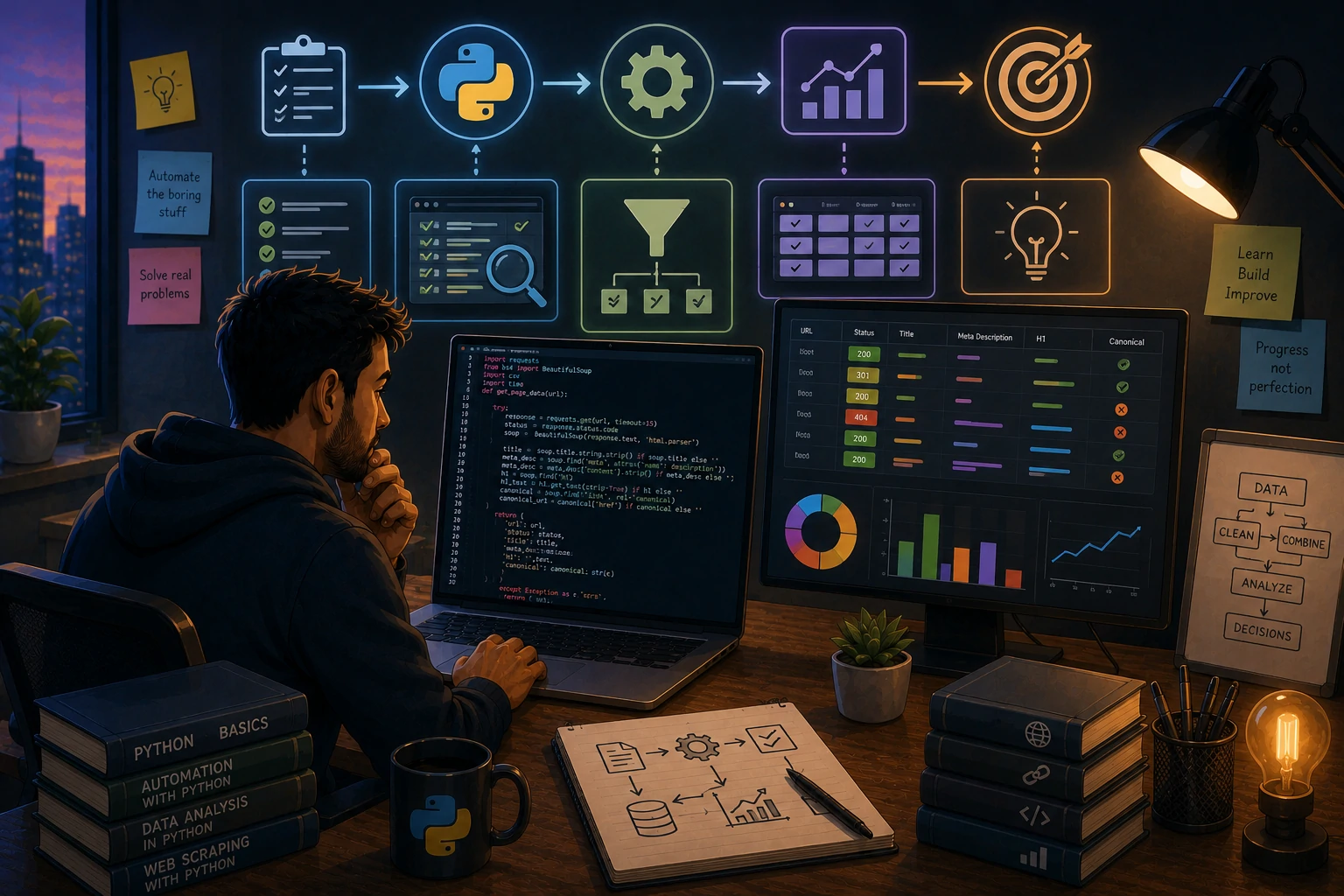
Take a list of URLs and check their status codes.
Suddenly loops make sense.
Extract the title from each page.
Now I have a reason to understand HTML parsing.
Export the results.
Now I’m working with data.
Handle a URL that doesn’t respond.
Now error handling isn’t just something from a tutorial.
The problem gives the programming concept a purpose.
SEO Is Full of Good Beginner Projects
One advantage I have is that I already know the problems I want to solve.
I don’t need to invent projects just to practise Python.
SEO gives me an endless supply.
URL checking.
Keyword cleaning.
Metadata analysis.
Redirect checks.
Search Console data.
Internal linking analysis.
Log files.
Competitor data.
Reporting.
Most of these tasks can already be completed with existing SEO tools.
That’s fine.
I’m not trying to replace them.
I’m using familiar SEO problems as a way to learn programming.
If I already understand what the output should look like, I can concentrate on learning how to get Python there.
Cybersecurity Is Giving Me Another Reason to Learn
Then cybersecurity entered the picture.
Python appears there too.
Working with logs.
Processing files.
Analysing data.
Automating repetitive security tasks.
Suddenly the same language I’m learning for SEO can help me explore another area of technology I’m interested in.
That makes Python much more interesting to me.
I’m no longer learning it because someone published a list of “10 skills every SEO needs.”
I’m learning it because I keep finding situations where knowing how to code would expand what I’m capable of doing.
I Don’t Need to Memorise Everything
This has been another useful realisation.
I used to think programmers had every command stored somewhere in their brains.
Then you watch experienced developers work and realise they’re looking things up too.
Documentation exists for a reason.
The goal isn’t to memorise every Python method.
I need to understand concepts.
What is a variable?
How does a loop work?
When would I use a function?
How do I work with a list?
How do I read a file?
How do I handle an error?
How do I use a library?
Once I understand what I’m trying to accomplish, I can look up the exact syntax when I need it.
That takes some pressure off.
AI Has Changed What Learning to Code Looks Like
And then there’s AI.
I can describe a problem and get working Python code in seconds.
Which raises an obvious question:
Why bother learning Python at all?
Because getting code and understanding code are different things.
AI can write a script that looks completely convincing.
If I don’t understand the fundamentals, I have no idea whether that script is doing exactly what I asked.
I don’t know why it failed.
I don’t know whether the output can be trusted.
I don’t know how to change it safely.
For me, the opportunity is using both.
Learn enough Python to understand the logic.
Use AI to move faster.
Ask it to explain unfamiliar code.
Use it when I’m stuck.
Then test everything.
AI becomes much more useful when I understand enough to question it.
My Code Doesn’t Need to Be Beautiful Yet
This one is important when you’re learning in public.
My early Python scripts are probably not going to impress experienced developers.
There will be inefficient loops.
Repeated code.
Strange variable names.
Solutions that could have been written much more elegantly.
That’s okay.
There’s a difference between:
Does this work?
and:
Is this the best way to build it?
Right now, I’m often working on the first question.
As I improve, I can start caring more about the second.
Trying to write perfect code before I can comfortably write basic code feels like a good way to never build anything.
I Still Want to Learn the Fundamentals Properly
Using Python practically doesn’t mean skipping the basics.
In fact, I’m starting to appreciate the fundamentals more because I can see where they fit.
Variables aren’t just lesson one.
They’re how I store something I need later.
Loops aren’t lesson four.
They’re how I perform the same check across 1,000 URLs.
Conditions are how I tell my script:
If the status code isn’t 200, flag it.
Functions help me stop repeating the same code.
Libraries let me use functionality other people have already built.
The concepts become easier to remember when they’re attached to something useful.
I Want to Be Dangerous Enough to Build Things
Not dangerous in the cybersecurity sense.
That would be a terrible choice of words given what else I’m studying.
I mean capable enough to have an idea and attempt to make it real.
That’s the level I’m chasing.
I don’t need to build the next Instagram.
I want to build a script that saves me an hour.
Then maybe something that saves my team time.
Then something that connects two datasets in a way I couldn’t easily do before.
Then perhaps something I haven’t thought of yet.
Each small project expands the range of problems I can solve.
That’s what interests me.
Programming Is Becoming Another Form of Literacy
I’ve started thinking about Python almost like learning Excel.
You don’t need to become a financial analyst to benefit from understanding spreadsheets.
You don’t need to become a data scientist to understand data.
And you don’t necessarily need to become a software developer to benefit from knowing how to program.
Technology increasingly sits underneath almost every part of digital work.
SEO.
Marketing.
Analytics.
Cybersecurity.
AI.
Automation.
Understanding some code gives you another way to interact with that technology.
I’m Learning Enough to Make Myself More Capable
I don’t know how far I’ll eventually take Python.
Maybe I’ll become much more advanced.
Maybe I’ll reach a level where I can comfortably automate the things I care about and spend my learning time elsewhere.
I’m not worried about deciding that now.
The goal isn’t a job title.
It’s capability.
Can I automate something that used to be manual?
Can I work with data more effectively?
Can I understand the code AI gives me?
Can I build a useful tool?
Can I better understand the technology around my work?
Every time the answer becomes “yes,” learning Python has paid off.
I don’t want to become a software developer.
I just don’t want “I don’t know how to code” to be the reason I can’t build something.
