
For years, SEO reporting has followed a familiar pattern.
Rankings went up. Organic traffic increased. Conversions improved. Everyone was happy.
That model isn’t useless, but it’s becoming incomplete.
AI Overviews, richer search results, local features and AI assistants are changing what happens between someone asking a question and eventually visiting a website.
The awkward part is that our reporting hasn’t completely caught up.
A ranking doesn’t tell the whole story anymore
I still track rankings.
If an important page moves from position 15 to position 3, I want to know about it.
But ranking third doesn’t necessarily mean what it once did.
There might be an AI Overview above you. There could be videos, Reddit discussions, a map pack, shopping results or other features competing for attention.
You can improve rankings and still see fewer clicks.
That doesn’t automatically mean the SEO work failed.
It means we need more context.
Traffic needs context too
Organic sessions have traditionally been one of the easiest ways to demonstrate SEO growth.
More visibility should mean more traffic.
Except sometimes people no longer need to click.
Someone might search for a question, get enough information directly from the results and leave.
For informational searches, that could mean fewer visits even when your content is highly visible.
This is where reporting can become uncomfortable.
Imagine telling a client:
“Your traffic decreased, but your visibility might actually have improved.”
Understandably, they’re going to want evidence.
And right now, getting that evidence isn’t always easy.
I’m paying more attention to what happens after the click
One change I’m making is putting more weight on outcomes.
I’d rather generate 5,000 visits that produce enquiries, purchases or qualified leads than 20,000 visits from people who disappear five seconds later.
That means SEO reports need to connect search performance with what the business actually cares about.
Are people completing forms?
Calling?
Buying?
Booking appointments?
Finding locations?
Searching for the brand later?
Traffic still matters, but traffic without context can make a report look healthier than the business actually is.
Brand visibility is becoming more interesting
This is one area I think we’ll talk about much more.
If people repeatedly encounter a company through search results, AI answers, Reddit discussions, review sites and other sources, they may eventually search for that company directly.
The final visit might appear as branded organic, direct or even another channel.
But something influenced that decision.
So I’m increasingly interested in branded searches, mentions, citations and how often a company appears around the topics it wants to be known for.
The problem?
Not all of this is easy to measure yet.
We should be comfortable admitting that.
AI visibility needs its own context
There’s a growing collection of tools promising to track whether brands appear in ChatGPT, Gemini and other AI experiences.
I think that information can be useful.
But I’m cautious about turning an “AI visibility score” into the new keyword ranking.
AI answers can vary based on the prompt, user, context and platform. A neat percentage on a dashboard can make something complicated look far more precise than it really is.
I’d rather use AI visibility as another signal than pretend it tells the entire story.
So what should an SEO report show?
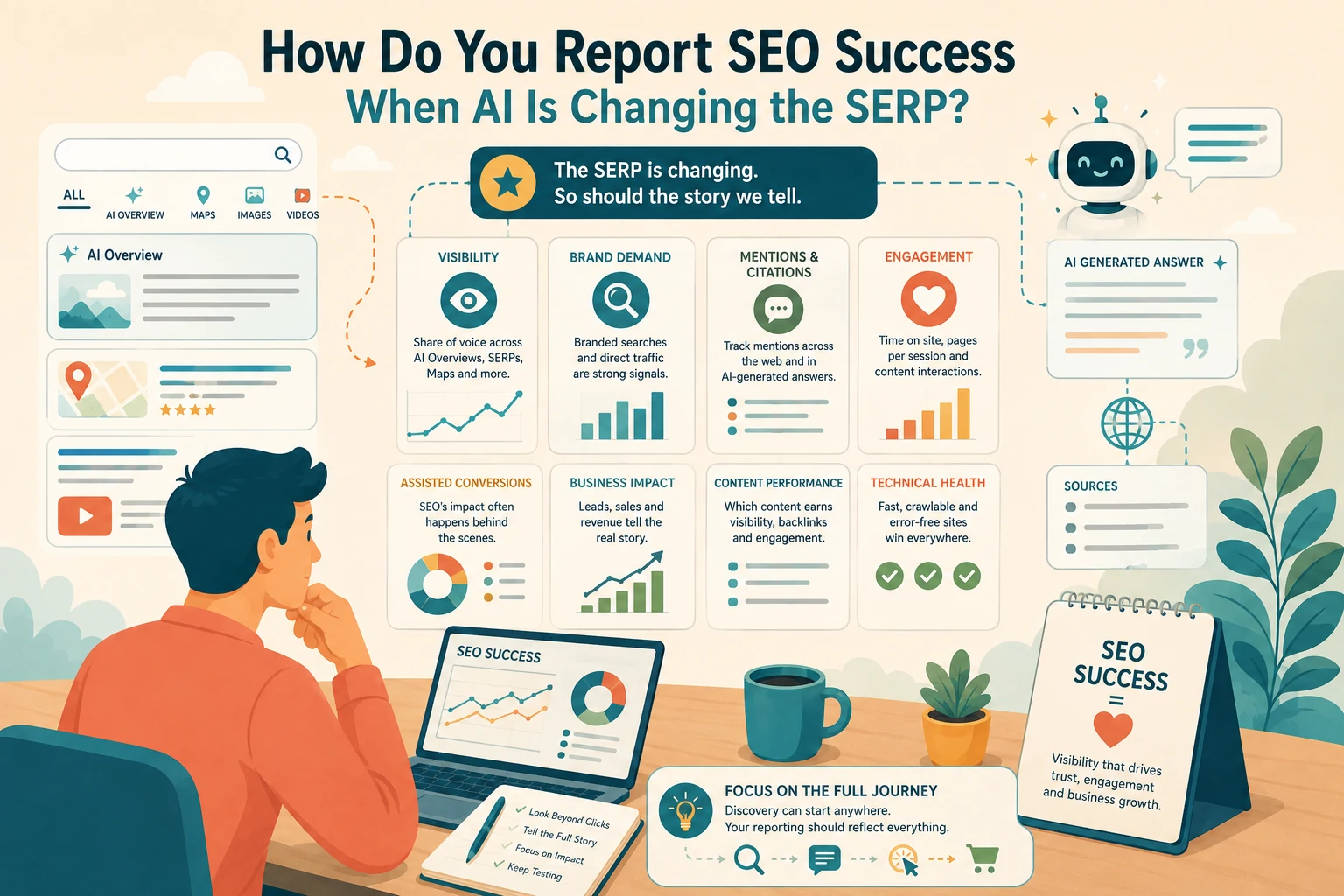
For me, reporting is moving towards several layers.
Traditional search performance still belongs there: clicks, impressions, rankings, CTR and organic traffic.
Then comes engagement and business performance: leads, sales, calls, bookings and other meaningful actions.
Beyond that, I want to understand brand demand, SERP visibility and, increasingly, presence within AI-powered discovery.
No single metric gets to declare SEO successful.
Maybe reporting was always supposed to change
The temptation with reporting is to measure whatever gives us the cleanest graph.
But our job isn’t to produce pretty graphs.
It’s to explain what is happening.
Sometimes rankings will rise while clicks fall.
Sometimes traffic will decline while conversions improve.
And increasingly, people may discover a brand through experiences we can’t perfectly attribute.
That makes reporting harder.
It also makes it more interesting.
SEO success in the AI era won’t be about finding one new metric to replace rankings or traffic.
It’ll be about becoming better at connecting visibility, behaviour and business outcomes — and being transparent about the parts we still can’t measure perfectly.
