
Every few years, SEO dies.
Google launches a major update. SEO dies.
Social media grows. SEO dies.
Voice search arrives. SEO dies.
ChatGPT appears. SEO dies.
AI Overviews roll out. SEO dies again.
I’ve worked in SEO long enough to stop paying much attention to the funeral announcements.
But I do think something important is happening right now.
SEO isn’t dead.
The version of SEO many of us learned is changing.
And I think the job of an SEO is changing with it.
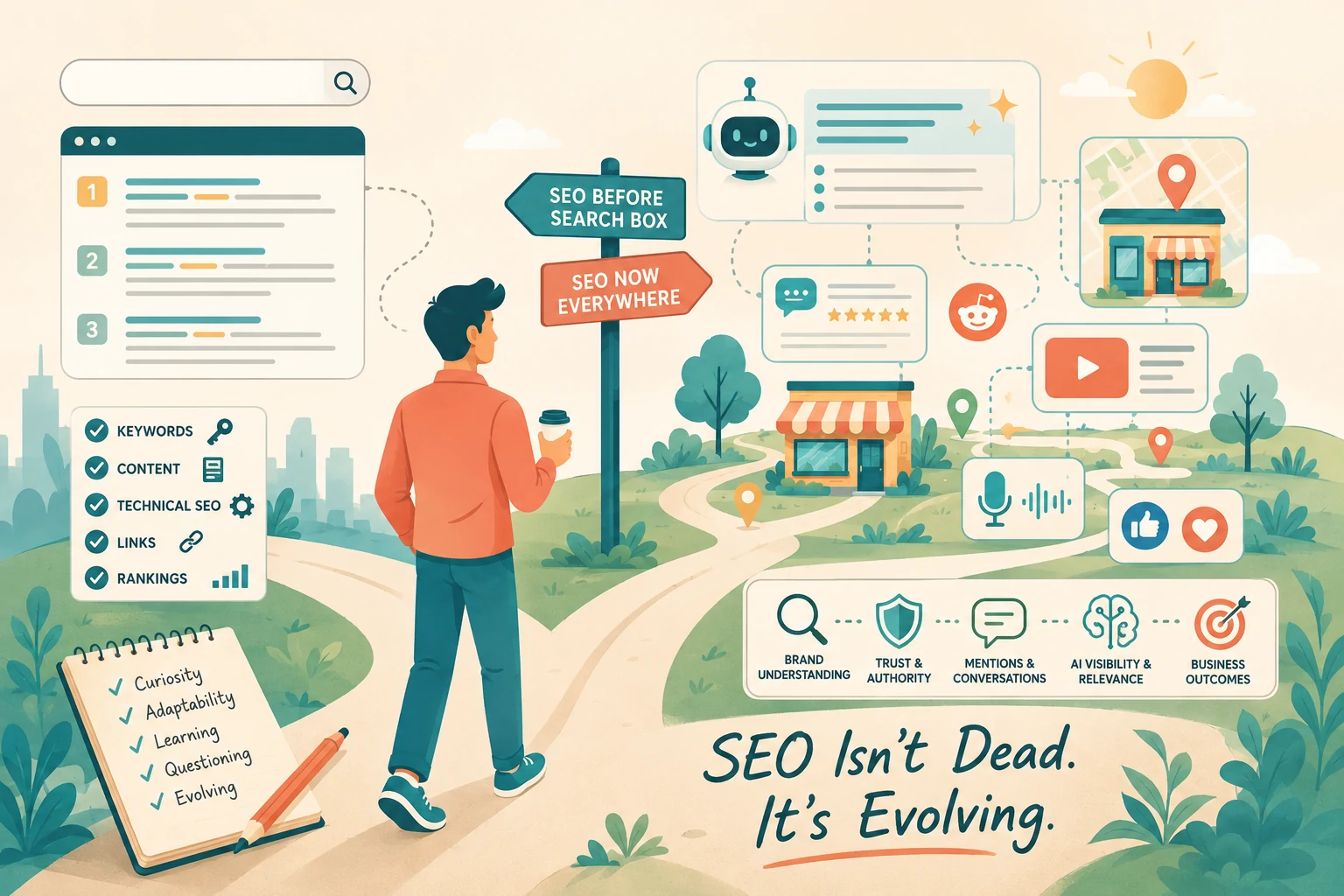
Search Has Escaped the Search Box
For years, the SEO journey was relatively easy to explain.
Someone searched Google.
Google returned a page of results.
You tried to rank as high as possible.
Someone clicked your website.
Hopefully, they converted.
Obviously, SEO was never quite that simple, but the search results page was the centre of everything we did.
That’s becoming harder to say.
People still search Google, but they’re also asking ChatGPT questions. They’re searching Reddit. They’re discovering businesses through TikTok, YouTube, Maps and other platforms.
And Google itself increasingly tries to answer questions before someone visits a website.
Search hasn’t disappeared.
It has spread out.
That’s a much more interesting problem for SEOs than whether rankings still matter.
Ranking Number One Isn’t the Entire Goal Anymore
Rankings still matter.
I don’t think we’re suddenly living in a world where traditional search positions are irrelevant.
If someone searches for something commercially valuable and your website ranks near the top, that’s still a very good place to be.
But rankings don’t tell the whole story anymore.
A person might search for something and receive an AI-generated answer.
Your company could be mentioned in that answer.
They could then search your brand.
Check Reddit.
Read reviews.
Look at your Google Business Profile.
Visit your website later.
Where does SEO begin and end in that journey?
I’m not sure it does anymore.
That’s why I’ve started thinking less about:
“How do I rank this page?”
and more about:
“How do I make this brand visible when people are looking for answers?”
The page still matters.
But so does everything around it.
Brands Are Becoming Part of SEO
This is one of the biggest changes in how I think about search.
For a long time, SEO conversations were heavily website-focused.
Keywords.
Content.
Links.
Technical issues.
Internal linking.
Metadata.
All of those things still matter.
But AI search has made me think much more seriously about the brand behind the website.
What does the internet know about this company?
Where is it mentioned?
What is it known for?
Are those signals consistent?
Do credible websites talk about it?
Do customers talk about it?
Can a search engine or AI system clearly understand what the company does, where it operates and why it might be relevant to a particular question?
That’s a broader problem than optimising a webpage.
It moves SEO closer to digital PR, brand building, reputation, content strategy and entity understanding.
And I think that’s where the job becomes more interesting.
Content Needs More of a Reason to Exist
AI has also made something painfully obvious.
The internet does not need another generic article explaining the same thing as the previous 500 articles.
We’ve all seen them.
“What Is SEO? A Complete Guide.”
“What Is Content Marketing?”
“10 Benefits of…”
You search for something, and five websites essentially give you the same answer in slightly different words.
Now AI can produce that type of information instantly.
So why should somebody visit your version?
That’s a question I think SEOs need to ask much more often.
Maybe you have original data.
Maybe you have experience.
Maybe you’ve actually done the thing you’re explaining.
Maybe you interviewed someone who knows more than you do.
Maybe you have a strong opinion.
Maybe your company has information nobody else can provide.
Maybe you can explain the topic better.
Content needs a reason to exist beyond “this keyword has search volume”.
That doesn’t make keyword research useless.
It makes the bar for what we do with those keywords higher.
Technical SEO Isn’t Going Anywhere
Ironically, the more search changes, the more important I think technical understanding becomes.
AI hasn’t made websites irrelevant.
Search engines still need to discover, crawl, render, understand and index information.
Websites still break.
JavaScript still causes problems.
Redirects still go wrong.
Canonicals still get implemented incorrectly.
Internal linking still matters.
Structured data still helps machines understand information.
Site migrations can still destroy organic visibility if handled badly.
And increasingly, SEOs are dealing with questions around AI crawlers, server logs, rendering, APIs and how different machines access website content.
That’s partly why I’m learning Python and cybersecurity.
Not because I think every SEO needs to become a developer or security professional.
I just want to understand more of the technology underneath the work I already do.
The further SEO expands, the more useful technical curiosity becomes.
Reporting SEO Is Getting Harder Too
This is probably one of the biggest practical challenges.
SEO reporting traditionally revolved around a familiar group of metrics:
Rankings.
Clicks.
Impressions.
Organic traffic.
Conversions.
Revenue.
We can still report those.
But what happens when somebody sees your brand inside an AI answer and never clicks?
What happens when an AI result answers the informational part of the journey, but the person searches your brand three days later?
What happens when visibility increases while organic clicks decline?
How much influence did search have?
These aren’t easy questions.
There are tools trying to measure AI visibility, citations and mentions, and I’m paying attention to them.
But I don’t think we’ve reached the point where everything fits neatly into a dashboard.
For now, SEO reporting needs more context.
The numbers still matter.
We just need to get better at explaining what the numbers don’t show.
The Job Is Becoming Less About Checklists
Early in my career, SEO often felt like a collection of things that needed to be done.
Fix the title.
Add the keyword.
Write the meta description.
Build links.
Add internal links.
Fix broken pages.
Improve the content.
Those tasks still exist.
But the further I’ve progressed in SEO, the less I think the real job is completing a checklist.
The job is deciding what matters.
A website could have 20,000 technical issues in a crawler.
Which five actually matter?
A keyword tool could give you 50,000 keywords.
Which ones are worth pursuing?
Traffic could fall 20%.
Is it an SEO problem, seasonality, a tracking issue, a SERP change, AI answers taking clicks, or something happening in one section of the website?
AI can increasingly help execute SEO tasks.
It can analyse data.
Generate metadata.
Cluster keywords.
Suggest internal links.
Write code.
Summarise audits.
That makes judgement more valuable, not less.
Knowing what should be done, why it matters and what should happen first becomes a bigger part of the job.
AI Probably Will Replace Some SEO Work
I don’t think it helps anyone to pretend otherwise.
There are SEO tasks that used to take hours that AI can now complete in minutes.
Some of the repetitive work will disappear.
Some will become automated.
Some will become so easy that clients and companies won’t need a specialist to do it.
That’s normal.
Technology has been doing that to jobs forever.
The question I’m more interested in is:
What becomes more valuable when the easy work becomes easier?
I think it’s strategy.
Judgement.
Technical problem-solving.
Communication.
Original thinking.
Understanding businesses.
Interpreting messy data.
Connecting information from different places.
Knowing when the obvious recommendation is actually the wrong one.
And curiosity.
Especially curiosity.
I Don’t Think We Need Another Name for Everything
We’ve now got SEO.
GEO.
AEO.
AI SEO.
LLMO.
And probably three more acronyms being invented while I’m writing this.
I understand why the terminology exists.
New search experiences create new questions and new disciplines.
But I don’t want to spend too much time arguing about labels.
If someone asks ChatGPT a question instead of Google, I still want to understand how brands become visible.
If Google generates an answer instead of ten blue links, I want to understand what influences that answer.
If people increasingly discover brands through Reddit, YouTube or social platforms, I want to understand that journey too.
Call it SEO.
Call it GEO.
Call it whatever comes next.
I’m interested in the underlying problem:
How do people find information, and how do we help the right information get discovered?
That feels much more durable than any acronym.
SEO Isn’t Dying. It’s Getting Bigger.
The SEO I started learning years ago isn’t exactly the SEO I practise today.
And the SEO I practise today probably won’t be exactly what I’m doing five years from now.
I’m okay with that.
That’s one of the reasons I’ve stayed interested in this field.
There is always another layer.
Search leads into content.
Content leads into user experience.
Technical SEO leads into web development.
Local SEO leads into reputation and customer experience.
AI search leads into brand, entities and information retrieval.
My interest in technical SEO has led me toward Python.
And that curiosity has taken me into cybersecurity too.
None of this feels like leaving SEO.
It feels like understanding more of what surrounds it.
So no, I don’t think SEO is dead.
But I do think being good at SEO is going to require a broader set of skills than it once did.
The search box is changing.
The tools are changing.
The way people discover information is changing.
The work will change with it.
And I’d rather change with the job than spend the next ten years arguing that it should stay the same.
